By Viesturs Deksnis.
The warning from the International Energy Agency has been unusually stark. In an interview with El País, IEA Executive Director Fatih Birol described the conflict involving Iran as “the biggest threat to energy security in history,” adding that the current disruption to oil supply exceeds even the oil shocks of the 1970s.
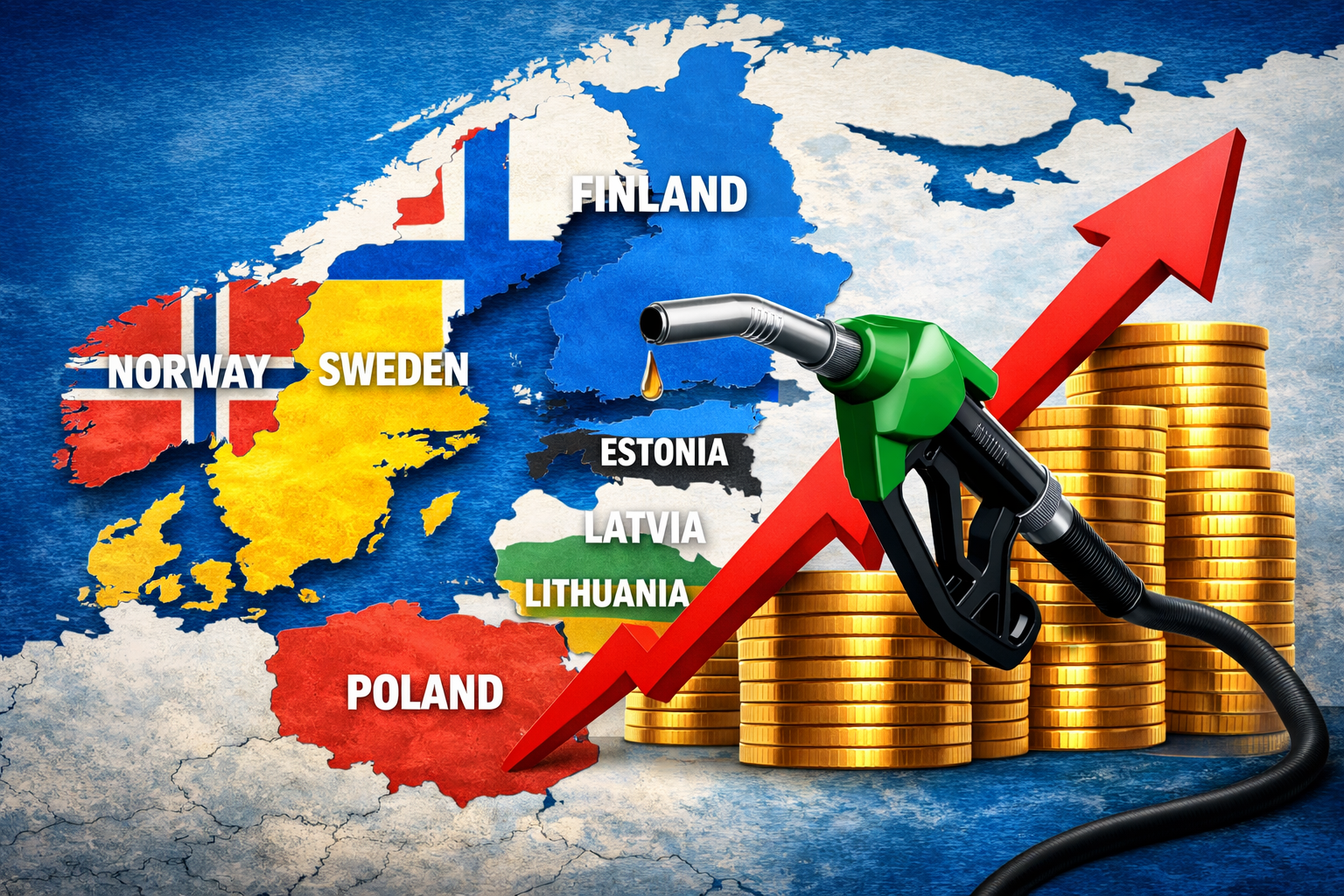
Across the Baltic and Nordic region, the picture emerging from governments, competition authorities, fuel companies and industry organisations is consistent in one key respect: there is no broad sign of immediate fuel shortages, but fuel prices are already reacting sharply to geopolitical tensions.
That distinction – stable physical supply, but rising market pressure – runs through nearly every response. In Latvia, for example, institutions and industry representatives say the impact so far has been felt primarily through price fluctuations on global exchanges rather than through physical supply disruptions.
The result is a regional picture that is more complex than a simple supply shock narrative. The Baltic and Nordic markets are not reporting a supply panic. They are instead describing exposure to a geopolitical crisis that is being transmitted first and most visibly through prices.
Supply remains stable, while prices react quickly
For fuel companies and sector organisations, the immediate effect of the conflict appears to be visible in prices faster than in physical deliveries.
Finland’s Neste says crude oil prices have recently increased due to the conflict, and that global market prices for gasoline and diesel have risen in tandem. The company also notes that the market price for renewable fuels generally follows the price trends of fossil fuels. Because the fuel market is inherently global, those international prices also affect local product pricing. Neste says its own prices are generally determined by several factors: world market prices for both raw materials and final products, logistics costs, exchange rates, taxation and local competition among distributors. At the same time, the company says its product deliveries to customers are currently not directly affected by the conflict and that it continues to monitor the geopolitical situation closely without speculating on possible future impacts.
Sweden’s OKQ8 gives a similar assessment. The company says it is seeing rising crude oil prices on the global market as a result of the conflict, which is also affecting wholesale fuel prices.
However, it adds that “at this stage, we do not see any disruptions to supply conditions.”
OKQ8 also says Sweden’s fuel supply chains are resilient, that its sourcing is based on long-term agreements with Nordic and European suppliers, that it currently sees “no risk of fuel shortages,” and that fuel companies are continuously monitoring market developments and maintaining preparedness to manage fluctuations in demand and supply.
Lithuania’s ORLEN also emphasises continuity. In a statement provided by AB ORLEN Lietuva, the company says there is “no identified risk to the continuity of supply to the domestic market or to our refineries.” It adds that the ORLEN Group has been diversifying its supply sources for years, with crude oil arriving from the Mediterranean basin, North and West Africa, Scandinavia and the Americas. It also points to contracts with Aramco and Equinor for part of its needs, with remaining volumes supplemented through spot purchases. According to the company, there are currently “no interruptions, downtime, or production drops” at ORLEN Lietuva or other ORLEN Group refineries, and there is “currently no scenario that would cause fuel problems.” It adds that the market security system, including strategic reserves, provides protection in the event of temporary retail disruptions, and that ORLEN remains a stable and predictable supplier due to a diversified raw material portfolio and operational flexibility.
Estonia’s Transport Fuels Union also points to continuity rather than disruption. It says Estonia’s fuel market is closely linked to the international oil market, because transport fuels are largely imported, and that global geopolitical developments – including the conflict involving Iran and wider tensions in the Middle East – “inevitably affect the broader fuel market environment.” At present, however, it says there are no signs of fuel supply disruptions or availability problems in Estonia.
Latvia’s Fuel Traders Association describes a similar situation. It says the Latvian market is integrated into the global and European fuel market and has so far been affected by Middle East tensions through price fluctuations on global exchanges rather than through physical supply problems. It adds that physical deliveries to Latvia have not been affected because fuel is imported mainly from European refineries, especially the Mažeikiai refinery in Lithuania and from Finland. At the same time, it notes “increased nervousness in the market,” reflected in volatility in exchange indices.
Baltic and Nordic markets are exposed to global pricing dynamics
Latvia’s Fuel Traders Association says the reaction in the Baltic and Nordic region is immediate because regional wholesalers and refiners trade on the basis of futures and spot indices for the Amsterdam-Rotterdam-Antwerp, or ARA, region, as recorded by S&P Global Platts. In its view, each escalation in the Middle East increases volatility in derivatives markets, feeding directly into regional price formation. The association describes the Baltics as a clear “price taker,” arguing that if geopolitical escalation continues to push up prices of fuel products on global exchanges, this will be reflected in higher prices at filling stations across the region.
Sweden’s Drivkraft Sverige uses different language, but reaches a similar conclusion. It says the world oil market is sensitive to expectations about the future and that the Baltic and Nordic countries are no different and must adapt as well. When asked whether the current geopolitical situation involving Iran had already affected fuel markets in Sweden, its answer was brief: “Through adjusted and increased prices.”
OKQ8 also underlines that the oil market is global and that global crude prices remain a major driver of retail developments in Sweden. Finland’s Ministry of Economic Affairs and Employment similarly says that fuel price developments in Finland are driven by global crude oil markets, “as is the case in most open and integrated economies,” and adds that global fuel market trends are a very important factor shaping both wholesale and retail fuel prices.
This means the region’s resilience on logistics does not translate into independence from global pricing. Operationally, the system may be robust. Commercially, it remains exposed.
The strongest price drivers are refined products, exchange rates, refining margins and taxes
Latvia’s Fuel Traders Association offers one of the most detailed breakdowns. It describes fuel price formation as a “multi-component system.” The first and most important factor, it says, is not crude oil itself but the exchange indices for refined products – gasoline and diesel – and this is currently the component having the greatest impact on price increases. The second factor is refining margins, or crack spreads, which can remain high even when crude oil itself is relatively cheaper. The third is the EUR/USD exchange rate, since global oil product trade is priced in dollars while fuel is purchased and sold locally in euros. A fourth factor is the fixed tax base – excise duty, the fee for compulsory reserves and VAT – which in Latvia accounts for more than half of the final price. Finally, it points to intense competition in the local retail market and to logistics and operating costs.
Latvia’s Competition Council provides a regulatory breakdown that leads in much the same direction. It says a 2022 fuel retail market monitoring exercise found that around 46 per cent of the final fuel price consists of taxes and duties, around 47 per cent is the procurement cost of the fuel itself, and only 6–7 per cent represents the retailer’s margin. It says this shows retailers have limited influence over final price levels because most of the components are externally determined.
Latvia’s Ministry of Economics makes a similar point using a broader grouping of cost components. According to the ministry, about 93 per cent of the retail fuel price consists of components that the retailer cannot influence or can influence only minimally – mainly procurement costs linked directly to international exchange prices, plus taxes and the security reserve fee. The retailer’s markup, it says, accounts for about 7 per cent of the final price. Because Latvia has no refinery and imports all fuel, mainly from Lithuania and Finland, domestic prices closely follow international exchange prices. Domestic elements such as excise duty, VAT and the reserve fee are fixed and do not fluctuate with exchange prices, so they do not explain the current increase.
Finland also highlights the weight of taxation. The Ministry of Economic Affairs and Employment says taxes account for around 50–60 per cent of the total fuel price at service stations. The Chemical Industry Federation of Finland says that current increases are being driven “mostly” by global crude prices and then by refining margins, while taxes form a substantial — but unchanged — part of the price.
The federation provides specific pump-price figures. According to Sampo Pehkonen, Chief Economist at the Chemical Industry Federation of Finland, as of 20 March gasoline prices in Finland had risen from the February average of €1.76 per litre to €2.00, while diesel had increased from €1.80 to €2.15, close to a 20 per cent increase. It adds that in a litre of 95E10 gasoline sold at €2.00, excise duty alone accounts for 70.3 cents and VAT for 40.6 cents, meaning total taxes amount to €1.109 per litre. The remainder is divided between the wholesale price and the distributor’s share.
Sweden’s Drivkraft Sverige likewise points to “global crude and product prices” as the main price drivers. It says taxes remain important even though they have been lowered in recent years, and also highlights the quota reduction obligation that requires suppliers to blend in biofuels to achieve a greenhouse-gas reduction of at least 10 per cent.
OKQ8 similarly says that global crude oil prices are an important driver, but taxes, biofuel blending requirements, refining margins and distribution costs also help determine the final pump price.
ORLEN makes the same general point in broader market language, noting that the geopolitical situation is only one of many factors influencing fuel product prices on global exchanges. It also mentions OPEC+ production decisions, global inventory levels, macroeconomic data, exchange rates, production costs, logistics, and equipment failure or damage.
Taken together, the responses show a consistent regional pattern: retail prices are being pushed mainly by global market forces and transmitted through refined product benchmarks, refining economics, exchange rates and national tax-heavy price structures.
Competition authorities are watching closely — but most do not equate current price spikes with collusion
A central question during any fuel price surge is whether the increase reflects market fundamentals or anti-competitive conduct. On that point, most authorities contacted are cautious.
Poland’s Office of Competition and Consumer Protection says it is “closely monitoring the current turmoil in the fuel market caused by the outbreak of the conflict with Iran” and the related uncertainty over crude oil supplies from the Persian Gulf, as well as the sharp increase in global crude oil and liquid fuel prices. However, it says it currently has “no basis to conclude that the price increases in the Polish fuel market are a consequence of illegal conduct, particularly anti-competitive agreements, or abuse of dominant positions.” The office also notes that the fuel market is especially sensitive to political turmoil and supply chain disruptions and reacts quickly to significant price changes in crude oil and finished fuels at both the retail and wholesale levels. It says investigations conducted in recent years into possible abuse of dominance in the fuel market have not provided grounds to establish such practices.
The Polish authority also adds market structure detail. According to POPiHN data cited in its response, Orlen had 1,941 stations in Poland at the end of 2024, equal to 24.4 per cent of all stations, while BP, Moya, Shell, Circle K and MOL operated between 386 and 577 stations. At the same time, it stresses that retail fuel markets are local by nature, with stations generally competing against nearby stations rather than across the country as a whole.
Latvia’s Competition Council makes a similar legal point. It says that fuel prices in Latvia are formed under free market conditions and that the authority does not have a mandate to set or directly regulate price levels. Fuel prices are heavily influenced by external factors beyond retailers’ control, particularly international oil product prices, logistics and transportation costs, and taxation. It also stresses that parallel price increases in markets exposed to common cost shocks do not in themselves constitute evidence of anti-competitive conduct. The council says it intervenes when there are indications of unlawful coordination or other distortions of competition, rather than because prices rise as such.
Lithuania’s Competition Council is monitoring the issue and provides one of the more data-rich responses. It says that in order to assess recent retail fuel price trends and determine whether they raise suspicions of possible price-fixing agreements, it analysed publicly available data on fuel prices in Lithuania, neighbouring countries and the European Union. According to that analysis, both gasoline and diesel prices increased during the month and during the week from March 2 to March 9 at a rate similar to that in Latvia, Estonia and Poland, and in line with the EU average. It notes, for example, that between March 2 and March 9 average pre-tax gasoline prices rose by 10.4–20 per cent across the countries under comparison, while in Lithuania the pre-tax gasoline price remained about one-tenth below the EU average of €0.825 per litre. Average diesel prices excluding taxes rose by €0.202–€0.295 per litre, or 26.5–33.1 per cent, across the countries compared.
The Lithuanian authority also says it looked at retail station margins excluding taxes and found they did not recently have a significant effect on final prices. It gives a concrete example: from March 2 to March 9 the retail margin on diesel fell from €0.111 per litre to €0.090 per litre, even though the retail price of diesel excluding taxes rose from €0.802 per litre to €1.018 per litre over the same period. The authority says fuel price changes in Lithuania generally follow trends in neighbouring countries, and that price dynamics alone are therefore insufficient grounds to suspect price coordination among fuel stations. At the same time, it says it has requested information from fuel station operators and from Orlen Lietuva on the principles and methodology used in retail fuel pricing and will evaluate the information once received. If it identifies circumstances suggesting possible competition law violations, it says it will act.
In Sweden, the Competition Authority differs in one respect from several other authorities. When asked whether it is currently monitoring fuel price developments specifically in relation to geopolitical tensions and global oil market volatility, it replied “No.” However, it says it has mechanisms in place to uncover and investigate indications of anti-competitive behaviour in general across all sectors. It continuously monitors for such indications and gathers information from the public and market participants. In the road fuel sector, it is monitoring fuel prices published online by the major road fuel companies, mainly to ensure companies comply with commitments made after an earlier investigation, but also because this may help reveal signs of anti-competitive behaviour.
The authority says it has recently conducted a broad and in-depth analysis of the road fuel sector and price formation at consumer level, and that it has investigated major fuel companies over possible coordination through company-wide recommended fuel prices.
Its conclusion was that while there is competition in the market, “price competition was overall limited.” It adds that the market has long been dominated by a few large companies, and that prices could be lower if competition were stronger. At the same time, it notes that since this analysis was conducted, the major companies have agreed not to publish recommended fuel prices for regular consumers. According to the authority, there are indications that the previous publication of recommended prices may have allowed companies to coordinate more easily, and it therefore considers it probable that competition is stronger today, although it says the analysis needed to confirm that has not yet been completed.
Norway’s Competition Authority is more explicit still. It says it is following competition in the fuel market closely through long-running monitoring and that this work will remain important in the current situation. It states that its monitoring is in place “due to too weak competition and coordinated price hikes, resulting in a cyclical pricing pattern.”
It also says there is a long-standing concern about weak competition and coordinated price increases in the market. In 2020, it says, an investigation was closed with a commitment decision requiring two companies to stop signalling future price hikes, which made such increases harder to coordinate.
From the authority’s perspective, competition could still be better and the market structure continues to facilitate coordinated pricing. However, it notes signs that coordination is becoming less stable and less effective, with fewer and less well-coordinated hikes, and points to the presence of challengers that do not follow the cyclical pattern and improve competition where they operate.
The regulatory message across the region is therefore not identical. But most authorities contacted do not regard the current price increase itself as evidence of illegality. Sweden and Norway, however, are notably more open than others in acknowledging structural competition concerns in their domestic markets.
Governments stress reserves, diversification and institutional coordination
When the focus shifts from pricing to energy security, governments across the region point to strategic reserves and diversified import systems as the main buffers.
According to Finland’s Ministry of Economic Affairs and Employment, the current situation does not pose a direct threat to energy security in the country, even though geopolitical tensions are affecting energy markets and fuel prices and higher oil and gas prices are being felt by consumers. It says Finland’s diversified import structure and strategic reserves provide protection against possible short-term disruptions. The ministry also notes that if tensions involving Iran were to continue for a long time, they would have significant price effects on fuel markets globally and would increase energy security risks.
Finland maintains strategic oil and fuel reserves, and its oil stocks exceed the obligations set by both the IEA and the EU. Total stocks exceed five months of consumption, against a regulatory minimum of three months. Finland says it has both government and industry stocks.
It also notes that on 11 March the IEA Governing Board adopted a recommendation intended to reassure oil markets, under which IEA member countries could make available a total of 400 million barrels of oil products from emergency reserves.
Finland says it would decide independently on any possible release and the exact amount, based on its own circumstances.
The ministry also stresses close coordination with the IEA, the EU and Nordic-Baltic partners on energy security and possible disruptions in global oil markets. In addition, it says Finland’s fuel supply system is now more resilient than during the 2022 energy crisis. It points to a broader shift towards clean energy, with fossil fuels now making up less than one-third of total energy consumption and electricity production based almost entirely on clean energy. It also notes that fuel imports have become much more diversified since the phase-out of Russian fossil fuels.
Latvia presents a similar argument, though with more focus on institutional reform. According to the Ministry of Economics, the physical availability of fuel is not currently at risk. Monitoring data from the state-owned asset manager Possessor show that stocks in traders’ excise warehouses are sufficient and supply routes to Latvia have not been disrupted. The ministry says the main challenge is not lack of supply but rising prices.
Latvia maintains petroleum product security reserves in accordance with EU Directive 2009/119/EC, covering approximately 92 days of average import equivalent, or around 380,000 tonnes.
Of that amount, 195,000 tonnes are state-owned, while the rest is maintained through ticket contracts and aviation-sector reserves. The reserves are managed by the state-owned company Public Assets Manager Possessor. Since 2024, Latvia has also been an IEA member state. Amendments to the Energy Law that entered into force in 2024 provide for a gradual shift to 100 per cent state ownership of security reserves by the end of 2028, which the ministry describes as a major improvement over the previous system. Since 1 June 2025, aviation-sector companies are also required to maintain aviation fuel reserves independently.
The Latvian ministry says the government is coordinating closely with EU and Baltic-Nordic partners. It says Latvia is working in close alignment with Estonia and Lithuania, as well as within the IEA and the EU. It also says that the Baltic states support and participate in coordinated international action, including the possible release of emergency oil stocks under the IEA framework.
ORLEN, although a company rather than a government body, presents reserves in similar terms. It says the market security system, including strategic reserves, provides protection in the event of temporary retail disruptions.
These statements are broadly aligned on one core point: reserves are an instrument against physical disruption. They are not a tool for keeping market prices low.
Some governments are discussing visible policy responses, while others are not
One of the clearest differences in the responses concerns policy readiness.
Finland’s Ministry of Economic Affairs and Employment says plainly that Finland has no intention of adjusting national taxes or pursuing structural changes in response to the current situation. Its language is essentially one of preparedness and monitoring rather than intervention.
Latvia’s Ministry of Economics, by contrast, says it has already prepared an informational report for the Cabinet of Ministers on fuel price stabilisation measures. According to the ministry, the set of instruments being considered includes a temporary reduction in excise duty on fuel – which it says is the only tax instrument allowed under the EU framework, since a reduced VAT rate on fuel is not permitted under Council Directive 2006/112/EC. Other measures under discussion include publication of a reference fuel price based on public exchange data to improve price transparency, and a solidarity payment mechanism intended to prevent unjustifiably high margins during extraordinary price periods.
The ministry also says the Competition Council is monitoring the fuel market for compliance with competition law, the Consumer Rights Protection Centre is supervising compliance with consumer rights rules, and the State Revenue Service is responsible for tax collection and oversight of fuel distribution.
Latvia’s Fuel Traders Association indicates a similar shift in emphasis. It says traders’ ability to cushion price spikes at the expense of their own markups has been largely exhausted because of intense competition, and that attention is therefore shifting toward government policy. It specifically mentions the possibility of an excise duty reduction as one of the most realistic instruments under discussion.
That creates an emerging divide in the region. Some governments are still primarily framing the current situation as a market event to be managed through resilience and coordination. Others are beginning to frame it as a political and social issue that may require visible consumer-facing measures.
Sweden and Finland provide some of the clearest short-term price signals
Several of the responses include concrete price movement data that illustrate how quickly the shock has already been transmitted to consumers.
The Chemical Industry Federation of Finland says that by 20 March gasoline had risen from a February average of €1.76 per litre to €2.00, while diesel had increased from €1.80 to €2.15. It says that if geopolitical tensions escalate further, and especially if disruptions to energy infrastructure widen, there is still room either for additional price increases or for a prolonged period of high prices. It offers a rough rule of thumb: an increase of $10 per barrel in crude oil prices raises the pump price by around 5 cents or slightly more, depending on refining margins.
Sweden’s Drivkraft Sverige provides similarly concrete national figures. It says the retail price of petrol has increased by approximately SEK 3.4 per litre, or 22 per cent, since 28 February. For diesel, it says the rise has been around SEK 6 per litre, or 35 per cent. The organisation also says fuel prices will likely increase further if world supplies of crude oil or oil products become more constrained.
The same organisation adds an important nuance on Sweden’s exposure.
While “every part of the world is sensitive especially in the long run,” it says Sweden may be less affected than many countries in the short run because the vast majority of Swedish imports of oil, petrol and diesel in 2025 came from the EU, the UK and the US.
Aviation fuel, however, was to a larger extent imported from countries outside the EU. It also says there are no signs, so far, of precautionary stockpiling, supply-chain adjustment or logistical challenges in the region, at least not to its knowledge.
These details reinforce the broader regional picture: supply chains may be functioning, but the price impact has already been substantial.
Market structures differ, but local competition still matters
Poland’s competition authority explicitly says stations usually compete with nearby stations rather than with national averages. Latvia’s Competition Council describes the domestic market as moderately concentrated but competitive, especially at the local level. It says several major retail chains operate nationwide alongside smaller regional operators, and that competition takes place mainly through retail prices, station location, loyalty programmes and additional services offered at the stations. It also notes that the situation is not particularly different from that in other EU member states and that over time the market has continued to develop, with established operators expanding their networks and new entrants entering the sector. At the same time, it says companies increasingly compete not only on price but also on service quality and the range of additional services.
Lithuania’s Competition Council gives a similarly plural market picture, listing major chains such as Orlen, Circle K, Viada, Emsi and Neste, alongside smaller players including Stateta, Baltic Petroleum and Alauša. It says it continues to advocate for as much competition as possible so that consumers benefit from rivalry between firms. The authority also notes that it has approved several mergers in the retail fuel market in recent years after finding that they would not create or strengthen a dominant position or significantly restrict competition. At the same time, it points out that in 2025 it fined the operator Emsi for unnotified transactions after the company acquired two stations and leased two more, and required it to notify the mergers formally. Those notifications are now under examination.
Norway and Sweden present more critical views of how retail competition functions. Latvia’s Fuel Traders Association adds that gross retail margins in the domestic market have historically fluctuated within a range of roughly 7 to 10 cents per litre, while net profit margins remain far lower. But across the region, even where prices are driven from outside, local market structure still influences how pressure is transmitted and how much room there is for competitive response.
The main risk described across the region is prolonged price pressure, not empty pumps
Taken together, the responses do not point to a classic supply panic.
They describe a region with functioning import channels, diversified sourcing, strategic reserves and, at present, no broad sign of immediate physical scarcity. Finland says there is no direct threat to energy security. Latvia says fuel availability is not currently at risk. Neste says deliveries are not directly affected. OKQ8 says it sees no supply disruptions and no risk of shortages. ORLEN says there is no identified risk to supply continuity and no scenario that would currently cause fuel problems. Estonia’s fuel industry association says there are no signs of supply disruption or fuel availability problems.
What the responses do show, however, is a region highly exposed to geopolitical escalation through prices.
According to Latvia’s Ministry of Economics, Brent crude has risen sharply since the start of the conflict, while ICE low sulphur gasoil – a key diesel benchmark – has increased even more steeply. The ministry also says diesel retail prices in Latvia have risen substantially since late February. Latvia’s Fuel Traders Association, for its part, argues that the first wave of the price shock has already occurred and that the pre-crisis inventory buffer in retail has been exhausted.
In Finland, the Chemical Industry Federation says prices have already risen by nearly 20 per cent. In Sweden, Drivkraft Sverige says petrol prices are up by 22 per cent and diesel by 35 per cent since late February. Lithuania’s Competition Council points to steep week-on-week increases in pre-tax fuel prices across the region. Even Estonia’s more cautious industry response makes clear that international political developments are feeding directly into the market environment.
The consequence is that the dividing line in the region is no longer mainly between countries with strategic reserves and countries without them. Increasingly, it is between those treating the current situation mainly as a market disturbance and those beginning to prepare politically visible instruments in response to sustained price pressure. As Latvia’s Fuel Traders Association argues, the Baltics function as clear “price takers”: if fuel product prices continue to rise on global exchanges, that pressure will inevitably be passed on to consumers across the region.
There is no broad institutional expectation of immediate fuel shortages in the Baltic-Nordic region. There is, however, a broad expectation that if tensions continue or escalate further, fuel prices will remain high or rise further – and governments may come under increasing pressure to show they are doing something about it.