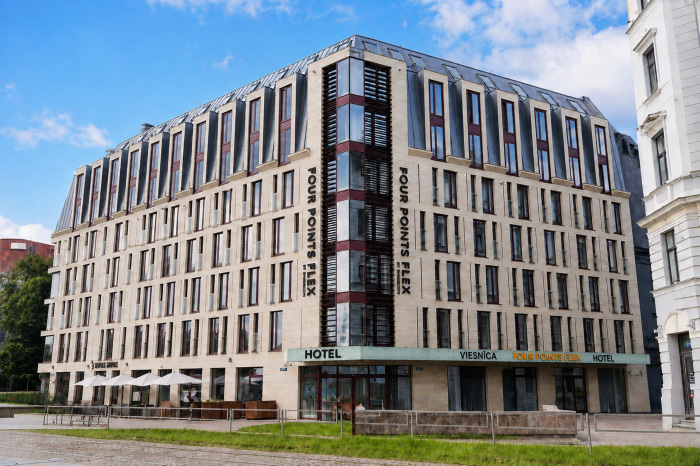
A significant gap has emerged in the new-build housing market between advertised prices and actual transaction prices. In the second quarter of this year, the average advertised price per square metre in the primary market for new-build homes reached EUR 3,220, while actual transaction prices were 16% lower. Compared with the same period last year, advertised prices have risen by 5%, whereas transaction prices have fallen by just under 1%. Developers justify high asking prices by citing construction costs and bureaucracy, but buyers are unwilling to accept their offers and are choosing more affordable alternatives—the secondary market for new-build homes, renovated pre-war buildings or standard Soviet-era apartments. Moreover, a developer’s promise of a dream lifestyle may turn out to be false: Latio has learned of a premium-class project in Pārdaugava where residents encountered falling plaster and a leaking roof during the very first year after the building was commissioned.
“The ‘new project’ label alone is no longer enough. Buyers expect not only a convenient location but also appropriate quality, clear warranty terms and a developer willing to accept responsibility for defects. In practice, we see that the promise of an ideal home often remains only on paper, while apartment owners encounter quality problems in their homes or buildings during the very first year,” says Latio market analyst Ksenija Ijevleva.
Supply Has Reached Its Highest Level
In August, a total of 3,830 apartments were available for purchase in Riga, while 2,930 were available for rent. The supply of homes in the primary new-build market reached 2,350 units, while 240 apartments were available for purchase in renovated pre-war buildings. Since 2022, the number of apartments available for purchase in the primary new-build market has increased by 50%, reaching its highest level in recent years.
During the first half of this year, the largest number of transactions took place in the Pīlādžu mājas project, where 76 homes were sold, followed by Deglava Gleznotāju rezidence with 58 transactions, Kaivas kvartāls with 47, Parka kvartāls with 36 homes sold and Ezerjugla with 24. The average transaction price in these projects ranged from EUR 2,380 to EUR 2,650 per square metre. In central Riga, the leading project was Šefela nams, with 33 transactions at an average price of EUR 3,280 per square metre, while most other new developments and renovated buildings recorded only around a dozen transactions. This indicates that buyers have not abandoned the idea of living in a new development, but are purchasing homes whose prices still appear affordable and do not exceed the threshold of EUR 2,700 per square metre.
Over the past year, the average transaction price in new developments in Riga’s residential neighbourhoods has risen by only 1%. Prices in new-build homes on the left bank of the Daugava reached EUR 2,680 per square metre, compared with EUR 2,610 per square metre on the right bank. Meanwhile, prices for secondary-market homes in new developments have increased by approximately 5%, while prices for apartments in standard Soviet-era buildings have risen by as much as 10%. Around 100 transactions take place each month in the primary new-build market, while the number recorded in standard Soviet-era buildings is nearly five times higher.
Price growth in the primary new-build segment in Riga’s residential neighbourhoods has now effectively stopped. The exceptions are the city centre, Skanste, Mežaparks and Ķīpsala, where the average transaction price has increased by 7% over the past year to EUR 3,670 per square metre, as well as exclusive premium-class properties, whose average transaction price has approached EUR 4,000 per square metre after rising by 6% over the year.
New Builds Compete with the Secondary Market, While Developers Are Slow to Offer Incentives
According to the latest data from the Latio Housing Market Report for 2026, 52% of transactions involving new and renovated developments take place on the secondary market, compared with 48% on the primary market. For example, an apartment in a new development built several years ago can cost almost 20% less on the secondary market in Riga’s residential neighbourhoods, while a renovated apartment in the city centre can be as much as 24% cheaper than an apartment in a newly built primary-market development. For buyers, this difference amounts to tens of thousands of euros.
“Competition is no longer taking place only between developers. Secondary-market sellers, owners of renovated pre-war buildings and even certain standard Soviet-era developments are also competing for buyers. They have one significant advantage—quality that has stood the test of time. In the eyes of buyers, a century-old but renovated building or a home in a new development where someone has already lived for several years may often be more valuable than a recently constructed building of questionable quality and with unclear warranty terms,” explains Ksenija Ijevleva.
While buyers’ purchasing power continues to lag behind price growth in new developments, developers have opportunities to motivate people through special offers and promotions. Latio’s real estate experts have observed that, despite the substantial supply of new developments, developers are in no hurry to adjust their prices to current market conditions. Nor is there meaningful competition among them to provide buyers with the most attractive offer. Many developers prefer to leave apartments empty and wait for residents’ purchasing power to improve rather than compete for buyers today.
“A few years ago, when the market had stalled because of high Euribor rates, we saw fairly intense competition. One developer included a parking space with the purchase of an apartment, another offered a fitted kitchen or storage room, while someone else tried to attract buyers with a EUR 5,000 discount. Such incentives are still available in some projects—for example, discounts on three- or four-room apartments for so-called ‘honour families’, or covered utility and property management fees. However, we increasingly see the main emphasis being placed on location, with developers attempting to sell the dream of an attractive family living environment with good infrastructure and neighbours whose habits will not cause daily problems,” says Ijevleva.
At the same time, this wait-and-see strategy is relatively risky for developers. The next phases of new residential quarters and buildings containing hundreds of new apartments are already entering the market, including Tērbatas dārzs, Mūkusalas pagalmi, Smilgas, Dzirciema pagalms, 360° Dzelzavas and others. Competition for financially capable buyers will only intensify. For the new-build segment to become a mass market, developers would have to compete for every buyer by highlighting not only the location but also a price corresponding to the quality offered and, equally importantly, the service provided after the owner receives the keys.
Housing Quality Falls Short of Expectations
Latio has learned about the experience of a resident in a newly constructed building in Pārdaugava that was commissioned in 2024 and publicly positions itself as a premium-class residential project. Its sales communications place particular emphasis on high-quality, durable finishing materials, energy efficiency, modern technical solutions and other benefits, which are also reflected in the transaction prices. Last year, the average apartment price in this project was approximately EUR 2,990 per square metre, while some transactions exceeded EUR 3,600 per square metre.
According to the resident, problems emerged during the first few months after moving in. Defects were also identified in neighbouring apartments and in the building’s common areas. Terraces attached to penthouse apartments are leaking, while in another apartment worth more than EUR 200,000, a container must regularly be placed in the bathroom to collect water dripping from the ceiling. Plaster has detached from a first-floor terrace, while according to the resident, a metal gate has fallen in the underground car park. Problems have also been identified in the building’s utility systems. For example, when a kitchen was being installed, it was discovered that the end of a three-phase electrical cable had been left inside the wall, meaning that a hole had to be broken into the wall before the household appliances could be connected.
After contacting the developer, the residents realised that the defects would not be repaired quickly. The building’s residents have therefore engaged an independent construction expert to assess the building’s technical condition and determine the causes of the damage.
Latio market analyst Ksenija Ijevleva points out that, in cases this serious, the issue is no longer merely one of appearance or whether the price corresponds to the quality. When damage affects common areas, the façade or the territory surrounding the building, the safety of residents becomes a concern.
“If a project is marketed as a modern, high-quality and family-friendly living environment, buyers should not have to worry after moving in about whether a fragment of the roof or a metal gate might fall on their child in the courtyard. At prices reaching EUR 3,000 or even EUR 4,000 per square metre, buyers are not purchasing only the floor space—they are also buying a promise of construction quality, safety and first-class service after the transaction. If plaster starts cracking or falling away, damp appears or incorrectly installed utility systems are discovered during the first years of use, and the developer is unwilling to provide a prompt solution, this represents a serious blow to the developer’s reputation and will also affect sales of future projects,” Ijevleva says.
When choosing an apartment in a new development, Mārīte Lipša, Head of Latio’s Legal Department, advises prospective buyers to do their homework. They should determine not only the year in which the building was commissioned but also its construction category and the remaining term of the construction warranty.
The Cabinet of Ministers’ Building Regulations currently provide for a construction warranty of at least three years for Category II buildings and at least five years for Category III buildings. For example, a typical apartment building with up to six above-ground floors will generally be classified as a Category II building, while an apartment building with more than six above-ground floors or more than one underground level will be classified as a Category III building. Buyers are advised to verify the building’s specific category in the documentation available in Latvia’s Construction Information System (BIS).
“In practice, buyers often confuse two important concepts: the seller’s liability and the builder’s warranty. This distinction is crucial when an apartment is purchased several years after the building was commissioned. Under the Consumer Rights Protection Law, when an apartment is purchased from a legal entity, namely the developer or seller, the buyer is entitled to submit claims concerning the home’s failure to comply with the terms of the contract for two years from the conclusion of the purchase agreement or the transfer of the property,” Lipša explains.
This creates an important legal distinction:
- The builder’s warranty applies to the overall quality of the building work and begins on the date the building is commissioned.
- The seller’s liability applies to the specific purchase transaction and begins on the date the buyer accepts the apartment from the seller.
This means that if an apartment is purchased in a new development that was commissioned two years earlier, the builder’s warranty for a Category II building may have almost expired. However, under the Consumer Rights Protection Law, the buyer’s right to demand that the seller provide a home that complies with the contract will remain in force for a full two years from the date of purchase.
Latio’s Recommendations for Buyers
- Check the exact date on which the building was commissioned and its construction category in BIS—Category II for buildings with up to six floors and Category III for buildings with more than six floors or more than one underground level—to determine how much time remains under the builder’s warranty for the building as a whole.
- Find out the procedure for reporting defects separately for the apartment and for the jointly owned parts of the property.
- Immediately notify the seller in writing of any defects in the apartment, such as falling plaster, referring to the property’s failure to comply with the contract.
- Remember that the seller is also liable for hidden defects that existed before the transaction.