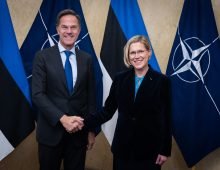
By Pēteris Celms, Head of Financial Strategy and Economics at RB Rail AS.
Europe’s fiscal environment has changed. For most of the period since the financial crisis, public investment in Europe was relatively constrained, as countries simultaneously had to comply with fiscal rules, navigate multiple crises and balance different budget priorities. Governments are now directing significant resources towards defence and infrastructure. Borrowing has become neither cheaper nor less risky, but countries are increasingly taking the cost of not investing seriously as well.
Germany illustrates this shift particularly clearly. In March 2025, it changed its fiscal framework to allow defence and certain security-related expenditure exceeding 1% of GDP to be financed outside the usual borrowing restrictions. At the same time, a EUR 500 billion special fund was established for investment in infrastructure and climate neutrality over a 12-year period. (Source: German Federal Ministry of Finance, Financing package for security and investment, April 2025; Special Fund for Infrastructure and Climate Neutrality, June 2026.)
Poland is making a similar choice under more challenging fiscal conditions. The European Commission forecasts that Poland’s general government debt will increase from 59.7% of GDP in 2025 to 64.5% in 2026 and 68.3% in 2027, while the budget deficit will remain at 6.5% of GDP in 2026. Investment in defence is one of the factors contributing to the increase in debt. (Source: European Commission, Economic Forecast for Poland, 21 May 2026.)
These decisions are being made at a time when general government debt in the euro area has already reached 88.9% of GDP, compared with 87.7% at the end of 2025. (Source: Eurostat, 21 July 2026.)
What simultaneous increases in expenditure mean
Simultaneous fiscal expansion in a monetary union deserves greater attention. If many governments increase borrowing and expenditure at the same time, the impact on prices is felt by all euro-area countries, regardless of how actively each individual country increases its own spending. Fiscal restraint by a small Member State alone cannot significantly influence overall inflation dynamics. Local conditions, of course, remain highly important, as 2022 vividly demonstrated in the Baltics, but the price level Latvian residents will face over the next decade will also be significantly influenced by decisions made in Berlin and Paris, not only in Riga.
High levels of public debt will also affect the development of Europe’s economy over the next decade. Large volumes of euro-area government bonds are held by banks, insurers and pension funds, meaning that they directly or indirectly also form part of people’s savings. In the longer term, countries with high debt burdens face a difficult choice between preserving the real value of debt, which may require prolonged restrictive fiscal policy and weaker income growth, and a situation in which inflation remains above interest rates for some time, gradually reducing the real value of debt.
The European Central Bank can contain inflation through higher interest rates, but in an environment of high debt this also has fiscal consequences. With euro-area government debt approaching 90% of GDP, increases in interest rates, as debt is gradually refinanced, significantly raise governments’ debt-servicing costs. It is precisely in this environment that Latvia must make decisions today about long-term investments.
What delaying looks like in practice
For Latvia, this is not a theoretical question. The country is implementing the largest infrastructure project in its recent history, which will connect the Baltic States to the European standard-gauge railway network.
In a project such as Rail Baltica, delaying rarely takes the form of a single decision to stop construction. It happens gradually: by financing the project in parts, waiting for the next European Union funding cycles, postponing decisions on other sources of financing and step by step pushing back implementation deadlines. Each such decision may be justified individually, but their cumulative consequences can be costly.
Cost increases have weakened confidence in Rail Baltica, and the state is justified in reviewing technical requirements, abandoning what is unnecessary and demanding credible cost estimates. Reducing the scope of the project to a technically and economically justified minimum is part of responsible management. However, cost discipline should not be confused with slower project implementation.
Rail Baltica is being built in a European market where defence and infrastructure programmes are increasingly competing for engineering and construction capacity, skilled labour, materials and equipment. Germany alone has approved a EUR 500 billion infrastructure programme over 12 years, while defence spending is simultaneously increasing across Europe. This does not mean that construction costs will rise every year, as markets are cyclical and commodity prices fluctuate. However, there is also no basis for assuming that postponing the project will in itself make it cheaper.
This is particularly important because substantial construction contracts have already been concluded in Latvia that include price indexation mechanisms. Political and administrative decisions can be postponed, but contractual timelines continue to run. Latvia can reduce the technical scope of the project and still end up with higher final costs if implementation is significantly prolonged. By reducing the scope of the project while simultaneously extending its implementation, inflation can consume the savings achieved.
Waiting has a price
Rail Baltica cannot be assessed solely in terms of construction costs, because postponing the project also means delaying the economic and security benefits that this infrastructure is intended to provide.
The economic benefits must be assessed realistically. A railway by itself will not create new factories, logistics centres or foreign investment, because such decisions are influenced by energy prices, productivity, taxes, regulation, access to capital and access to markets. Transport infrastructure also cannot be separated from energy policy: an electrified railway requires sufficient capacity in the electricity system, while new manufacturing plants and logistics centres will require additional capacity.
The role of the state is not to create the businesses that may develop along the Rail Baltica corridor in the future. Its role is to provide the infrastructure and preconditions for private investment. For small economies on the geographical periphery of the European Union, a reliable European standard-gauge railway connection to the major European markets is an important component of the investment environment, particularly at a time when the restructuring of supply chains is influencing decisions about the location of production capacity in Europe.
The security aspect is even more direct. The railway networks of the Baltic States predominantly use a 1520 mm track gauge, while the standard across most of continental Europe is 1435 mm. The difference in track gauge complicates the movement of heavy military equipment by rail from Central Europe to the Baltic States. Rail Baltica is therefore dual-use infrastructure: military requirements have been taken into account in the project’s technical design, and the project has already received dedicated EU funding for military mobility. (Source: Rail Baltica, Rail Baltica attracts military mobility funding, August 2022.)
Economic benefits begin to materialise once the infrastructure enters operation. Security benefits, meanwhile, exist only if the necessary infrastructure is available at the moment when it is needed.
Grants alone are not enough
The Connecting Europe Facility (CEF) should continue to be the main source of financing for Rail Baltica, as EU co-financing can cover up to 85% of eligible costs and significantly reduces the burden on national budgets. Funding allocated to the project to date exceeds EUR 4 billion, while another CEF grant agreement worth EUR 295.5 million was signed in October 2025, including approximately EUR 153.5 million for Latvia. (Source: Rail Baltica, Finances; RB Rail AS information on CEF funding, October 2025.)
However, CEF funding is limited, competition for it is strong, and its allocation is linked to EU budget cycles that do not always coincide with the most efficient construction schedule for a project of this scale. If grants are not available at the time when it would be economically justified to continue construction, the choice is between waiting and using other sources of financing.
The alternatives are EU loan instruments, government borrowing and private capital, and none of them can automatically be considered better or worse. Borrowing creates future liabilities that must be carefully assessed, but the terms of borrowing are equally important. Long-term financing at a fixed interest rate has a very different risk profile from short-term borrowing at a variable rate, and in circumstances where interest rates over a longer period may be lower than inflation, rejecting long-term fixed-rate financing for the creation of productive assets is not necessarily the more prudent choice.
Private capital should be assessed according to the same principle. It is generally more expensive than government borrowing, and a poorly structured public-private partnership (PPP) can create costly long-term liabilities for the state. In a well-structured availability-based PPP model, however, part of the construction and life-cycle risks is assumed by the private partner, while the state begins payments after the infrastructure has been commissioned and makes them over a longer period. Such a model is justified only if faster project implementation and genuine risk transfer to the private partner outweigh the higher financing costs.
Fiscal prudence remains important
Latvia has legitimate reasons to be cautious about increasing public debt, and the experience of the 2008 crisis continues to influence attitudes towards borrowing. However, circumstances today are different. Latvia entered the financial crisis with public debt of approximately 9% of GDP in 2007, while maintaining the lat’s peg to the euro and preparing for membership of the euro area. Latvia’s general government debt is currently approximately 47% of GDP, which remains one of the lowest levels in the euro area, where the average stands at 88.9%. (Source: Eurostat; European Commission historical government finance data; Eurostat, 21 July 2026.)
The lesson from the 2008 experience should therefore not be that borrowing must be avoided under all circumstances. What matters is that the costs, risks and long-term impact are clearly assessed before liabilities are assumed. The same principle should be applied to Rail Baltica: a realistic project scope, credible cost estimates and disciplined procurement are necessary. But delays must be assessed with the same care, because postponing the project is itself a financial choice and is not always the financially safer one.
The question is not whether Rail Baltica should be built as quickly as possible at any cost. The question is whether, once the necessary and financially justified scope of the project has been determined, Latvia uses a combination of grants, borrowing, private capital and implementation timelines that allows the infrastructure to be built at the lowest possible total cost and with an acceptable level of risk.
In the next decade, the public finance debate will increasingly need to focus not only on the amount of liabilities, but also on what productive assets are created with those liabilities. By the end of the decade, Latvia needs a functioning railway, not merely a bill for investments made elsewhere in Europe.