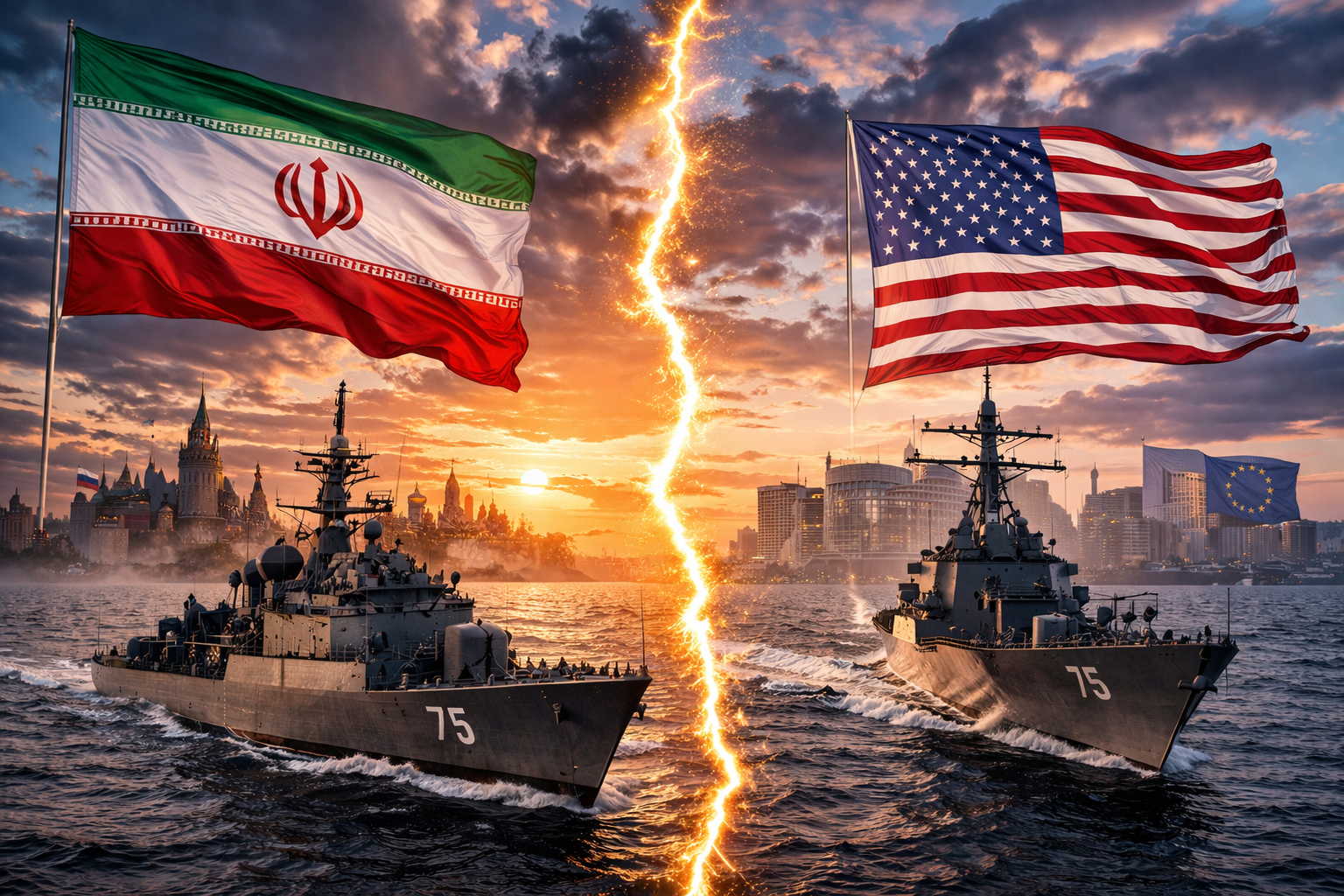
Poland is no longer treating the war involving Iran as a distant geopolitical conflict. The tone coming from Warsaw—across official X statements, government messaging, and Polish media—has become sharper, more strategic, and increasingly focused on what officials see as the real battlefield: energy, systemic leverage, and Europe’s structural exposure.
Energy as a weapon, not a side effect
Foreign Minister Radosław Sikorski has framed the issue in unusually direct terms. In remarks amplified by Poland’s Ministry of Foreign Affairs on X, he warned that Iran’s most powerful tool is not its missile arsenal, but its geographic control over global energy flows.
Tehran’s ability to disrupt the Strait of Hormuz, he suggested, functions as a “big bazooka”—a lever that could trigger immediate global consequences.
Polish media have echoed this interpretation. According to Onet, analysts close to government circles stress that any disruption in Hormuz would rapidly translate into price shocks across Europe, hitting already fragile energy markets. Similarly, TVN24 has highlighted that the conflict’s escalation risks “economic shockwaves” rather than just military escalation.
For Warsaw, this is a familiar scenario. After years of navigating Russian energy pressure, Poland is reading Iran not as a distant actor, but as another potential disruptor of global supply systems.
Iran, Russia and the logic of interconnected conflicts
Poland’s Ministry of Foreign Affairs has also pointed to a broader geopolitical pattern: the alignment between Iran and Russia. In official messaging, the two are increasingly treated as part of a shared strategic axis.
This view is widely reflected in Polish reporting. PAP has reported that Polish officials see the Iran conflict as potentially strengthening Russia’s economic position, particularly through rising energy prices. The logic is straightforward: instability in the Middle East drives up oil and gas prices, which in turn boosts Russian revenues.
Prime Minister Donald Tusk has made clear that Poland will not send troops to the conflict, as reported by Reuters. But Warsaw is far from neutral. Instead, it is analysing how the conflict feeds into Europe’s primary security challenge—the war in Ukraine.
This interconnected view of global crises is becoming central to Poland’s strategic thinking: conflicts are no longer isolated, but mutually reinforcing.
No troops, but full-spectrum awareness
Poland’s position is not one of disengagement, but of recalibration. President Andrzej Duda has indicated that Poland remains fully integrated into allied coordination frameworks, staying informed about developments through international partners.
At the same time, Polish authorities are increasingly aware that the conflict may extend beyond traditional military domains. Reports covered by TVN24 and Onet point to growing concerns over hybrid threats, including cyber activity potentially linked to Iran.
The implication is clear: even without direct military involvement, Poland—and Europe more broadly—may already be part of the conflict’s wider impact zone.
A warning Europe should take seriously
Taken together, the messaging from Polish officials reveals a coherent and increasingly explicit doctrine.
Poland is not preparing for a conventional war with Iran. It is preparing for disruption—of energy flows, of economic stability, and of critical systems.
The message from Warsaw is blunt: this conflict will not be decided only on the battlefield. It will be shaped by control over chokepoints, by price shocks, and by the ability to exploit systemic vulnerabilities.
And in that kind of war, Poland is warning, Europe is far more exposed than it might like to admit.