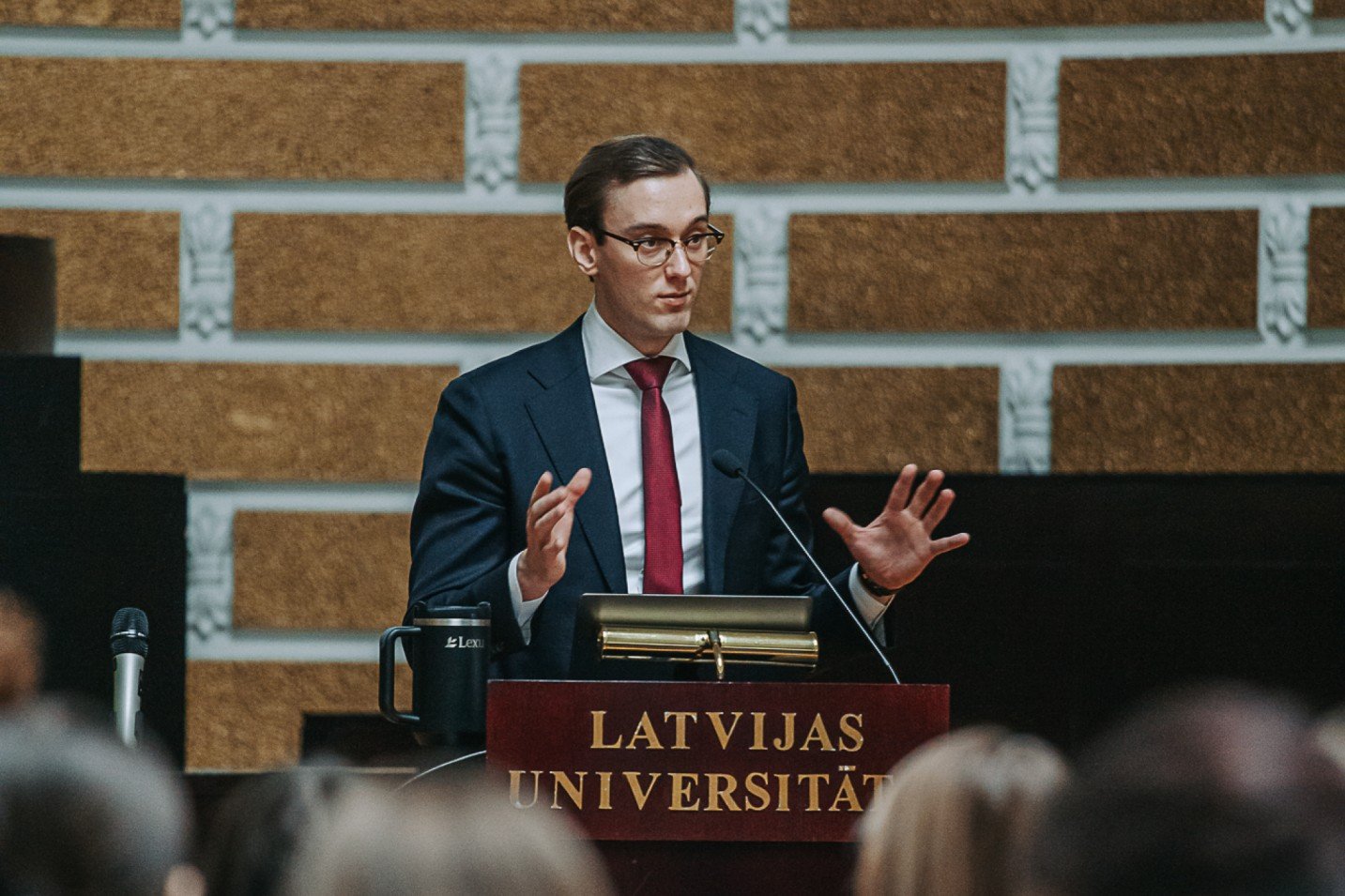
By Mārtiņš Odobērs, Founder and CEO of Lexu AI.
Two years ago, my team and I set out to solve a very specific problem in Latvia’s legal sector: how to ensure that artificial intelligence (AI) provides lawyers with truthful answers rather than confidently fabricated ones. Today, our platform has been integrated into the study programme of the Faculty of Law at the University of Latvia and is used daily by law firms as well as public sector institutions. This experience has convinced me more than ever that the real challenge is not the technology itself. More often than not, we simply lack an understanding of how to use it properly.
A few years ago, the hallmark of a professional was the ability to find the right information. Today, it is becoming increasingly important to determine whether that information is actually correct. This is no longer a distant future—it is our reality. A doctor who relies on AI without understanding its limitations puts patients’ health at risk. A journalist who republishes AI-generated content without fact-checking becomes a distributor of misinformation. And a lawyer who blindly trusts AI-generated legal arguments without verifying the cited sources risks their client’s future. Unfortunately, this happens more often than many would like to admit.
In other words, schools used to teach students how to find answers. Today, they must also teach them to say: “This answer sounds convincing, but I don’t believe it.”
In practice, we have observed one particularly dangerous characteristic of AI: it does not make foolish mistakes—it makes convincing ones. That is precisely why people believe it. And that is what makes it so dangerous. Nobody believes something that is obviously absurd. People believe what sounds intelligent, logical and persuasive—even when it is wrong. This is exactly why we built Lexu AI on a different principle: if the system cannot find verifiable evidence, it simply does not provide an answer.
The difference between being able to use AI and being able to critically evaluate its output is fundamental. Across the Baltic Sea region, governments are beginning to recognise this distinction as well. However, the approaches they are taking still differ considerably.
Estonia is taking a systematic and strategic approach
In 2025, at the initiative of President Alar Karis, Estonia launched the nationwide AI Leap (TI-Hüpe) programme, becoming one of the first countries in Europe to formally integrate AI literacy into its national school curriculum. [1]
The programme combines centralized access to leading AI education tools with professional development for teachers, implementation support for schools, and a cross-sector public–private governance model. [4] Its five core priorities are access, teacher training, pedagogical integration, safety and data protection, and research.
The first pilot year began in August 2025 and covers all 154 general education schools in Estonia. Approximately 20,000 students in Grades 10 and 11 and around 4,900 teachers are participating. Since August 2025, more than 60% of teachers have been using AI tools on a weekly basis. [1] Most importantly, the programme’s objectives explicitly include not only the use of AI tools but also the development of advanced AI and media literacy skills to strengthen critical thinking and democracy. [2] This distinction has not yet been explicitly reflected in any policy document in Latvia.
The programme is funded jointly by the Estonian government and private-sector partners. The total funding allocated to the pilot project amounts to €4 million. [3]
In Finland, critical thinking about AI predates ChatGPT itself
Finland did not begin thinking about critical thinking only after the emergence of ChatGPT. In fact, Finnish schools have been developing these skills for more than fifty years, beginning with the introduction of media literacy into school curricula in response to the growing influence of television and radio. The most recent curriculum reform, introduced in 2014 shortly after the annexation of Crimea, already included the critical evaluation of social media and smartphone use. [6]
In 2025, the Finnish National Agency for Education integrated AI literacy across all levels of education, from early childhood education to vocational education and training. [8] This followed an extensive period of preparation. Since the spring of 2024, the Agency and the Ministry of Education and Culture, working together with teachers, researchers, and industry representatives, have been developing AI guidelines for every level of education. [7]
The first part of these guidelines was discussed in autumn 2024, with particular emphasis on explaining what AI is, as well as its limitations, errors, and inaccuracies. This is precisely the question that has yet to be addressed systematically in Latvia.
Latvia is not at the starting line – but the risk is stopping halfway
It would be unfair to say that Latvia is doing nothing. On the contrary, several important steps have been taken in recent years. The real question is whether they will be enough. In April 2026, the Ministry of Education and Science launched the country’s first nationwide artificial intelligence initiative for schools, while more than €33 million has been allocated to the digitalisation of higher education through 2029. [9][11]
Latvian universities are also experimenting with new approaches. Rīga Stradiņš University was the first university in Latvia to develop guidelines for the use of AI in the study process, [10] while University of Latvia has introduced its own guidelines allowing academic staff to permit or restrict the use of AI tools depending on course objectives. At the same time, universities are exploring new ways of assessing student knowledge in the era of generative AI. [13]
Former Minister of Education and Science Dace Melbārde emphasised: “Our approach develops critical thinking, judgement, and argumentation skills.” [9] That is the right objective. However, the programme currently provides for the creation of an expert community and an “AI Leading Schools Network” involving just 15 general education schools and five vocational schools. This is only the first step.
In my view, this is where the main challenge lies. We spend a great deal of time discussing how to use AI. We spend far less time discussing how to verify whether AI is wrong.
This challenge was clearly illustrated in the Latvian Radio programme Krustpunktā, which hosted a discussion entitled “How are universities regulating the use of AI in higher education?” Participants included University of Latvia Rector Gundars Bērziņš, Rīga Stradiņš University social sciences lecturer Klāvs Sedlenieks, President of the Latvian Students’ Association Luīze Monta Remese, and Ieva Opmane. Rector Bērziņš succinctly captured the central challenge:
“How do we ensure that students understand, develop contextual understanding, and analyse texts independently? That is the most difficult part, because if you always trust something that has already summarised everything for you, you miss the traditional training needed to understand how to work with complex texts.”
In 2024, Rīga Stradiņš University published Latvia’s first guidelines on the use of AI in higher education, but these are advisory resources for lecturers rather than mandatory requirements for students. [10] This is an important and commendable step, yet voluntary guidelines are not the same as a systematic national approach.
It is also encouraging that the discussion on AI in higher education has clearly begun in Latvia. Both the RSU guidelines and the Krustpunktā debate demonstrate that university leaders, academics, and student representatives are actively engaging with the issue. In other words, the challenge is no longer being ignored.
However, discussion alone is not enough. At present, no Latvian bachelor’s programme—whether in law, medicine, journalism, engineering, or other disciplines—includes a mandatory course dedicated to the critical evaluation of AI-generated outputs. In January 2025, the Ministry of Education and Science announced a €33.4 million investment in the digitalisation of higher education through 2029. [11] The plan includes digital diplomas, flexible course selection, and digital infrastructure. Yet it does not make AI literacy—or the critical assessment of AI-generated content—a compulsory element of university education.
Latvia is also beginning to develop domestic AI solutions with a strong emphasis on reliability. For example, in the legal sector, our company’s AI-powered legal research platform has been designed around the principle that the system does not generate an answer unless it can support it with a verifiable source. This demonstrates that Latvia already possesses both the expertise and the technological capability to build responsible AI systems. The key challenge now is to ensure that this same principle becomes the norm throughout the education system.
Why the Difference Between “Using” and “Verifying” AI Is Critical
Before launching the AI Leap programme, Estonian researchers conducted a nationwide study. The findings were uncomfortable: even before the programme began, between 64% and 90% of students were already using commercial AI tools for schoolwork, often simply to complete assignments more quickly. [5] Research shows that uncontrolled use of these technologies can hinder the development of critical thinking, concentration, and self-directed learning. This accurately reflects the situation in Latvia as well—except that we have neither a national study documenting the problem nor a programme specifically designed to address it.
The distinction between knowing how to use AI and knowing how to verify AI is far from theoretical. We encountered this challenge firsthand in the legal sector. Before the creation of Lexu AI, a lawyer searching for a specific court judgment in a publicly accessible database containing hundreds of thousands of cases was effectively playing a keyword lottery—guessing the right search phrase or spending hours reading irrelevant documents.
The solution was not simply to “add AI.” The solution was to train the system to provide evidence-based answers, relying exclusively on verifiable sources and, when no supporting evidence exists, to say so explicitly. This remains one of our core design principles: if the AI refuses to answer because there is no reliable evidence, that response can be just as valuable as an answer itself—it may indicate that the legal issue has simply never been addressed in judicial practice.
General-purpose AI systems operate differently. They are designed to produce an answer even when no reliable basis for one exists. This difference—between a system that recognises the limits of its own knowledge and one that always generates something plausible—is precisely what schools and universities are still not teaching in any systematic way.
The greatest mistake would be to assume that AI literacy simply means teaching students how to write better prompts. In reality, the most important skill is being able to recognise when an answer is persuasive—but wrong.
During the Latvian Radio programme Krustpunktā, lecturer Klāvs Sedlenieks illustrated this challenge with a striking example: “We can assign students a book to read. Will they actually read it? There is a fairly good chance they won’t.” Instead of engaging with the original text, many students simply ask AI for the key points and then behave as if they have read the book.
An even deeper concern was highlighted by Gundars Bērziņš, who observed that “AI converges towards the most probable, average, expected answer.” The consequence is not merely increasingly uniform student essays. It is the homogenisation of thinking itself, where students internalise the same AI-generated perspectives rather than developing their own independent reasoning.
The discussion also highlighted encouraging developments. University of Latvia has introduced a controlled AI environment for all students and academic staff, ensuring data protection and preventing sensitive information from leaving the university’s systems. Beginning next year, final theses will include a mandatory oral examination of theoretical knowledge, acknowledging that written work alone is no longer sufficient evidence of learning. Meanwhile, Sedlenieks has abandoned written examinations altogether: “I conduct oral examinations in the form of discussions to assess students’ knowledge.” These are promising innovations, but they remain initiatives of individual lecturers and universities rather than elements of a coherent national strategy.
From my own experience, I have observed another encouraging development. Since our company’s platform was integrated into the study process at the University of Latvia’s Faculty of Law, lecturers have reported that students have become significantly more interested in case law because they are using AI for legal research rather than simply copying answers. This is a model that is already working in Latvia. The real question is why it has not yet become standard practice across the education system.
As Luīze Monta Remese aptly noted, “The risk is not artificial intelligence itself. The risk is that we have not yet found a way to assess students’ knowledge in the age of AI.” Until this challenge is addressed systematically, isolated initiatives will remain exceptions rather than the norm.
Latvia could take three practical steps today.
First, expand the national AI programme for schools by introducing measurable competency standards that go beyond “responsible AI use” to include the ability to identify, evaluate, and explain AI-generated errors, biases, and limitations.
Second, incorporate into the Ministry of Education and Science’s €33.4 million higher education digitalisation programme a requirement that the critical evaluation of AI-generated outputs become a compulsory component of university curricula.
Third, conduct a nationwide study on how students actually use AI, following the example set by Estonia before the launch of AI Leap. Public policy should be based on evidence rather than assumptions.
In 2026, digital literacy no longer means simply knowing how to use digital tools. It means being able to critically evaluate the information those tools produce. This is a skill that can be taught, measured, and strengthened through public policy—provided we are willing to recognise it as a national priority.
The encouraging news is that Latvia does not have to start from scratch. Many of the necessary building blocks already exist: university initiatives, the first national AI programmes, and locally developed AI solutions designed around reliability and verifiable evidence. What remains is to connect these elements into a coherent national framework.
Twenty years ago, a digitally literate person was someone who knew how to find information on the internet. Today, a digitally literate person is someone who can distinguish truth from confidently presented nonsense.
***
Sources and References:
[1] e-Estonia (2026). AI Leap Initiative
[2] European Commission, Education and Training Monitor 2025 – Estonia
[3] e-Estonia Briefing Centre (2025). AI Leap 2025: Estonia sets the standard for AI in education
[4] Regulations.AI (2026). AI Leap – full programme documentation
[5] Frontiers in Education (2025). Student engagement with AI tools in learning
[6] Euronews (2025). Finland’s war on fake news starts in schools
[7] Cedefop / ReferNet (2025). Developing AI guidelines for teaching and learning: Finland
[8] Faktabaari (2025). AI literacy frameworks for teachers – Finland
[9] IZM (2026). Latvia launches national AI program in schools
[10] RSU (2024). RSU develops first guidelines in Latvia for the use of AI in higher education
[11] IZM (2025). Latvia’s Universities and Colleges to Implement Study Solution Modernization
[12] OECD (2025). Progress in Implementing the EU Coordinated Plan on AI – Latvia Country Note
***
Reference: “How Are Universities Regulating the Use of AI in Higher Education? | Krustpunktā,” Latvian Radio. Participants: Gundars Bērziņš (Rector, University of Latvia), Klāvs Sedlenieks (Lecturer, Rīga Stradiņš University), Luīze Monta Remese (President, Latvian Students’ Association), and Ieva Opmane (Economist, Bank of Latvia).