
By Taavi Raudsaar, Economist at Eesti Pank.
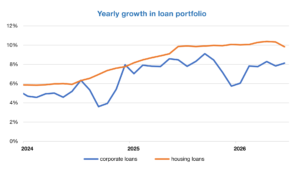
By the end of June, the portfolio of corporate and household loans issued by the banks operating in Estonia had increased by more than 8% over the year to stand at 30 billion euros. The growth in lending by banks in Estonia was also more than twice as fast as the average in the euro area. This illustrates the enduring capacity to lend of the banks in Estonia and their continuing interest in doing so, though it also indicates that people and companies are more prepared to invest than they were earlier.
The housing loan portfolio continues to grow at the most rapid pace, and its loan stock growth is nearly 10%. The volume of other household loans and leases has also started to increase, but growth is still slow at 2%. The corporate loan portfolio increased by 8% over the year. Growth is driven primarily by the real estate sector, as well as by agricultural and forestry companies. At the same time, the growth in loans to industrial companies has also accelerated and is close to 8%. Lending activity is clearly more subdued in retail and logistics, whose loan portfolio is around the same as it was a year ago.
In the first half of the year, the banks operating in Estonia earned a net profit of 356 million euros on the local market, which is about the same as a year ago. A larger loan portfolio and a higher Euribor rate have increased the banks’ interest income, while so far, they have managed to keep their interest costs at a level similar to last year’s. Nevertheless, their administrative (mainly personnel) costs have grown and even though loan quality is generally good, there were also more write-downs on loans than in the previous year. The full pass-through of the rise in Euribor in recent months into interest income, together with the growth in the loan portfolio, will continue to support the banks’ profitability over the coming quarters.
Source: eestipank.ee