As freshwater shortages become increasingly severe, the industrial use of seawater for cooling is gaining importance. In the future, it may also become necessary to use saline water from mining operations. In both cases, specialised valves and fittings designed to operate under extreme conditions are essential. Polish companies have been manufacturing such equipment for decades.
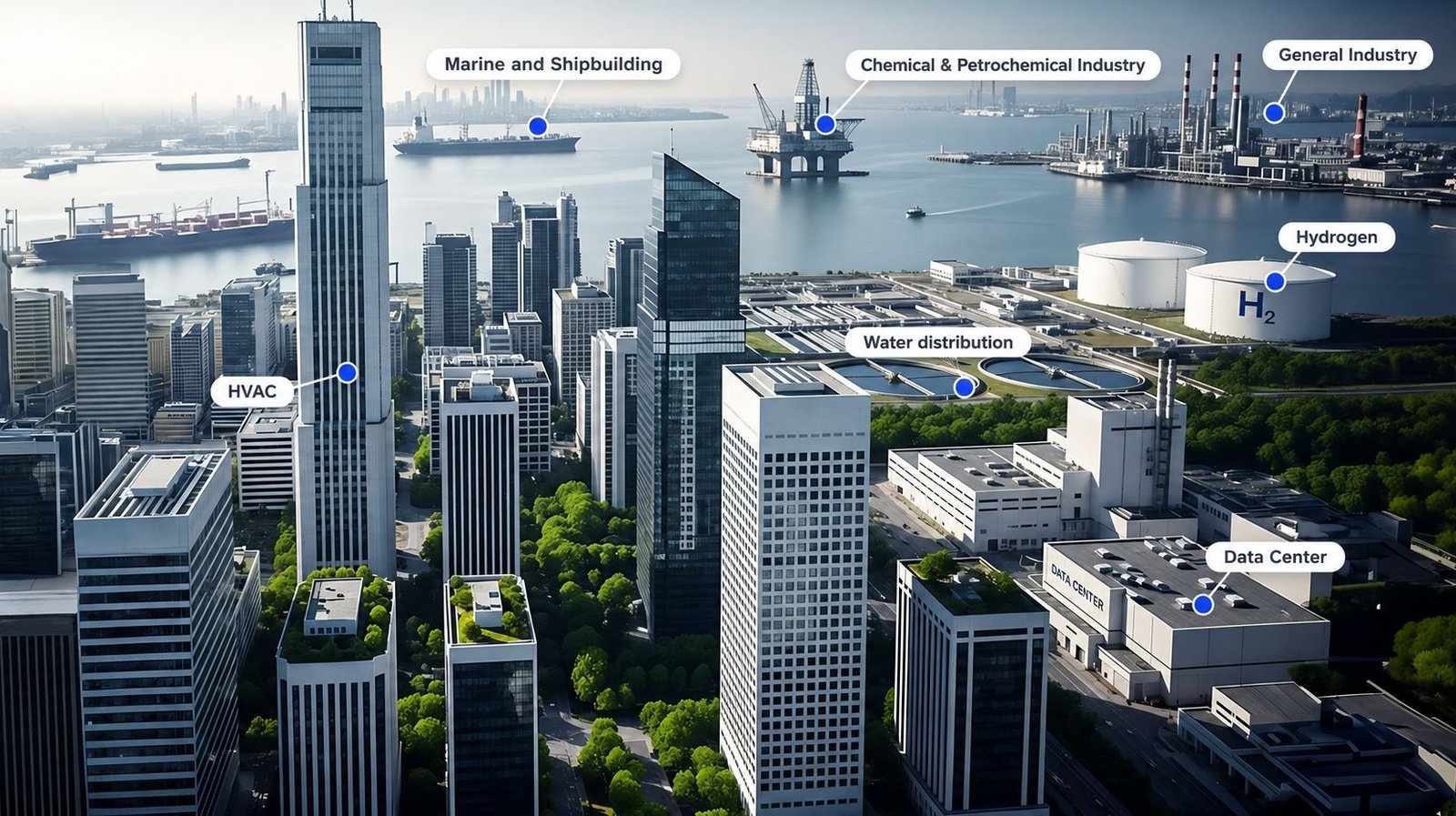
These products primarily include a wide range of valves and fittings incorporating bronze components, ensuring a long service life in contact with aggressive saline environments. Today, such solutions are used not only in the energy, petrochemical and shipbuilding industries, but also in data centres and server rooms.
“This is one of our key product groups, and one that we are continuously developing. We started with solutions for the shipbuilding industry, gradually expanding our product range and, consequently, broadening our customer base. As a result, for a quarter of a century we have been supplying specialised valves and fittings designed to operate in saline environments, primarily valves and butterfly valves. These now include not only products operating in an open/close mode, but also those capable of regulating the flow of process fluids,” emphasises Marek Felsztyński, President of the Management Board of Zetkama.
Different approaches to seawater cooling
Various seawater cooling solutions are available on the market.
In the case of server rooms, two cooling models are competing to become the preferred solution.
The first is an indirect cooling system.
“Seawater flows through a heat exchanger, cooling a separate, closed freshwater circuit connected to the server room. The seawater does not come into direct contact with the electronic equipment. In the second type of system, known as direct cooling, a sealed, nitrogen-filled capsule containing servers is submerged in the sea, with its casing acting as a heat exchanger. Cooling takes place through convection, without air conditioners or refrigeration units,” explains Robert Wojtynek.
Zetkama’s valves and fittings are primarily intended for use in the onshore and coastal sections of indirect cooling systems, including pumping stations, onshore heat exchangers and distribution manifolds.
In Scandinavia, an interesting example of seawater cooling technology is Google’s Hamina data centre in Finland, which has been operating since 2011.
“However, these are still isolated installations,” notes Robert Wojtynek.
“Realistically speaking, seawater cooling systems currently account for only a very small share of the global data centre market. For the vast majority of planned data centres, seawater cooling is not geographically feasible. This is not a matter of technological competition, but simply physical location. Nevertheless, we can reasonably assume that the share of such solutions will increase over time,” Wojtynek explains.
Dramatically low water levels in many European rivers may indeed encourage investors to consider the use of saline groundwater in the coming months and years.
“Before that happens, however, we are already seeing growing interest in moving away from conventional evaporative cooling towers towards closed-loop systems. This is an excellent way to achieve a significant reduction in annual water consumption,” says Felsztyński.
He adds:
“Another solution, also attractive from the perspective of a valve manufacturer, is changing the source of water. This applies to industry, the energy sector and data centres alike. Instead of rivers and deep wells, wastewater treatment plants could become the source of water.”
A challenge extending beyond Poland
According to data from Poland’s Supreme Audit Office (Najwyższa Izba Kontroli), between 2020 and 2023, mines in Silesia discharged as much as 469 million cubic metres of saline water into the Vistula River basin and 264.5 million cubic metres into the Oder River basin.
As the report’s authors emphasise, the average salinity of water discharged by mines is approximately 8 grams per litre. This means that rivers in Poland can sometimes be saltier than the Baltic Sea, whose average salinity is around 7 grams per litre.
Meanwhile, according to the European Union’s Joint Research Centre, salinisation affects approximately half of Europe’s continental river network. In 2% of cases, salinity levels significantly exceed international standards for the protection of aquatic life.
A direct consequence of increased salinity in the Oder River basin is the recurring proliferation of golden algae.
Scientists also warn that river salinisation may pose risks to agriculture and human consumption.
The use of saline water for irrigation, cooling and industrial production creates risks of corrosion, technical problems and secondary salinisation of soils and water resources [1].
Although using saline water in industrial cooling processes does not solve the underlying problem, it could significantly reduce the volume of saline discharges into rivers.
“This is also a very interesting technological and operational challenge. Zetkama has the necessary valves and fittings that could be used in implementing such projects,” says Robert Wojtynek.
There is little doubt that seawater or saline water from mining operations will be more expensive than the tap water currently available, partly because of the specialised valves and fittings required for desalination or direct use in industrial installations.
However, it is worth noting that in August this year, 625 of Poland’s 2,479 municipalities issued appeals and warnings calling for restrictions on water consumption.
Water shortages were reported in several regions, including the Kuyavian-Pomeranian, Masovian, Lublin and Łódź voivodeships [2].
Invaluable experience from the shipbuilding industry
For decades, the shipbuilding industry has operated in an environment where installations routinely come into contact with saltwater.
“Seawater is used, among other things, in cooling systems, ballast installations and fire protection systems. As a result, the industry has developed material and engineering solutions that can now serve as an important reference point for other sectors increasingly dealing with water of elevated salinity,” Robert Wojtynek explains.
In shipbuilding, particular attention is paid to the appropriate selection of materials for valves, butterfly valves, gate valves, bodies, seals, connections and actuating components.
Exposure to seawater and the marine atmosphere can affect both the external parts of valves and fittings and components that come into direct contact with the fluid.
Incorrect material selection can lead to corrosion of valve seats, discs, plugs or guiding elements, potentially compromising the proper functioning of the equipment.
Depending on operating conditions, materials with enhanced corrosion resistance are used, including copper and bronze alloys, as well as appropriately selected high-alloy steels, including superduplex stainless steel.
“The experience we have built over decades of cooperation with shipyards in designing, manufacturing and servicing solutions intended for saline environments now enables us to offer products for virtually any industry planning to use saltwater, regardless of its origin or the technological process in which it will be applied,” concludes Marek Felsztyński.
Zetkama, part of the Mangata Holding group, remains one of the leading manufacturers and suppliers of industrial valves and fittings in the Polish and international markets.
Sources:
[1] River salinisation in Europe – Poland among the hotspots, Wodne Sprawy