Rail Baltica, the multi-billion-euro European standard gauge railway linking Poland and the three Baltic states, is scheduled for completion by 2030, but meeting that deadline will be a major challenge, according to the project’s head in Lithuania.
“It’s a very, very big challenge. We can all calculate how many years are left for design work, construction, and all other elements, including electrification and traffic management. If I were to say I can fully guarantee this will happen, that would be frivolous,” Arenijus Jackus, chair of the supervisory board of RB Rail, the pan-Baltic venture coordinating the Rail Baltica project, told BNS in an interview. He emphasized, however, that there is a “very strong” ambition to ensure that people can travel from Warsaw to Tallinn by 2030.
In February, Jackus had warned the Lithuanian parliament’s Committee on Economic Affairs about risks that could delay construction of the railway in Lithuania until 2032–2033.
By as early as 2028, Lithuania and Poland are expected to be connected via a European standard gauge line built a decade ago between Kaunas and the Polish border, once a traffic management system allowing trains to reach speeds of 120 kilometers per hour is installed.
“When the infrastructure allows, it will be much more convenient, and Kaunas residents will be able to travel directly to Warsaw. We plan for that to happen in 2028, and that interconnection with Warsaw will definitely improve through the first line of Rail Baltica,” Jackus said.
Meanwhile, the second European gauge line on this section is planned for completion by 2030.
Jackus noted that there may be a “technical pause” between EU funding periods, so various funding sources are being considered for the project, including borrowing from international financial institutions.
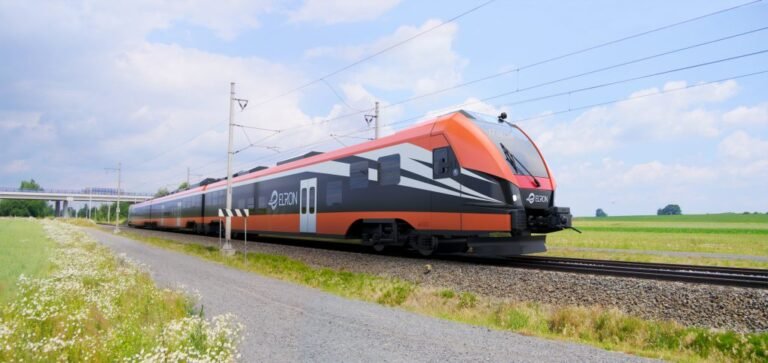
According to Jackus, Lithuania should have a strategy in place for acquiring rolling stock adapted to European railways by the end of this year.
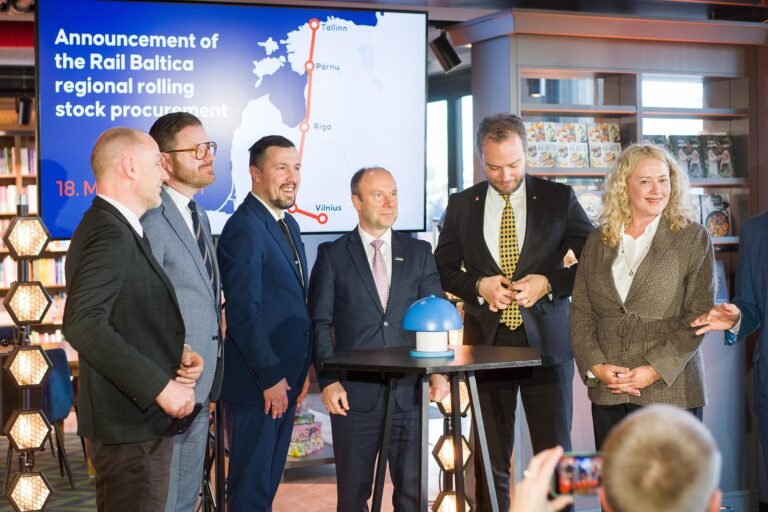
Rail Baltica will connect Tallinn, Pärnu, Riga, Panevėžys, Kaunas, Vilnius, and Warsaw, with a 392-kilometer stretch running through Lithuania.
Source: BNS
(Reproduction of BNS information in mass media and other websites without written consent of BNS is prohibited)