“Once you go abroad, you realise that the world is far broader than your everyday surroundings – and you get to know yourself much better too,” says Ūla Jankauskaitė, a Master’s student at the Faculty of Political Science and Diplomacy at Vytautas Magnus University (VMU), who has taken part in several international mobilities in Asia and Europe over the course of her six years of study.
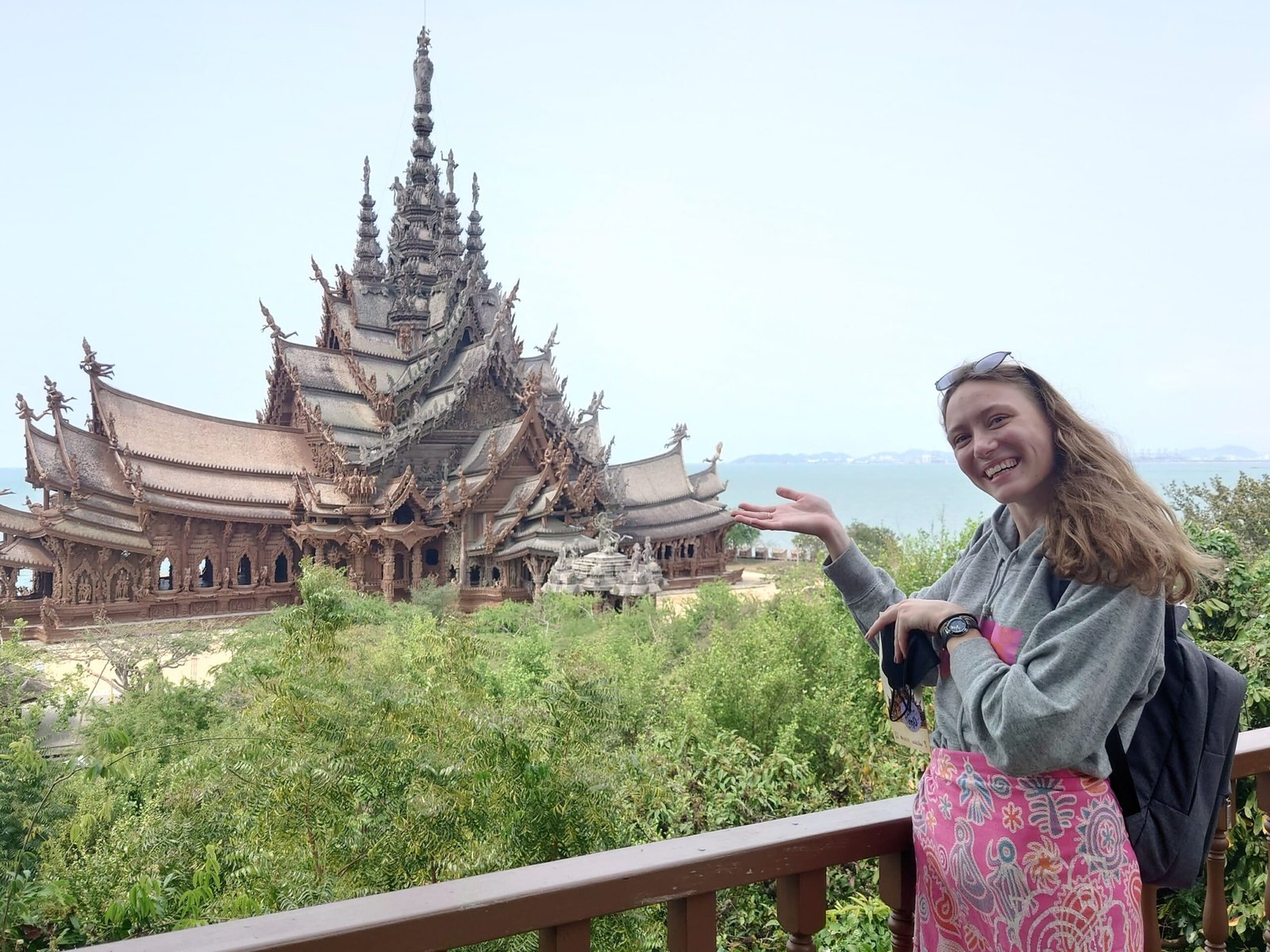
While studying in the International Politics and Development Studies programme, Ūla spent a semester at Chulalongkorn University in Thailand, later studied at Sciences Po Grenoble in France, and, during her Master’s studies, went to Tamkang University in Taiwan. She also managed to take part in shorter international programmes in Estonia and Brussels.
In our interview with Ūla, we discuss her international experiences abroad, her new job at the Ministry of Foreign Affairs, and her Master’s thesis, inspired by those international experiences.
Quarantine and a visa at the last minute
Ūla first went abroad to study while the world was still in the grip of the COVID-19 pandemic. Then a second-year student, she was worried whether she would be able to leave at all – the stress came not only from the various restrictions imposed due to the pandemic, but also from the protracted visa application process.
“Looking back now, I have no idea how I managed to leave. I had to overcome quite a few challenges, and I only received my visa in the final days. But in the end, everything worked out and I left for Thailand to study at Chulalongkorn University in Bangkok,” the student recalls.
As soon as she arrived, Ūla had to spend a week in quarantine in a hotel. “On the one hand, it was a good thing, because even though I was stuck in a hotel, I had time to adjust and acclimatise – after all, I had gone from a very cold Lithuanian winter to a tropical climate. It was quite a shock for both body and mind,” she remembers.
For the first two months, lectures were held remotely. Ūla does not hide the fact that she felt a little lonely at the time: “I was living alone in my dorm room, and while lectures weren’t taking place in person, my social circle was definitely limited. It felt like I was by myself all the time. But I still managed to make a few friends from other countries, and we travelled around both Bangkok and all of Thailand together.”
Still, as Ūla explains, online lectures also had their advantages in that they did not limit her opportunities to travel. “I’d put my laptop in my backpack, pack a few things for the weekend, and head off somewhere. I saw quite a lot of Thailand and got to talk to the locals,” she says.
During the final two months of her mobility, lectures moved back to classrooms. “There was more dynamism, and that feeling of being stuck alone in a bubble disappeared. And since I was studying international relations, we had quite a few visits to embassies – we went to the Swedish and U.S. embassies, and even had some classes there, not to mention all sorts of other visits and tours around Bangkok focusing on migration and urbanisation,” the student explains.
Tropical heat, fruit, and fried insects
“Thailand initially seemed like such a distant country to me. I kept wondering what life was like there and where all the civilisation was. But when I arrived, it felt as though everything was actually much better here – the weather, the friendly people, the fruit. There was a fruit market right next to my dorm, and I ate more fruit there than I ever had in Lithuania,” Ūla says, recalling her sweet first impressions, and adds that she liked the Thai people just as much, describing them as friendly and kind.
“I was one of four international students, while everyone else in our group was Thai. The girls would always invite me to join them for lunch or go for a coffee, and they asked me lots of questions, showed interest, and shared their own stories too,” Ūla recalls, adding that although she felt her personal space was respected, there was no lack of openness or warmth. “You could really feel that sense of care – that you had arrived there and now they were going to look after you, that they wouldn’t leave you alone throughout the whole process,” she says.
Ūla felt that care and kindness from the very first day of online lectures. One of the girls in her group wrote to her, asking where she was from, what she was studying, how she was settling in, and whether she needed any help. “She told me that if I needed even the slightest bit of help – whether it was understanding how something worked or translating something – I could always reach out. I was so happy and grateful to be welcomed like that, and to be cared for in that way, even though I was a complete newbie there,” the student recalls with a smile.
The food in Thailand also left a strong impression on Ūla. One of her favourites was papaya salad, and in the final month of her mobility, when her parents came to visit, she found the courage to try even more unusual foods – fried and otherwise prepared crickets, caterpillars, and other insects.
European culture and skiing in the Alps
While still in Thailand, Ūla and one of her coursemates completed the paperwork to apply for an Erasmus+ exchange at Sciences Po Grenoble in France. After being selected, they left for France exactly a year after their trip to Thailand.
Ūla describes this experience as completely different – after all, France is culturally closer to Lithuania than Asian countries. “There were a lot of international students at the university, so we lived in a real Erasmus+ bubble the whole time. After classes, we’d all often go somewhere to hang out, buy some drinks and cheese, and put together a little picnic,” the student recalls.
However, Ūla was not particularly impressed by the study system at Sciences Po Grenoble, and she also found the grading system unusual – marks were given on a scale from 0 to 20, with 10 being the lowest passing grade, while only 0.1% of all university students achieve the highest marks. “When you arrive for an exam, you have to show your student ID, sit in your assigned seat, and for every missed class you have to provide a justification for your absence,” Ūla remembers, adding that, coming from a much more flexible environment at VMU, she needed time to adjust to such strict oversight.
She also did not get to travel much around France, as it was rather expensive for students. However, Ūla and her coursemate still managed to visit neighbouring countries – they went to London and flew to Portugal and Italy. She also had the chance to learn to ski – in Grenoble, considered the skiing capital of France and located right by the Alps, the university even offered students discounted ski passes.
Lunch for just a few euros and other student perks
Ūla says that another major advantage was that the French government subsidises canteens at higher education institutions, which meant she could have lunch every day for just a few euros. “When we returned to VMU, we realised how much we missed that. Something that seems so basic – being able to eat for 3 euros. I hope we’ll have something similar in Lithuania one day,” she says.
Besides inexpensive lunches, Ūla notes that the French are generous with all sorts of other social guarantees and support for students. She is delighted that she had the opportunity to receive compensation for her dormitory rent, and that she could also choose from a fairly long list of extracurricular activities that were either free or offered to students at a discount. “I did yoga and also went to the swimming pool – with my student ID, I could get a membership really cheaply. I think Lithuania could definitely learn from the French here – from their system of student support and social guarantees,” she says.
After returning from a semester of study in France, Ūla also took part in several shorter international trips during her Bachelor’s studies: she spent a week in Estonia exploring the political development of the Baltic states as part of a Blended Intensive Programme (BIP), and during her Master’s studies she also participated in a simulation of the Council of the European Union held in Brussels, the capital of Belgium.
Taiwan: lots to do, too little time
Ūla went on her final international mobility – at Tamkang University in Taiwan – while already pursuing her master’s degree. According to her, this semester abroad was something of a blend of her previous experiences: a combination of France’s active social life and Thailand’s cultural exoticism. “If I had to name the experience I liked the most, I’d probably choose Taiwan,” the student says.
Tamkang University in Taipei left a very positive impression on Ūla – from the studies and accommodation to the people she met there. The only downside was that she did not have enough time to travel around the country, because that semester she was not only studying and writing a research paper, but also working remotely for a Lithuanian company.
“I was a bit short on time, but on the other hand, I was living rather lavishly – I didn’t have to limit myself. While others had to budget their stipend and think carefully about what they could afford, I felt very free,” Ūla says.
Asked how she managed to do it all, the student laughs and says she does not know the answer, but if she could turn back time, she would not change a thing.
“There was enough time for everything – hanging out with friends, travelling, getting to know Taiwan, trying the local cuisine, learning some Chinese, and building relationships with lecturers,” Ūla says, adding that she is still in touch with some of the lecturers she met there, as she is writing her Master’s thesis on Taiwan. She did not choose the topic by chance – knowing that she would be spending a semester in the country, she saw an opportunity to enrich her research with authentic personal experience.
A country of contrasts and sleeping in the library
What surprised Ūla most about Taiwan was its contrasts. “It’s a country of contrasts. There are no litter bins on the streets of Taipei, yet the city is unbelievably clean. The country positions itself as a high-tech leader, but they ‘fix’ a leaky library roof by covering the books with waterproof material and placing a couple of buckets to catch the rainwater,” Ūla says, giving a few examples that stuck with her.
The student also noticed certain cultural nuances – people being more reserved, stricter social norms, and certain double standards towards foreigners. “Everyone kept telling me how fun, friendly, and nice Taiwanese people are, but I didn’t really feel that – their society seemed rather cold to me. If we’re talking about individual people, then yes, I made friends, and my roommates were also very friendly and helpful. But taken as a whole, Taiwanese society still seemed rather cold to me,” Ūla says, and adds that, compared with the Taiwanese, Thai people seemed more open and welcoming.
Another thing that stood out to her from her semester at Tamkang University in Taiwan was local students’ habit of napping in the library. “They’d come in, study for a bit, then move the books aside, put a scarf under their head, and fall asleep for about 15 minutes. I used to think, do you really come to the library to sleep? I come here to work,” Ūla says with a laugh.
Experiences that prove useful everywhere
Ūla currently works at the Ministry of Foreign Affairs, where she serves as an attaché in the Diaspora Relations Division of the Global Lithuania Department. She was led there by the Ministry’s annual mentorship programme and by her mentor, who encouraged her to take part in the diplomatic competition.
Ūla has no doubt that international experience is valuable in diplomatic work. The semesters she spent in Thailand, France, and Taiwan taught her not only how to navigate different cultures, but also how to communicate with people whose worldviews and habits are entirely different from her own.
She recommends taking advantage of international exchange opportunities not only to those interested in international relations, but to everyone else as well. Ūla lists many reasons why it is worth going abroad, but particularly emphasises personal growth.
“Living abroad, especially for the first time without your parents, forces you to learn independence faster than any other experience. From opening a bank account to paying rent or buying groceries – everything falls on your shoulders. And although making mistakes at first is inevitable, it’s precisely from those mistakes that you learn the most. And once you realise that you can do everything on your own, the whole world opens up to you,” Ūla says.
According to the student, it’s also incredibly interesting to see different education systems, approaches to learning, and different perspectives on the same everyday things – that, too, broadens your horizons. She also considers the social benefits of international exchange just as important: “Even if you couldn’t find like-minded people at your own university, you’ll certainly find them once you go abroad. You’ll begin to realise just how many different kinds of people and perspectives there are.”
In Ūla’s view, staying in the same “bubble” for too long is not a good thing, especially when it becomes your comfort zone. “Once you go abroad, you realise that the world is far broader,” Ūla says.