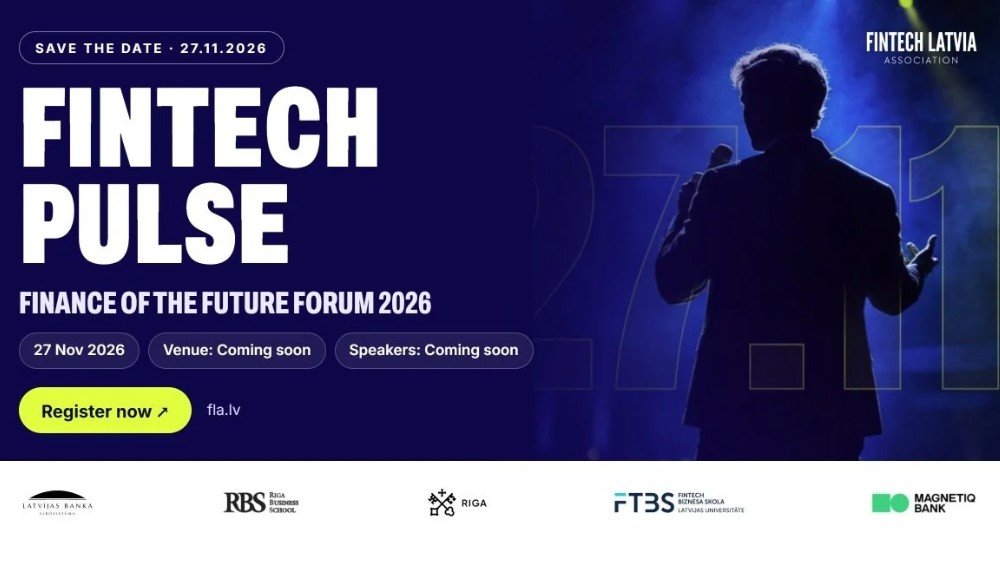
On November 27, at the “Fintech Pulse 2026” forum, Latvian and international experts will discuss attracting investment,financial technology development, and Latvia’s competitiveness in international markets.
The Investment and Development Agency of Latvia (LIAA), in implementing Latvia’s Financial Technology Sector Development Strategy for 2025–2027, continues targeted efforts to attract foreign investment, promote the export of Latvian fintech companies, and strengthen the country’s international recognition. At the “Fintech Pulse 2026: Finance of the Future Forum” taking place in Riga on November 27, the achievements of the strategy’s first year of implementation,progress to date, and future directions for the sector’s development will be evaluated. By the end of 2027, the strategy aims to increase the number of fintech companies by 30%, boost attracted investments by 15%, and increase employment in the sector by 18%.
LIAA Director Ieva Jāgere emphasizes: “Financial technology is one of the sectors in which Latvia has every opportunity to become a major player in the international market. We have competitive companies, qualified specialists, and a business environment capable of attracting international interest. LIAA’s task is to turn these advantages into concrete investments, new export markets, and well-paid jobs. In the first year of implementing the strategy, we laid the foundation for a more targeted international positioning of Latvia’s fintech sector, and this year we significantly expanded our work with foreign investors and potential market participants. Our ambition is clear—Latvia must become the place international financial technology companies choose to develop their operations in Europe. The latest industry data will allow us to assess what has been achieved and determine our next steps more precisely.”
At the forum organized by the FinTech Latvia Association, the fifth annual industry report, “Fintech Pulse,” will be presented, revealing the latest data on the number of companies, turnover, profit, tax payments, and employment. The conference will bring together Latvian and foreign financial technology executives, investors, regulators, and industry experts to discuss Latvia’s advantages in international competition, the licensing environment, access to capital, financial security, and technology development trends.
Tīna Lūse, Head of the FinTech Latvia Association, notes: “The fintech sector in Latvia has grown from a niche into one of the drivers of the economy, and the numbers prove it. Five years of data will allow us to honestly assess where we are strong and where we still need to work, particularly in the areas of licensing, access to capital, and financial security. This year, for the first time, we will also present the ‘Fintech Pulse’ awards, as we want to publicly highlight companies whose work strengthens Latvia’s reputation in the international market.”
Latvia Strengthens Its Position in the International Fintech Market
During the implementation of the strategy, LIAA, in cooperation with the FinTech Latvia Association and other partners,has expanded the international activities of Latvia’s fintech sector. In June of this year, Latvian companies were represented with a national stand at one of the world’s most significant financial technology events, “Money20/20 Europe,” in Amsterdam. In September, during a trade mission organized by LIAA in Berlin, Latvian fintech companies met with German institutional investors, banking, and financial technology representatives, presenting their solutions and discussing cooperation opportunities.
In October, LIAA, in cooperation with the FinTech Latvia Association, organized a special workshop for the agency’s foreign representatives, strengthening their ability to reach out to potential investors and explain Latvia’s advantages for developing financial technology operations. Next year, participation in “Money20/20 Europe 2027” in Amsterdam is planned, alongside further activities in Germany, Austria, and France.
Latvia’s attractiveness is also evidenced by growing licensing activity. Since the beginning of 2026, the Bank of Latvia (Latvijas Banka) has issued more than 20 licenses to fintech companies, including payment institutions, crowdfunding platforms, investment brokerage firms, and crypto-asset service providers. Several other companies are currently in the licensing process or utilizing pre-licensing consultations.
Latest Data Will Show Industry Growth Over a Five-Year Period
One of the central events of the forum will be the presentation of the latest “Fintech Pulse 2026” report, which will allow for a comparison of the Latvian fintech sector’s development over a five-year period and an evaluation of its competitiveness on a Baltic and European scale.
Data from the previous report demonstrated rapid growth. There were 127 fintech companies operating in Latvia, whose total profit in 2024 reached 97 million euros, more than doubling the 2023 result. Companies in the sector paid over 91 million euros in taxes into the state budget, while the number of employees grew to 3,644 people. The companies’ combined turnover reached nearly 372 million euros.
A significant advantage of Latvia’s fintech sector is its international operational scale. Investment platforms licensed in Latvia serve more than 800,000 investors abroad, and the total volume of investments made through these platforms exceeds 13 billion euros. This confirms the ability of Latvian companies to compete in the European financial market and create added value by serving clients outside Latvia.
Forum Focus: Investments, Licenses, and Financial Security
The forum’s program includes discussions on the future of the financial technology sector, attracting investments,company licensing in Latvia, and international growth opportunities.
One of the special guests will be Alexander Browder, who was placed on Russia’s sanctions list at the age of 17. The “Global Cryptocurrency Laundering Database” he created has helped uncover sanctions evasion and money laundering schemes. In an exclusive interview, Browder will speak about detecting financial crimes, sanctions risks, and the potential of technology to mitigate these risks.
Meanwhile, Ronald Kleverlaan, Director of the European Centre for Alternative Finance at Utrecht University, will analyze the development of crowdfunding in Europe and its potential to help small and medium-sized enterprises raise capital.
In separate discussions, representatives of the Bank of Latvia and international companies will discuss the experience of licensing fintech companies in Latvia, changes in the supervision of non-bank lending, and development prospects for specialized banks. Two speakers who have worked at Europe’s most renowned financial institutions will also share their experiences. Thomas Köck previously headed Austrian Erste Group’s building society (s Bausparkasse) and is now the co-founder of the company “pinyya”.