
After several challenging years shaped by economic and geopolitical uncertainty, 2025 marked a rebound in global initial public offering (IPO) activity. Both the number of transactions and the amount of capital raised increased, signaling improved investor sentiment. The market recovery was supported by declining inflation, stabilizing interest rates, and solid macroeconomic indicators. These factors created more favorable conditions for companies to return to capital markets and for investors to participate more actively in new public offerings.
Globally, the number of IPOs increased by 7% to 1,331 transactions, while capital raised grew by 44% to EUR 151 billion.[1] In Europe, overall IPO activity remained lower, largely due to competition between public and private markets – companies are staying private longer due to the continued availability of private capital. The number of IPOs declined by 20% to 105 transactions, and capital raised decreased by 10% to EUR 14.8 billion. However, companies that did go public tended to be of higher quality, with more stable cash flows, stronger governance, and clearer growth strategies. Sweden stood out as the most active European market, accounting for approximately 60% of total IPO capital raised in Europe, largely driven by Verisure’s EUR 3.7 billion IPO – the largest in Europe since 2022.
The strength of the Swedish market is built on a well-developed ecosystem that enables companies of different sizes to raise capital successfully. Small and medium-sized enterprises in Sweden rely on capital markets more extensively than in other EU countries. This is supported by a strong investment culture – households allocate a significant share of their savings to equities and investment funds. For example, government data shows that about 40% of Sweden’s population uses investment accounts, and nearly 90% of the capital invested in those accounts is allocated to equities.
By comparison, the investment culture in the Baltics is more developed in Lithuania and Estonia, where approximately 10% of financial assets are invested in equities (above the EU average of 9%). In Latvia, this figure is only 0.2%.[2] The market capitalization of Baltic equity markets relative to GDP remains significantly below the EU average (Latvia 1%, Lithuania 6%, Estonia 13%, EU average 69%, Sweden 169%). This indicates that the market remains underdeveloped but holds substantial growth potential. The market needs several large, high-quality companies to go public, thereby attracting more institutional and retail investors. Capital market development could also accelerate if private equity funds more frequently chose public listings as an exit strategy.
The Baltic IPO Market: Current Situation
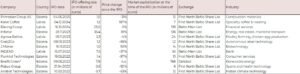
The Baltic equity market experienced rapid growth in 2021–2022, demonstrating that companies can successfully raise capital locally. In 2025, only one IPO took place (Primostar Group), raising EUR 1 million, compared with two IPOs in 2024 (Eleving Group and Kalve Coffee) with a combined value of EUR 30.2 million. A key advantage of the Baltic market is its well-established shared market infrastructure, which enables companies to attract investors from all three Baltic states.
IPOs in 2026: What the Early Signals Show
The global IPO market entered 2026 with optimism. Continued economic growth, potential interest rate cuts, and the possibility of several high-profile “mega IPOs” supported expectations of a breakthrough year. Several large private companies, including SpaceX, OpenAI, and Anthropic, have been mentioned as potential IPO candidates this year, with combined valuations that could exceed EUR 2.6 trillion.
Positive developments are also emerging in the Baltics. For example, Liven, one of Estonia’s leading residential real estate developers, has launched an initial public offering, and its shares are available to investors in Latvia. In Latvia, preparations are also underway for the IPO of LAU Infra Group (Latvijas autoceļu uzturētājs), which could become the first IPO of a state-owned company in the country.
At the same time, the IPO market remains sensitive to global developments. IPO windows are relatively narrow, and decisions to proceed with an offering can change quickly depending on market sentiment. Tensions in the Middle East are contributing to volatility in energy prices and supply, which in turn fuels economic uncertainty. In the first quarter of 2026, the number of IPOs declined by 23% year over year, while capital raised increased by 37%, suggesting that, in uncertain conditions, capital tends to flow toward larger and more resilient companies. The current geopolitical and economic environment continues to create challenges for IPO execution, and further developments will significantly influence market dynamics.
Investors Expect a Compelling Growth Story, Scale, and Higher Returns
Industry experts consistently emphasize the importance of scale and stronger capital returns when discussing investor expectations. Voldemārs Strupka, Chairman of the Board at Signet Asset Management and investment expert at Signet Bank, notes that investors expect Baltic equity issuers to present a clear growth story, reliable corporate governance, and sufficient scale to ensure that the stock is truly liquid after listing rather than merely formally traded. Equally important, in his view, is the company’s ability to convincingly explain how the raised capital will be used and to ensure that its valuation is reasonable relative to risks and future potential.
Jūlija Bistrova, Partner at Alphinox, adds: “Like any equity investors, investors in Baltic companies expect higher returns compared with bonds or deposits. However, the history of IPOs in the Baltics – aside from a few success stories, such as Kalve and Madara – has generally been challenging. The share prices of several companies, including Indexo, DelfinGroup, and Virši, are currently below their IPO levels. If this was an investor’s first experience with Baltic equities, such an outcome may discourage further investment in the region.”
Bistrova explains that to avoid such outcomes, it is essential for investors to conduct thorough due diligence before investing and assess the credibility of the company’s growth story. At the same time, company owners must avoid setting unjustifiably high valuations, which often lead to share price declines after an IPO or even to the cancellation of the offering. Investors typically expect several key elements from a company planning to go public: an appropriate valuation aligned with growth prospects, a clear and credible development strategy, a transparent plan for the use of proceeds, a well-defined dividend policy, strong and transparent governance, solid financial performance, and effective communication with investors both before and after listing.
Currently, investors in the Baltic market remain more cautious toward IPOs than toward bonds, as the bond segment has been significantly more active. V. Strupka comments: “The bond issuance market is currently in a ‘golden age,’ while new equity offerings remain relatively limited. In the near term, I see greater potential in companies with predictable cash flows and clear business models, particularly in municipal and state-owned enterprises, as well as in infrastructure and real estate segments. Liven’s ongoing IPO and LAU Infra Group’s announcement of a planned IPO this year are positive signals, but overall macroeconomic and geopolitical risks still make me cautious about expecting a broad IPO wave.”
The First IPO of the Year: A Signal of Renewed Regional Activity
Last week saw the announcement of the first IPO in the Baltic equity market this year – and the first larger-scale IPO in the region since Eleving Group’s IPO in 2024. Liven’s IPO signals a possible revival of market activity.
Through the public offering, the company plans to raise approximately EUR 8.7 million, with the option to increase the amount to EUR 12.7 million in the event of strong investor demand. The company’s expected market capitalization after the IPO will exceed EUR 60 million. The proceeds will be used to finance new development projects and land acquisitions. This transaction not only represents a new phase in the company’s growth but may also serve as an indicator of investor appetite for new equity offerings in the Baltic states.
This raises an important question: will Latvian companies be ready to follow? LAU Infra Group has already announced plans to conduct an IPO in 2026, which could become Latvia’s first IPO of a state-owned enterprise.
Kristiāna Janvare, Head of Investment Banking at Signet Bank, emphasizes: “It is critical that such transactions are successfully executed, as they can serve as an important turning point in the development of the local capital market, demonstrating the stock exchange’s ability to function as a financing platform not only for smaller businesses but also for large and strategically important companies.” Another frequently mentioned potential candidate is Rīgas namu pārvaldnieks, which, like other public-sector companies, could benefit from the advantages offered by capital markets.
“These potential IPOs of state and municipal companies are also important in a broader context, as they support the government’s capital market development objective – to reach equity market capitalization of 9% of GDP by 2027,” K. Janvare concludes.
The emergence of positive precedents can serve as a powerful catalyst for broader market development. Successful IPO transactions not only strengthen investor confidence but also encourage other companies to consider public markets as a viable financing alternative. The development of the Baltic capital market is unlikely to happen through a single rapid leap. While major state-owned company IPOs are still anticipated to provide a significant boost, recent experience in the bond market shows that growth can also occur gradually. Every journey has to start somewhere – and the entry of small and medium-sized enterprises into the public market would represent an important step forward.
A well-developed capital market means broader financing opportunities for companies, reduced dependence on bank lending, and greater opportunities for local investors to invest in the regional economy. Even relatively modest IPO activity can therefore lay the foundation for long-term market growth and support the development of both investment culture and corporate governance standards across the Baltics.
[1] Data from Ernest & Young.
[2] Data from the European Central Bank.