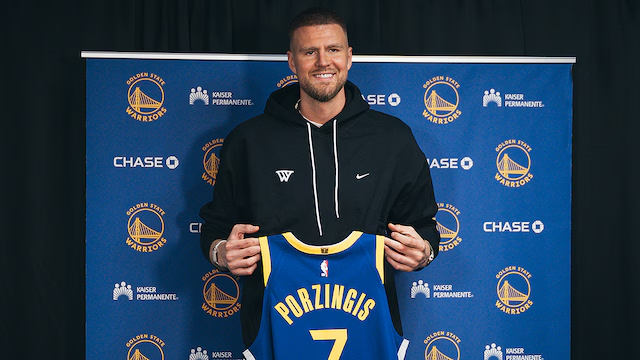
Kristaps Porziņģis has already been on the move once in the past year, having been traded from the Boston Celtics to the Atlanta Hawks in a multi-team deal during the 2025 offseason. Now, as the NBA trade deadline approaches, league insiders are once again asking a familiar question: will Porziņģis be traded again, or will Atlanta hold onto him through the season?
According to ESPN’s trade deadline coverage, this is not a marginal storyline but one of the Hawks’ central strategic dilemmas. The framing from league insiders is clear: Atlanta must decide whether to actively shop Porziņģis’ $30.7 million expiring contract or allow it to run its course, preserving cap flexibility for the summer.
From a front-office perspective, Porziņģis represents both opportunity and uncertainty. On the one hand, expiring contracts of this size are among the most useful trade assets in the NBA. They can serve as salary-matching tools in larger deals, allow teams to absorb longer contracts from other franchises, or simply function as clean financial reset buttons. On the other hand, Porziņģis’ availability has once again become a complicating factor.
Through 13 games this season, Porziņģis has averaged 19.2 points, 5.6 rebounds, and 3.1 assists per game while shooting nearly 50 percent from the field. Those numbers, cited by both ESPN and Reuters, underline that when he is on the floor, he remains a productive and efficient offensive big. However, his season has been interrupted by illness and knee soreness, and he is currently listed as out, with Atlanta announcing he would miss at least two weeks while undergoing further evaluation.
This timing matters enormously in the trade market. Front offices do not just evaluate talent; they evaluate reliability. As multiple ESPN insiders have noted, expiring contracts are most valuable when the attached player can either help immediately or pass a clean medical review. Any lingering uncertainty around Porziņģis’ health inevitably narrows the pool of interested teams and depresses leverage in negotiations.
That said, there are clear reasons why Atlanta might still explore a trade aggressively. The Hawks remain a team caught between buying and retooling. They can plausibly argue that adding another high-impact player alongside Trae Young could justify using Porziņģis’ contract as the financial centerpiece of a larger deal. Around the league, expiring contracts like his are often described as “trade math gold,” and several market-watch columns — including reporting aggregated from Marc Stein and echoed in ESPN’s broader deadline ecosystem — consistently point to Porziņģis as Atlanta’s most obvious movable piece.
At the same time, there is an equally credible argument for restraint. When healthy, Porziņģis fits cleanly into modern offensive systems as a spacing big who can score inside, stretch the floor, and protect the rim. That skill set was precisely why Atlanta targeted him in the first place. If the Hawks believe his current absence is short-term and that he can return to form before the postseason, forcing a trade at a discounted value may make little sense. In that scenario, holding the expiring contract becomes a strategy rather than a failure — allowing the team to reassess in the offseason or explore a re-signing at a number that reflects both impact and risk.
Around the league, three broad scenarios are viewed as realistic. In the most aggressive version, Atlanta uses Porziņģis’ expiring salary as part of a multi-team construction aimed at acquiring a higher-end player. ESPN’s Shams Charania has repeatedly emphasized that many blockbuster trades hinge less on stars themselves and more on which teams can make the salary structures work, and Atlanta’s books would allow them to participate if they choose.
A more conservative path would see the Hawks flip Porziņģis for a combination of rotation players and draft compensation, prioritizing availability and depth over upside. This would require another team believing either that Porziņģis can be healthy enough to contribute in the playoffs or that his expiring deal is valuable cap relief in itself.
The final, and perhaps most underappreciated, outcome is that Atlanta simply keeps him through the deadline. If illness and medical uncertainty limit meaningful offers, the Hawks could reasonably decide that preserving flexibility is preferable to selling low.
So, will Kristaps Porziņģis be traded? Based on current reporting, the answer sits firmly in the middle. ESPN has explicitly identified the decision around his expiring contract as Atlanta’s most pressing deadline question, which alone signals real trade potential. At the same time, his current absence complicates negotiations, and nothing in league reporting suggests a deal is inevitable.
If Porziņģis returns, stays healthy, and looks like a plug-and-play playoff contributor, the market could shift quickly. If not, Atlanta may choose patience — and optionality — over urgency. In either case, his name will remain one of the most closely watched as the deadline approaches.