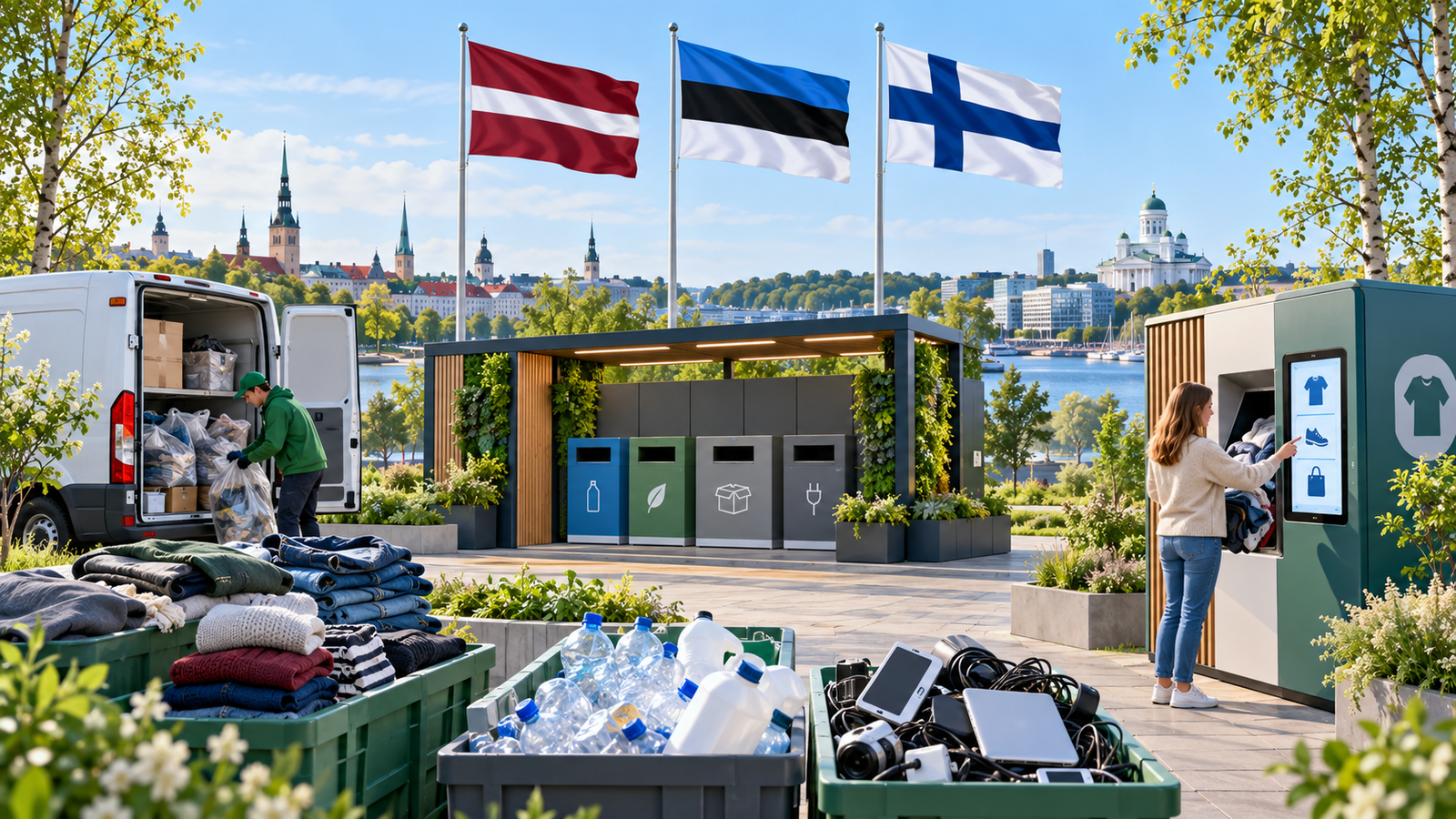
Five mobile waste collection points in Latvia, three self-service circular economy hubs in Estonia and a digitally guided textile sorting station in Finland form part of a joint initiative to make recycling more accessible and keep more materials in use.
Partners in Latvia, Estonia and Finland are testing different approaches to collecting and sorting textile, plastic and electronic waste through SustainaCycle, a €2.64 million cross-border project supported by the Interreg Central Baltic Programme.
The pilots are tailored to local needs: reaching smaller communities in Latvia’s Vidzeme region, combining waste collection and reusable-item donations in Estonia’s Viimsi municipality, and helping consumers sort end-of-life textiles correctly in the Finnish city of Imatra.
Once the three countries’ pilots are operating, the project aims to collect at least 40 tonnes of waste annually in total and direct at least 60% of the collected material to reuse or recycling.
Latvia: mobile collection points to serve smaller communities
In Vidzeme, waste management company ZAAO plans to introduce five mobile collection points that will travel between communities on a set schedule. The approach is intended to improve access to textile, plastic and electrical and electronic waste collection in places where establishing a permanent collection site would not be economically justified.
Before operations begin, the partners will define the collection schedule, accepted materials and practical information for residents. The pilot will assess how a mobile service works in settlements of different sizes.
“Residents’ willingness to sort waste often depends on how convenient and straightforward the service is to use. Mobile collection points will bring the service closer to people, including in less populated areas,” said Māris Ozols, a project expert at the Valmiera Development Agency.
He added that the project would assess both collection volumes and opportunities to return materials to circulation through reuse or recycling.
Estonia: three self-service hubs planned in Viimsi
Viimsi municipality plans to establish three self-service circular economy points, called Ringpunkt, by spring 2027. They will be located in Püünsi, Randvere and Viimsi, making the service accessible across different parts of the municipality.
Each point will consist of two modular units measuring 3 × 6 metres. One side will contain containers for separately collected textile, plastic and electronic waste, while the other will provide shelves for reusable items such as wearable clothing, working electronic devices, plastic toys and household goods.
A partner organisation will collect the reusable items and direct them towards resale, people in need or other reuse opportunities. Visitors will not be able to take items directly from the points.
The service will be free for registered Viimsi residents and people with a waste collection contract in the municipality. Electronic identification will control access, while video surveillance will support site security.
“By bringing separate waste collection and reuse together in a place that residents can reach easily, we can improve recycling options and extend the life of items that are still usable,” said Aet Põld, a specialist in Viimsi Municipality’s Environmental Department.
The modular design will also allow the points to be adapted or relocated as needs change.
Finland: touch-screen guidance for textile sorting
In Imatra, LAB University of Applied Sciences is piloting a digitally guided sorting station at the entrance hall of the Prisma hypermarket. The trial runs from 15 September 2026 to 30 April 2027, and the service is free to use.
Residents bringing clean end-of-life textiles answer questions about their condition on a touch screen. Based on those answers, the system automatically opens either the compartment for material recycling or the residual waste compartment. A light indicator helps users identify the correct opening.
Users can also rate the service and leave feedback after depositing their textiles.
LAB is working with SaimaanVirta ry, a non-profit organisation promoting employment and the circular economy, which empties the collection containers. Fill-level sensors notify staff when a container is approaching capacity, allowing collections to be scheduled according to actual need.
The pilot will assess whether digital guidance improves sorting accuracy, alongside the user experience and the efficiency of the collection process.
Shared research into material recovery
Beyond the collection points, SustainaCycle partners will map material flows and work with businesses, waste management companies and other organisations to identify reuse and recycling opportunities for the materials collected.
The project also includes circular economy seminars, public information activities and educational materials for younger audiences, alongside an assessment of residents’ responses and changes in behaviour.
SustainaCycle runs from 1 May 2025 to 30 April 2028, with a total budget of €2,644,194.50. Its partners are Valmiera Municipality and ZAAO in Latvia; Viimsi Municipality and the Estonian Circular Economy Industries Association in Estonia; LAB University of Applied Sciences in Finland; and Sustainability InnoCenter in Sweden.