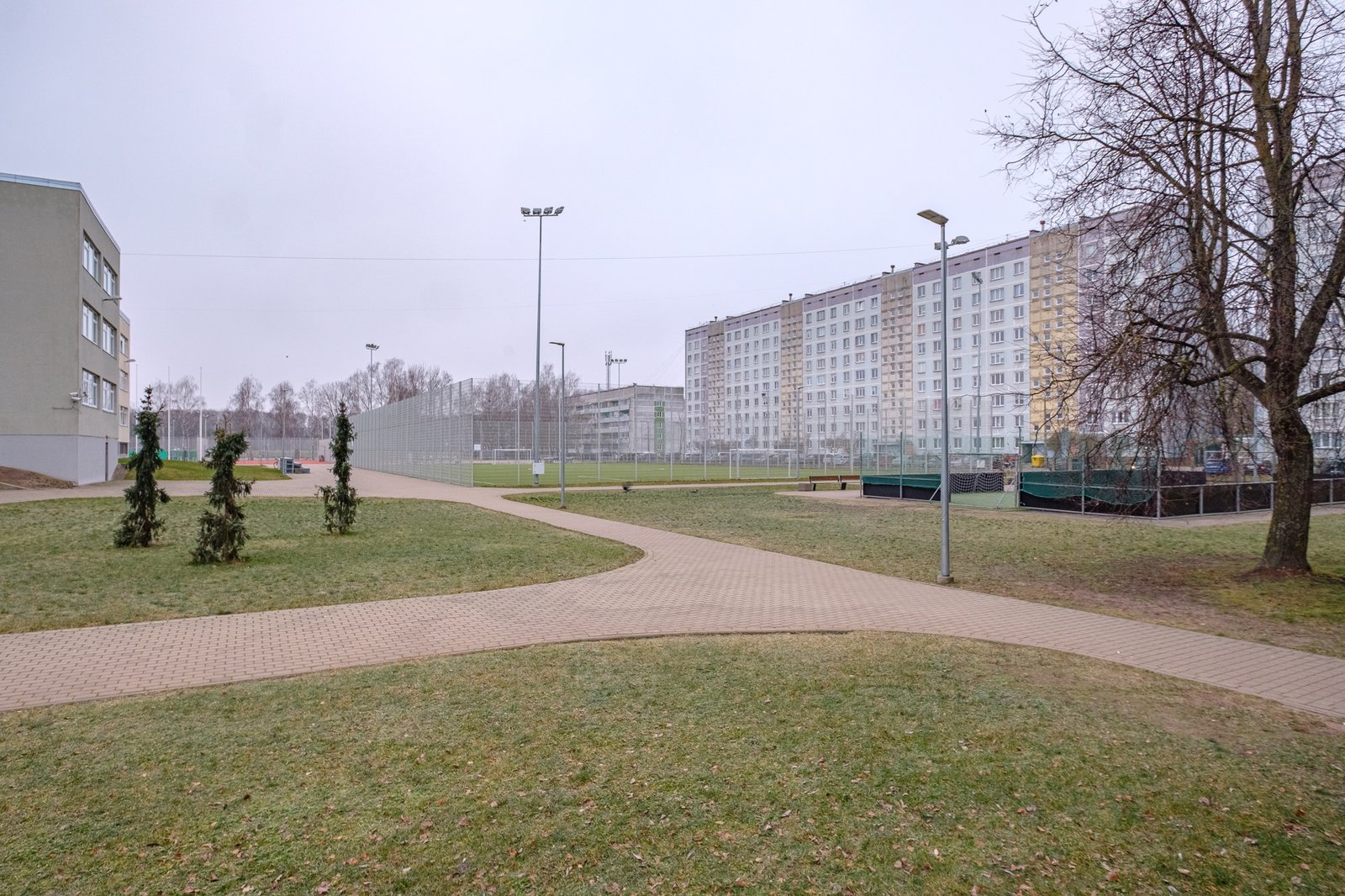
The lowest point of the economic crisis in 2009 provided an opportunity for part of the population to invest free funds into real estate, as apartment prices fell by approximately 70% over a two-year period. For investors, this served as an advantageous market entry point: back then, €100,000 could buy roughly three apartments in serial-type (standardized) buildings. Given that banks financed no more than half of the purchase price, investors acquired properties primarily using their own capital. Real estate agency “Latio” has previously noted that prices for serial apartments in Riga’s neighborhoods have still not reached their pre-crisis levels, and even for an investor who bought at the lowest point of the crisis, the majority of the profit came from rental income rather than price appreciation. This remains an essential consideration today when evaluating what can be purchased with available funds and what income a specific property might yield in the long term.
55% Less Space for the Same Amount, and New Projects Out of Reach
The lowest point of the crisis occurred 17 years ago when housing prices plummeted rapidly. While in April 2007 an apartment in a serial building in Riga’s neighborhoods could be purchased for €1,720 per m², two years later its value had dropped by approximately 70%. As a result, the same apartment was priced at €540 per m² in late 2009.
For one hundred thousand euros in late 2009, one could acquire 186 square meters of serial apartment space in Riga’s neighborhoods—or roughly three two-room apartments. To buy those same 186 m² today would require €220,000,whereas the aforementioned hundred thousand in the autumn of 2026 can buy only 84 square meters of serial apartment space.
Similarly, not long ago, a €100,000 budget allowed buyers to purchase an apartment in the primary market for new developments. For instance, in late 2018, one hundred thousand euros was sufficient to buy up to 68 m² of space in Riga’s neighborhoods. Depending on the layout, this budget could cover a spacious and modern two-room home or a compact three-room home. In contrast, by the autumn of this year, options for a budget under one hundred thousand are shrinking,corresponding to just 35 square meters in the new development segment—enough for a one-room or a very compact two-room apartment. Therefore, if space is a priority for the buyer, apartments in serial buildings remain the most accessible choice.
Rental Income Forms the Main Slice of Returns
Over this period, inflation has significantly impacted not only housing prices but purchasing power as well. To buy the same basket of goods and services today that could be purchased for €100,000 in late 2009, one would now need approximately €170,000. Latio estimates indicate that if those same one hundred thousand euros had been kept in a fixed-term bank deposit, the balance would have grown to approximately €119,400 this year.
As Latio market analyst Ksenija Ijevleva points out, having more money in a bank account does not automatically translate to higher purchasing power. “Considering that the purchasing power of savings has shrunk by about 30%, the real gainers would only be those whose savings exceeded €170,000. Holding money in a bank account cannot yield such a return, unlike an investment in real estate,” concludes Ijevleva.
She explains that if an investor had purchased serial apartments in Riga for €100,000 at the lowest point of the crisis and rented them out, the total value of the properties in the autumn of this year would be approximately €220,000.Additionally, rental income would account for around €181,000 if accumulated. Thus, the investment would have quadrupled, exceeding €400,000 overall. For comparison, price appreciation alone accounted for roughly €120,000.
“When discussing serial apartments specifically, the rental income figure is calculated after deducting approximately 15% for vacancy periods and maintenance costs; taxes and transaction costs are not included in the calculation. Normally, we first look at what we bought the apartment for and what we can sell it for. However, if we have been renting out the apartment in the meantime, those two numbers alone are not enough. In this example, rent yielded more than the price appreciation itself. Therefore, when choosing an apartment to rent out, it is important to understand what the neighborhood demand will be and how much rental income remains after expenses,” Ksenija Ijevleva clarifies.
What Should a Buyer Do With €100,000 Today?
Looking at rising real estate prices across all Baltic nations—and recognizing that price growth in Latvia has been the most moderate so far—experts believe there is no reason for sales prices to fall in any segment in the near future,including serial developments. In the third quarter of this year, average transaction prices rose for apartments on both the right and left banks of the Daugava River. For a buyer with saved capital, this is a reason to start browsing options now and set a price at which a specific purchase is advantageous, without relying on future price increases. An apartment can generate rental income and value appreciation over a longer timeframe, but maintenance costs, vacancy risks, and the fact that real estate cannot always be sold quickly must not be overlooked.
Housing in Riga’s city center pre-war buildings also remains in high demand. In the autumn of 2026, average transaction prices for apartments in renovated pre-war buildings reached approximately €2,850 per square meter in the primary market and €2,680 in the secondary market. With a €100,000 budget, this corresponds to around 35–37 m². By comparison, in the unrenovated central building segment—where the average price is €1,749 per square meter—the budget corresponds to around 57 m². For a pre-war apartment, this serves as a starting benchmark: buyers must evaluate both the apartment’s condition and planned building renovations, as well as how much of the budget will be needed to prepare the property.
“A good layout and a well-maintained building will attract tenants despite a compact floor plan. Before purchasing, it is crucial to find out what investments have been made in the building itself—whether risers or electrical wiring have been replaced, or if the staircase or facade has been renovated. It is definitely worth calculating how much more will need to be invested in furnishing the apartment and how much rent will remain after expenses. If these numbers are convincing even without the expectation of price growth, such an apartment can be a good first investment for a small-scale investor,” explains K. Ijevleva.
If a city center apartment is intended for rent, it is worth comparing two scenarios: the income generated by long-term rentals versus net returns from short-term rentals after deducting cleaning costs, platform fees, utilities, and other operational expenses, while also accounting for seasonal lulls with lower occupancy.