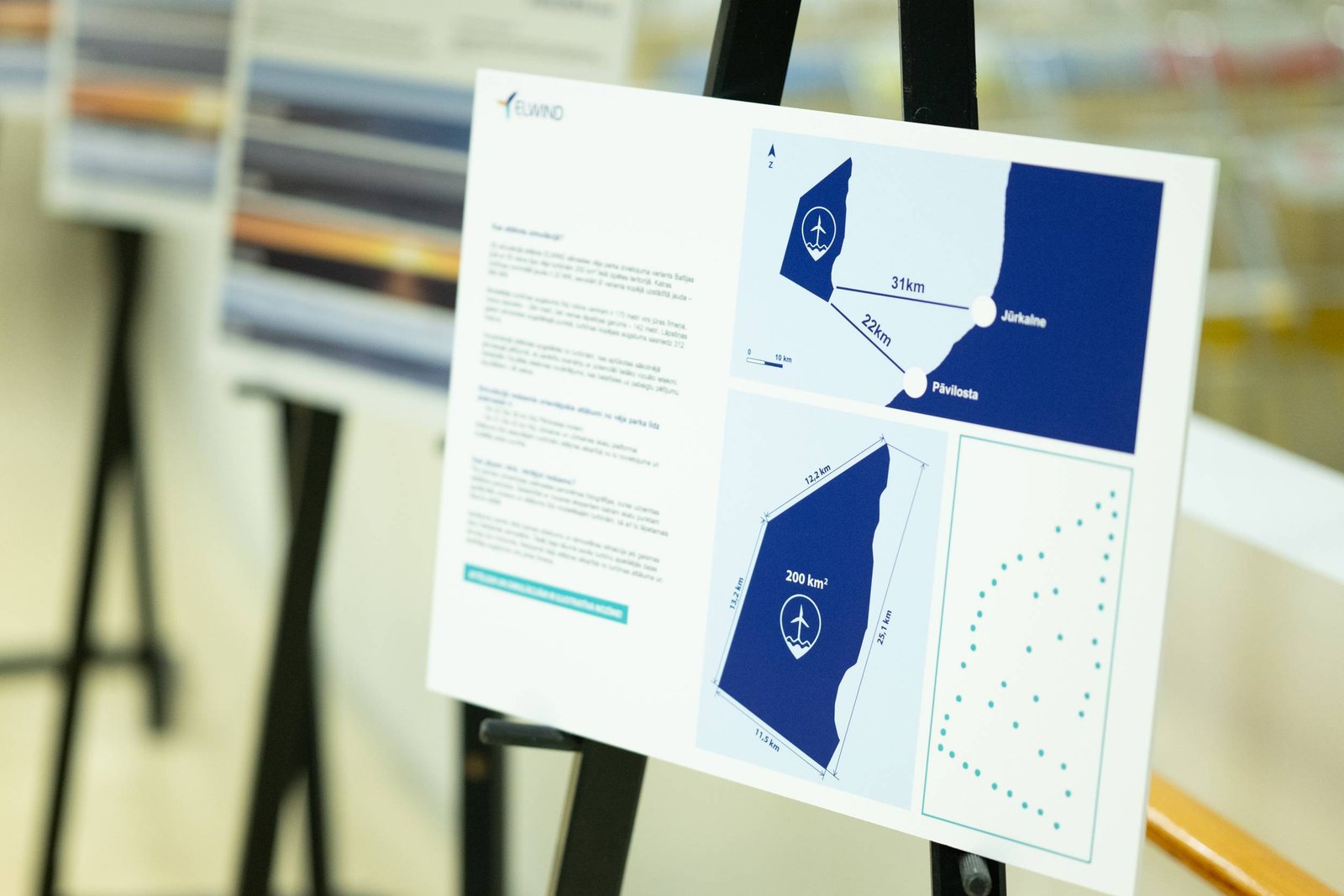
From 4 to 6 November, initial public consultation meetings for ELWIND, the joint Latvian-Estonian offshore wind energy project, were held in Ventspils, Pāvilosta and Ziras. The meetings brought together around 170 residents, municipal representatives and other interested parties. Discussions focused on the potential impact of the wind park on the Baltic Sea environment, the coastal landscape and the lives of local residents, the project’s economic benefits, as well as the development of onshore cable corridors. More than 20 environmental and technical studies are being carried out under ELWIND to obtain the data needed for future decisions.
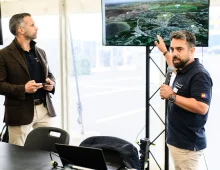
At three meetings held at Pārventa library in Ventspils, Pāvilosta culture centre and Ziras community centre “Saulgrieži”, project representatives and researchers briefed participants on the progress of the studies, preliminary findings and the next stages of project development.
The consultations showed that coastal residents particularly value concrete, research-based answers about the potential impacts on fish resources, birds, marine mammals and the coastal landscape. Questions were also raised about the decommissioning and disposal of wind turbines, infrastructure development and the economic benefits for local communities. Precise answers to several questions will only be possible once the relevant studies have been completed.
“Offshore wind energy opens up new opportunities for Latvia, but the project must be developed on the basis of thorough environmental research and open dialogue with coastal communities. We cannot promise specific benefits until the project’s technical solutions and potential impacts have been assessed. At this stage, our task is to obtain reliable data and ensure that residents’ questions and proposals are taken into account in the further assessment,” emphasises Jānis Ločmelis, Head of the ELWIND Project Division at the Investment and Development Agency of Latvia (LIAA).
More than 20 studies will help assess the project’s potential impacts
Environmental, grid connection and technical studies are being carried out as part of the ELWIND project. They cover seabed geology, meteorological conditions, biodiversity, water quality and other factors required to assess the potential impacts of an offshore wind park.
Preliminary findings have already been obtained from some of the studies, while data collection is continuing in others and procurement procedures are still to be organised for several more. Some studies require observations over multiple seasons to ensure that the data reflect the marine ecosystem under different conditions.
The study results will also have broader scientific value. They will add to knowledge of the Baltic Sea’s geology, biodiversity and environmental condition in areas where studies of this level of detail have previously been limited.
Oskars Beikulis, Lead Consultant at SIA “Estonian, Latvian & Lithuanian Environment”, explained during the consultations that the environmental impact assessment (EIA) is a process strictly regulated by law. Its purpose is to establish the baseline environmental conditions, forecast potential changes, assess project alternatives and identify measures to reduce or prevent potential adverse impacts.
International companies and experts with experience in offshore wind park studies are also involved in assessing the environmental impacts. The EIA process also evaluates the monitoring measures needed to ensure that potential environmental impacts are monitored during construction and operation.
Onshore cable corridors will be developed in consultation with local residents
At the final public consultation meeting in Ziras, one of the main topics discussed was the construction of onshore cable routes to the Ziras substation. Residents expressed concerns about the proximity of the planned cable routes to private properties, their potential impact on the planned reconstruction of the village’s water supply and sewerage networks, and the cumulative impact of several energy projects on the surrounding area.
Project representatives explained that preliminary studies are still under way and possible solutions for constructing the cable routes are being assessed. The cable routes are intended to be developed through voluntary agreements with landowners. If an agreement cannot be reached, alternative technical solutions and route alignments will be sought.
Wind park operation could generate new revenue for coastal development
One of the most frequently discussed issues was the project’s potential economic contribution to coastal municipalities and residents. The regulatory framework currently in force requires a wind power producer to make an annual payment for local community development of EUR 2,500 per megawatt (MW) of installed nominal capacity. The potential capacity of the Latvian part of ELWIND is 500-1,000 MW. Based on this calculation, once the wind park becomes operational, the total annual payment could amount to approximately EUR 1.25-2.5 million.
The exact amount and distribution of the payment will depend on the final installed capacity, the location of the wind turbines and the applicable regulatory framework. The payment is intended to be allocated to the relevant municipalities and to households meeting specified criteria. The figures therefore represent an estimate of the potential total payment, rather than guaranteed revenue for any particular municipality or residents.
Further economic opportunities could arise from the involvement of local companies in construction and maintenance services, the creation of new jobs, and demand for port infrastructure and logistics services. Ports in Kurzeme, including Liepāja, Ventspils and Pāvilosta, could benefit from such opportunities, although no specific solutions have yet been selected.
“Our aim is to ensure that offshore wind energy development also creates opportunities for Latvia’s coastal areas. Local residents understandably want to know what the tangible benefits will be. At this stage, we cannot promise a specific number of jobs or investment in a particular port. These opportunities will depend on the study results, the project’s technical solutions and future development decisions,” says Jānis Ločmelis.
Study area moved more than seven kilometres further offshore
The potential impact of the wind park on the coastal landscape was also discussed during the consultations. The study area for the Latvian part of ELWIND is located in the Baltic Sea between Liepāja and Ventspils, approximately 22-30 kilometres from the coast. Based on the findings of the LIFE REEF project implemented by the Nature Conservation Agency and information on valuable marine habitats, the originally selected area was moved more than seven kilometres farther offshore in 2025.
Moving the area helps reduce risks to biodiversity and avoids overlap with an area that could be designated as a marine protected area in the future. The greater distance from the coast will also reduce the visual impact of the wind park, although its actual extent will be assessed in detail during the EIA process. The final turbine layout, number of turbines and technical solutions have not yet been determined.
Public proposals may still be submitted until 13 November
The key conclusion from the three in-person consultation meetings is the need to continue explaining the project’s potential environmental impacts and to provide as specific information as possible about economic opportunities for local communities. Some answers will depend on the results of studies that have not yet been completed; therefore, informing and involving residents will remain important in the subsequent stages of the project.
The questions, proposals and objections received during the consultations will be compiled and submitted to the State Environmental Service for evaluation. Well-founded proposals will be taken into account in the further assessment of the project and the preparation of the EIA documentation.
Although the in-person meetings have concluded, the initial public consultation continues until 13 November 2026. Written proposals concerning the planned activity may be submitted to the State Environmental Service by 13 November, either by email to pasts@vvd.gov.lv or by post to 23 Rūpniecības iela, Riga, LV-1045, Latvia