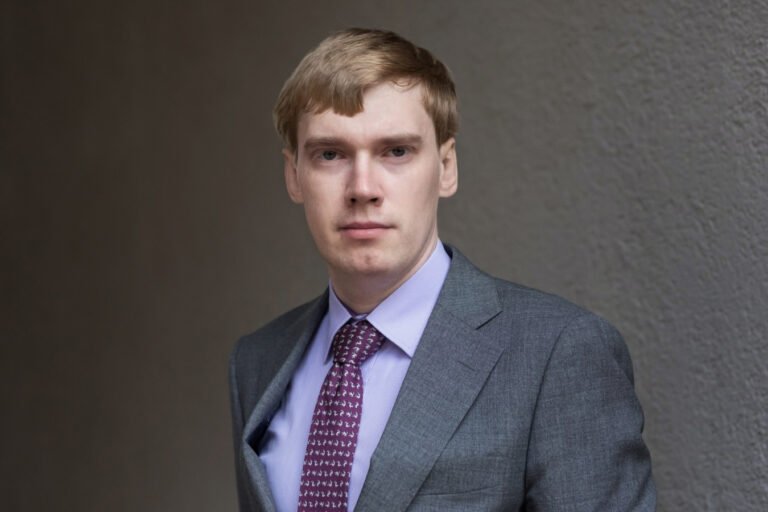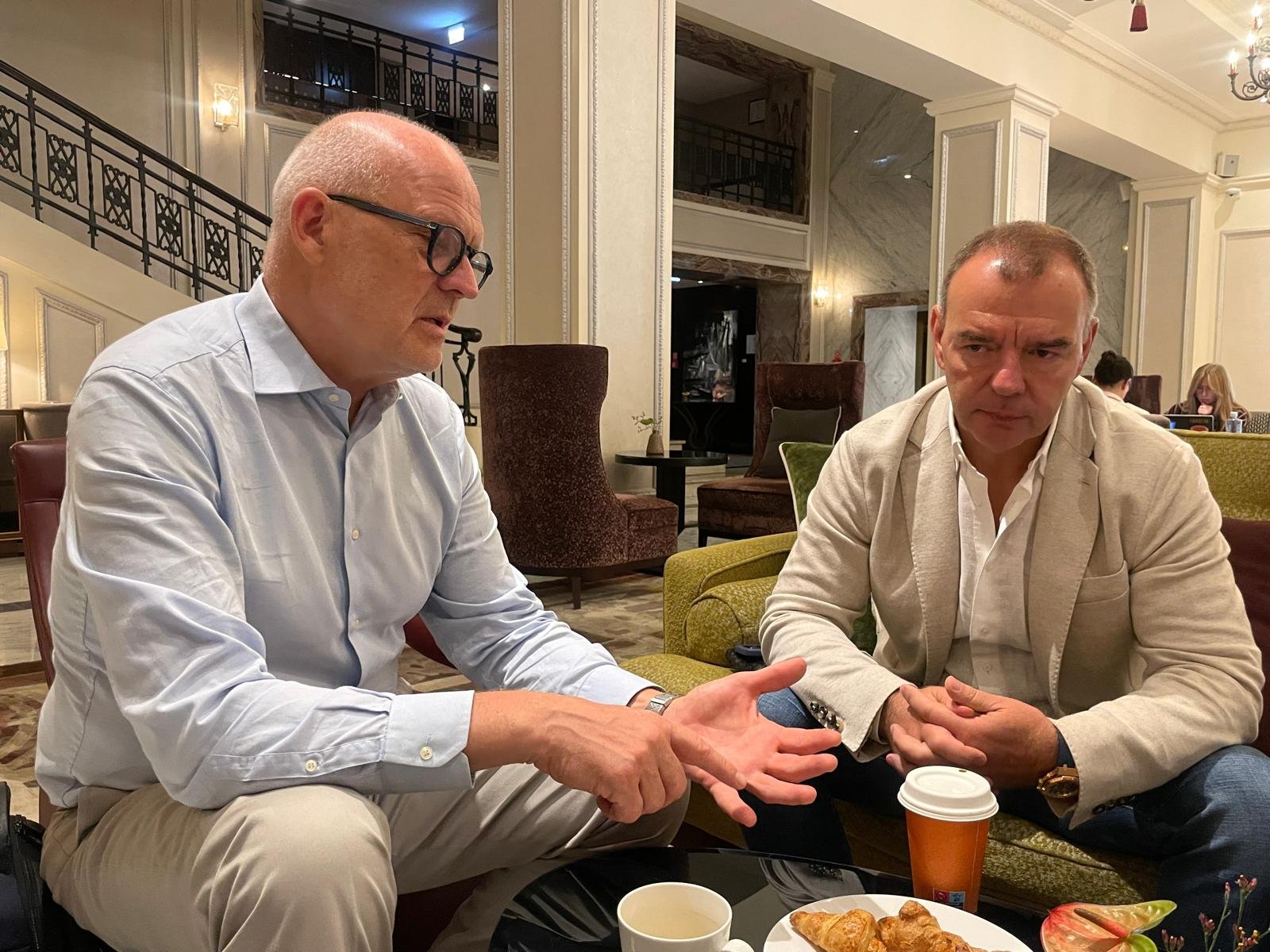
Latvian entrepreneur Māris Martinsons believes Riga needs a 20–30-year development plan that does not change after every municipal election. In his view, the city’s competitiveness requires political continuity, clear rules for investors, more efficient governance, and closer cooperation between the public and private sectors.
Riga is regularly compared with Vilnius and Tallinn — in attracting investment, developing new residential and commercial projects, and improving the quality of the urban environment. At the same time, the Latvian capital must find a balance between new development and preserving its historic urban fabric, between business interests and the needs of residents, between cars and public transport, and between tourism and a city where people live their everyday lives.
In a conversation about Riga’s development, construction entrepreneur and investor Māris Martinsons and entrepreneur Viesturs Koziols discuss the lack of a long-term strategy, the investment environment and bureaucracy, opportunities for public-private partnerships, as well as examples from Norway, where urban development and infrastructure issues are approached differently.
A strategy can be developed in four years, but it cannot be implemented
– Riga is often compared with Vilnius and Tallinn. What, in your view, should Riga’s model for urban development look like?
Māris Martinsons: When we talk about Riga’s development, I have followed it to some extent and, in a way, have also been involved in it. Of course, there are elements that are contradictory.
Historically, Riga’s Old Town was one of the most active parts of the city. There was a time when being located in the Old Town was considered prestigious — it was home to offices, banks and commercial premises. Its residential function was relatively limited.
Later, the approach changed conceptually and the commercial sector began moving out of the Old Town, with offices being built elsewhere. Banks were a striking example: they moved away from the centre and are now, to some extent, beginning to return towards it.
This is an urban-planning problem and, in my opinion, what we lack is proper long-term stewardship. At the same time, I understand one of the reasons: our electoral system means that something changes every four years. In four years, you can develop a strategy, but you cannot implement it.
The city needs a plan for the next 20 or 30 years
– So is the main problem a lack of political continuity?
Māris Martinsons: It is a very significant problem. In other countries, there are systems where decisions made by a previous government or municipal administration cannot simply be completely reversed.
Here, we can have one programme today, and after an election different people come in and everything changes.
There needs to be a strategy and a plan for how the city will develop over the next 20 or 30 years. Then we can understand where we are heading and what results we want to achieve.
To some extent, the same thing happened in hockey — we experimented and changed things, but we had a goal and a vision of where we wanted to go. In my opinion, that is one of the prerequisites for success.
Vaļņu Street can be redeveloped, but first we need to understand what we actually want from the Old Town
– Riga City Council is once again discussing changes to Vaļņu Street. Can individual projects like this provide a solution?
Māris Martinsons: I think we first need to look at the overall model for the city’s development. Riga’s Old Town has changed significantly over the past 30 years. Offices and commercial activity used to be concentrated there, but later the approach changed and these functions began moving elsewhere.
That is why a single street cannot, by itself, solve what is fundamentally an urban-planning issue. We need to understand what kind of Old Town we actually want and how it fits into Riga’s overall development.
The war is a major factor for investment
– The investment environment is currently also being affected by the war in Ukraine and Latvia’s geographical location.
Māris Martinsons: Of course. It cannot be ignored. The war is close to us, and it has a significant impact on investment in Latvia.
A large number of European and Scandinavian companies are currently in wait-and-see mode. When we look at larger investments across a number of sectors, the most active investors are very often Baltic companies themselves — Estonians, Latvians and Lithuanians.
It is no longer quite like it used to be, when major foreign funds were actively entering the market. There are also Baltic companies looking towards Poland and other markets.
We cannot simply remove this factor from the equation. However, every crisis also creates opportunities, and the question is whether we are capable of taking advantage of them.
Public administration should help, but too often it creates obstacles
– Viesturs, do you see the problem as broader than Riga alone?
Viesturs Koziols: I would divide it into several areas. First, Latvia as a whole is not sufficiently business-friendly.
The administrative apparatus and bureaucracy are enormous. Civil servants have a great deal of power. I think that if the number of civil servants were reduced by even 15–20 percent, in many areas society would not even notice the difference.
Of course, there are highly professional people working in public administration. But there are also people who simply come to work from nine to five and do not really create anything.
In my opinion, the underlying principle is wrong: the civil service should serve and assist businesses, but very often the opposite happens — obstacles and completely unnecessary bureaucracy are created.
Artificial intelligence will take over some of the work currently done by civil servants
– Could artificial intelligence change this?
Māris Martinsons: I think we are very close to that. Leading countries are already introducing artificial intelligence into public administration.
AI will be able to perform some of the intermediate functions currently handled by civil servants much more efficiently. Of course, the final decision must be made by a person. You cannot remove the human element. But a great many intermediate steps can be automated.
Any foreign investor entering Latvia encounters bureaucracy. We may have a very good Land Register system, but before achieving the desired result, a person can still be sent from one institution to another.
– And eventually the foreign investor asks: why do I need this?
Viesturs Koziols: If we want to look 20, 30 or 40 years ahead and remain competitive, then public administration must make use of the opportunities offered by artificial intelligence.
Politicians are on one side, entrepreneurs on the other — and in the end, we end up doing the splits
– Why do we talk so much about business when discussing the urban environment?
Māris Martinsons: Because over the past ten years, business and politics in Latvia have increasingly gone in separate directions. That cannot happen in a normally functioning country.
Business and politics need to work hand in hand. Business is the environment that sustains the state — it develops production, creates jobs and pays taxes.
That does not mean business should control politics. But the two cannot be artificially separated.
It is like a clock — remove one part of the mechanism and the clock stops. In my view, something similar has happened here.
The environment has become divided — politicians on one side and entrepreneurs on the other. But a person has two legs. If one goes one way and the other goes the opposite way, you end up doing the splits. You cannot move forward like that.
– Viesturs, you also said that the country lacks clarity about where it is actually heading.
Viesturs Koziols: The first issue is the civil service. The second is what decisions we are actually making and where we are going. Right, left or straight ahead?
In my view, far too often we do not have a clear understanding of what we are doing at the national level.
– The war is a huge factor. Whether we like it or not, that is the reality. We all hope it ends as soon as possible, but in the meantime we have to ask: what can the state do under these circumstances? How can the country make money? Where is the plan?
If you do not want parking in the city centre, provide an alternative
– What kind of urban-development model could we adopt from other countries?
Viesturs Koziols: I like the Norwegian example.
In central Oslo, there is a large sports arena with around 6,000 seats and a training hall. Despite the size of the facility, the number of parking spaces is very limited.
Why? Because land in the city centre is extremely expensive. The municipality’s policy is that it does not want enormous car parks next to every facility — people should use public transport.
You may agree or disagree, but it is a policy. The key point is that the municipality has provided the necessary public transport.
– So restricting cars is not a problem in itself?
Viesturs Koziols: No, not if you provide an alternative.
If the city says there will be no parking in the centre, it has to provide a system that allows people to get there.
In Norway, it is a policy decision: we will not build an enormous car park next to the facility because urban land is too valuable. But in return, people are provided with public transport.
A private investor builds the arena, while the municipality guarantees ice time for children for 20 years
– You also mentioned the example of an arena in Stavanger. What exactly happened there, and how was the ice hockey arena financed?
Viesturs Koziols: In Stavanger, a private owner built a new arena. The financing model was very interesting.
He went to the municipality and said: pay me in advance for a certain amount of arena usage over a 20-year period, specifically for the hours between ten in the morning and one in the afternoon — a time slot that is very difficult for any arena to fill. In return, I guarantee that these hours will be reserved every day for children living in the municipality.
The municipality calculated the value of that usage time and paid for it in advance, and that money made a significant contribution to financing the construction of the arena.
In return, the municipality has a guarantee that for 20 years, children in the area will have access to ice — for hockey, figure skating and other ice activities.
Even if the investor were to leave one day, the arena would not disappear. It remains as infrastructure and continues to serve local residents.
– Could something like that be done in Latvia?
Viesturs Koziols: Try taking an idea like that to a Latvian municipality.
– We talk a great deal about public-private partnerships. But how many projects have actually been built this way in Latvia?
We have been talking about it for a very long time, but in practice it is extremely difficult to implement anything. My experience is that bureaucratic objections often appear right at the beginning — there is some regulation, something cannot be done, something is too complicated. There are mechanisms that are complicated and incomprehensible to entrepreneurs and therefore unacceptable to them. Civil servants, meanwhile, are protected: nothing happens — only one PPP project has been implemented in Latvia during all these years — and no one holds them accountable for it.
An investor has to benefit — that is not a problem, that is economics
– Māris, have you personally looked into the public-private partnership model?
Māris Martinsons: Yes. And the problem is that legislation and the practical idea of partnership sometimes come into conflict.
The rules of the game should be developed together with entrepreneurs — people who are actually prepared to develop something. Then we should look at what can realistically be implemented.
Every investment also has to provide a return for the investor. That is normal. An investor does not put in their own money simply to do the state a favour.
– But in Latvia, profit is often viewed with suspicion?
Māris Martinsons: Exactly.
– I have had experience in Germany. In one project, we had planned for a profit margin of around 15 percent, and the local tax authorities asked us: why so little?
They explained it very simply: construction involves risks, someone may fail to pay, the company needs to develop and it needs to be able to continue investing.
Taxes are paid from profits, and profits allow a company to pay salaries and grow.
In Latvia, by contrast, there is very often a sense that if an entrepreneur is making money, something must be wrong. Especially in construction.
In my view, instead of criticising those who make a profit, we should create conditions in which successful businesses contribute more to the country — through taxes, jobs and investment.
– What should Riga do to make private investors feel more secure here?
Māris Martinsons: A private investor wants to make money. That goes without saying.
– If a country develops an attitude that making money is somehow wrong, then what kind of investment can we expect?
We have many advantages — Latvia has beautiful nature, tourism potential and plenty to offer. But we need a strategy.
Business should not simply be restricted. If the state considers a particular activity undesirable, it can use tax policy or other clear instruments. But entrepreneurs need clear rules of the game.
We also need to look for solutions. I understand perfectly well that nature has to be protected. But, for example, if a project requires five trees to be cut down, then say: plant 25 new ones. An entrepreneur will understand that and do it.
It cannot be the case that the first priority is to find a reason why something cannot be done.
Riga’s Old Town cannot be separated from tourism, sport and the country’s overall strategy
– Returning specifically to Riga, how do we balance investors, local residents, housing and tourism?
Māris Martinsons: It has to be divided into several parts.
Tourism is important to Latvia’s economy. Unfortunately, our climate does not allow us to maintain the same level of tourist activity 12 months a year, but that is precisely why tourism needs to be developed strategically.
We should do everything possible to promote Latvia. And one of the most powerful ways to promote a country is through success.
We have culture and sport — two areas Latvia can be proud of.
– Do you also see sport as a tool for urban development and tourism?
Māris Martinsons: Absolutely.
Look at what other smaller European countries are doing. They build infrastructure and attract sporting and cultural events so that local businesses can benefit and the city can gain recognition.
It is a way to generate revenue while simultaneously promoting the city and the country — including the name of Riga.
That is why urban development cannot be viewed separately from tourism, transport, sport, culture and the country’s overall strategy. The city needs to work together with the national government and establish common goals and priorities.
If the rules of the game are clear, people will know what they are working with
– And that brings us back to the same issue — clear rules of the game?
Māris Martinsons: Yes. Clear rules of the game are extremely important.
If they are clear, we can of course review them over time. But people need to know the principles according to which the system operates.
That applies to investors, sports organisations and every other sector.
If the rules and criteria change after every election, it is impossible to build anything for the long term.
Source: mmnews.eu