As the new academic year approaches, the student rental market gains momentum every year, with the number of homes available for rent traditionally increasing by around 15%. International tenants account for a significant share of the rental segment: nearly 12,000 mobile students were registered last year, most of whom look for accommodation in the capital.
International students are also becoming more demanding when it comes to their temporary homes. While in the past they typically opted for dormitories or a room in a shared apartment, a new generation of co-living is now gaining ground — small, fully equipped private apartments combined with shared work, leisure and household facilities.
The growing demand for comfort and privacy is also making co-living properties attractive to local investors, who may potentially recover their initial investment in less than ten years, according to the latest Housing Buyer Confidence Index published by real estate agency Latio.
Housing Buyer Confidence Index data for July
- 47 days — the average time required to sell a property at market price (49 in June, 48 in May, 48 in April, 50 in March, 47 in February and 48 in January);
- 17% of homes were sold within one month of being listed (18% in June, 19% in May, 20% in April, 18% in March, 20% in February and 20% in January);
- 20% of sellers asked prices that were disproportionately high compared with market conditions (22% in June, 21% in May, 21% in April, 20% in March, 17% in February and 17% in January);
- 2% of buyers offered more than the advertised asking price (1% in June, 1% in May, 1% in April, 1% in March, 2% in February and 2% in January).
In July, approximately 3,350 apartments were available for purchase in Riga, 15% fewer than during the same period last year. In Riga’s residential neighbourhoods, average transaction prices for apartments in new developments reached €2,630/m², compared with €3,650/m² in the city centre.
A total of 2,260 apartments were available on the primary market in July. In renovated buildings, average transaction prices exceeded €3,000/m², representing a 12% increase year-on-year. On the secondary market for newer developments, average transaction prices were around €2,280/m² in Riga’s neighbourhoods and exceeded €3,200/m² in the city centre.
The seasonal increase in supply was less pronounced in the rental segment. Approximately 2,570 rental apartments were available in July, almost the same number as in June. Around 65% of these were located in central Riga, including pre-war buildings, renovated properties and new developments. The city centre remains popular not only among local residents but also among students.
Mobile students — a growing rental audience
International mobility is having an increasing impact on Latvia’s student rental market. According to data from the Central Statistical Bureau of Latvia, one in six students in Latvia comes from abroad. During the 2025/2026 academic year, there were 11,900 mobile students studying in Latvia, an increase of 7.5% over the year. Around 4,000 mobile students began their studies at Latvian higher education institutions last year.
This group is concentrated primarily in Riga and particularly at two universities: Rīga Stradiņš University (RSU), with 3,103 mobile students, and Riga Technical University (RTU), with 2,578.
Students have a range of temporary accommodation options, from university dormitories to privately rented apartments or homes shared with other students. RSU and RTU both provide several student residences, but capacity is limited, meaning some students have to seek alternatives on the private rental market.
As overall living standards have risen, students’ expectations have also changed. Historically, one of the most common models involved several tenants sharing an apartment, with each person renting a separate bedroom while sharing the kitchen and bathroom. Although this reduced accommodation costs, it also required compromises in terms of privacy and comfort.
The market response — the modern co-living concept
Modern co-living developments are now expanding rapidly, combining compact private living spaces with shared infrastructure and services.
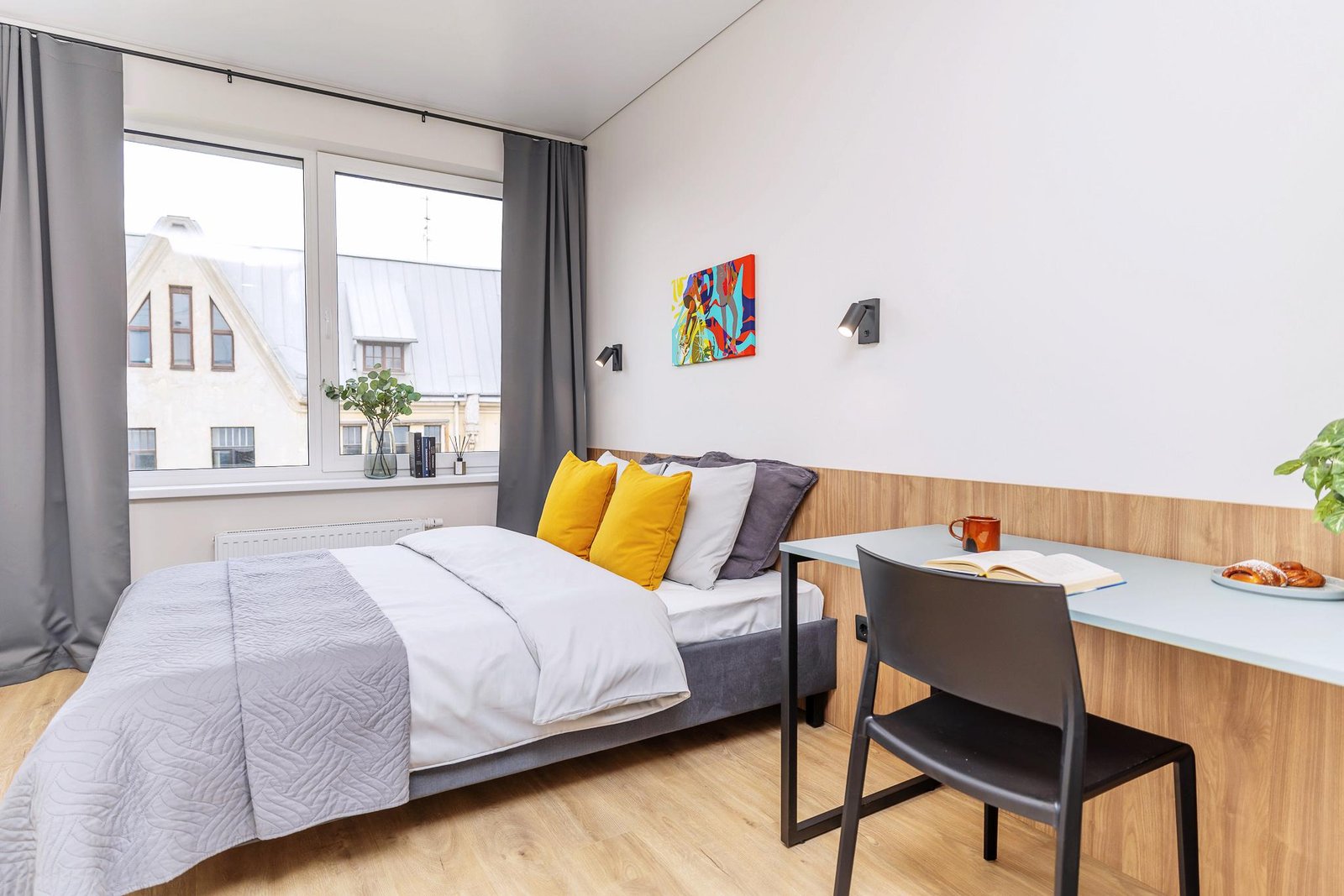
One example in central Riga is Youston Co-Living on Krišjāņa Valdemāra Street. The project comprises 174 fully equipped investment apartments ranging from approximately 12 to 27 m². Each has its own kitchen, bathroom and furniture, while residents also have access to a gym, steam room, cinema and gaming rooms, co-working facilities, a shared kitchen and dining area.
Prices for apartments currently available for sale start at around €46,000, with the smallest units measuring approximately 11–12 m². According to Latio, around 93% of the apartments in the project are currently rented out.
“The concept of co-living is nothing new, but it has acquired an entirely new meaning in the real estate market. In the past, it immediately brought to mind several people living together in one apartment. Today, co-living means modern and functional individual apartments in buildings equipped with shared infrastructure. Tenants no longer have to sacrifice privacy in order to experience a sense of community and benefit from shared services,” explains Ksenija Ijevleva, market analyst at Latio.
Latio emphasises that the actual return on any investment property must be assessed individually, taking into account management costs, potential vacancy periods, taxes and other expenses.
Gross returns can reach 11% annually
Mobile students are one of the most visible target groups for co-living, as they typically need fully furnished accommodation for a defined period of study and often have little interest in buying furniture or entering into complicated long-term rental arrangements.
However, the potential tenant base is much broader. Such apartments may also appeal to local students, young professionals, people relocating to Riga for work, and foreign specialists who need accommodation for a limited period.
Student budgets also vary considerably. On the traditional rental market, a one-room apartment in a standard Soviet-era building in Riga’s most popular residential neighbourhoods currently rents for around €250–340 per month, while a one-room apartment in a new development can cost approximately €340–530 per month.
With co-living, tenants pay not only for the private apartment itself but also for the location, furniture and shared facilities. As a result, the product competes not only with renting a room in a shared student apartment, but also with high-quality small apartments in central Riga.
The investment potential is another reason why co-living is attracting attention from property buyers. The value of a compact apartment is determined not only by its size, but also by its ability to appeal to several different groups of tenants.
“For an investor, the key question is not whether the apartment will specifically be occupied by an international student, but how much demand there would be from other tenant groups if student numbers declined. If a compact apartment is centrally located, fully equipped and suitable for a student, a young professional or someone staying in Riga temporarily, its potential uses are much broader. This is why co-living can also be attractive to local investors looking for a small property with an established rental model,” says Ksenija Ijevleva.
For example, purchasing a co-living property for €46,000 and generating average rental income of €430 per month would result in annual gross rental income of €5,160, equivalent to approximately 11.2% of the purchase price.
If rental income remained at this level, the initial investment would theoretically be recovered in less than nine years. After that period, the investor would still own the property itself — an asset whose future value could either increase or decrease depending on market conditions.
Experts stress, however, that this calculation does not include taxes, property management, maintenance or other ownership-related expenses. Investment decisions should therefore not be based solely on a low purchase price or headline yield. Investors should also consider the location, management costs, rental agreement terms, potential vacancy periods, future demand and the property’s liquidity when it eventually comes to resale.
*To keep the public better informed about current developments in the real estate market, Latio publishes its Housing Buyer Confidence Index every month, compiling five key indicators that characterise market conditions during the previous month.