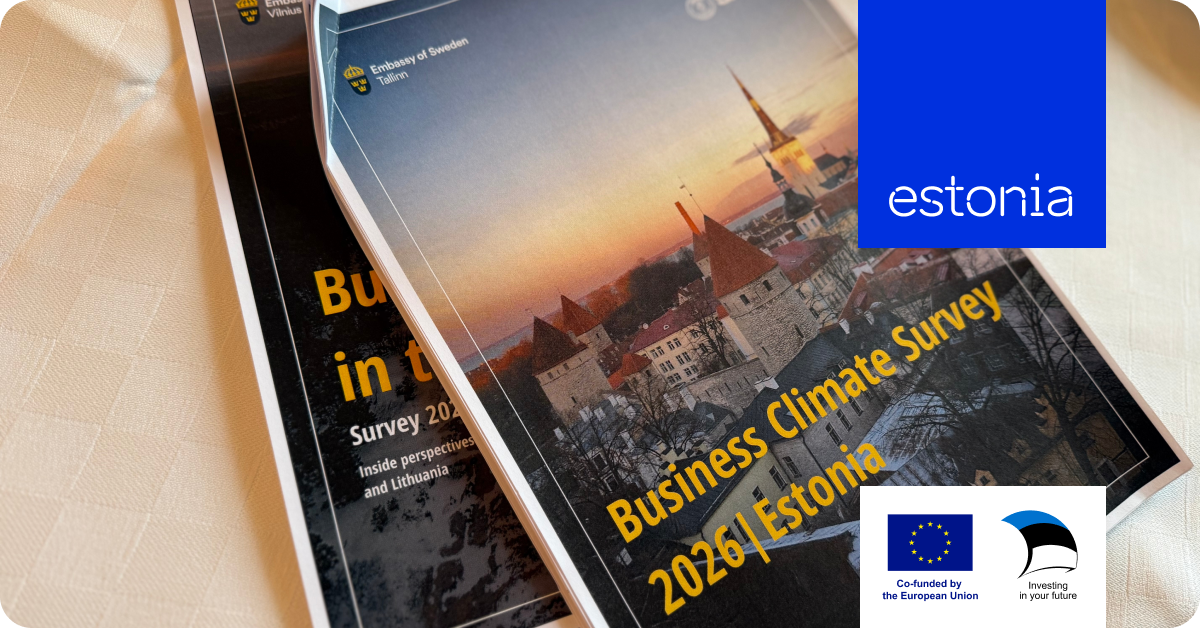
The Baltic Business Survey 2026 finds 46% of Swedish-linked companies in Estonia plan to increase investment over the next 12 months, the highest share among the three Baltic states, while 69% reported a profit in 2025.
The 2026 Baltic Business Climate Survey, conducted annually by the Swedish embassies in Estonia, Latvia and Lithuania together with the Stockholm School of Economics in Riga, shows Estonia ahead of its neighbours on investment intentions. Some 46% of Swedish-linked companies in Estonia plan to raise spending over the next 12 months, compared with 38% in Lithuania and 34% in Latvia. A further 35% in Estonia expect no change, putting the combined share planning to increase or maintain investment at 82% across the region.
Profitability improved markedly in Estonia: 69% of surveyed companies reported a profit in 2025, up from 56% in the previous survey, while the share reporting a loss fell from 31% to 14%, the largest such reduction across the three countries. Lithuania recorded the highest profitable share at 71% and Latvia 66%. Larger companies performed better, with 88% of those employing 500 or more people locally reporting a profit. All respondents in industrial equipment, telecommunications, and IT and electronics reported profitable operations.
Estonia scored highest among the Baltic states for corporate taxation, rated 4.1 on a five-point scale, followed by licences and permits at 4.0 and regulation at 3.9. Digitalisation received the top rating of any operating condition at 4.5, ahead of the financial system at 4.2 and market access at 4.1. The reported effect of corruption fell to 1.4, the lowest figure in the Baltic survey.
Access to specialists and key personnel was Estonia’s lowest-rated operating condition at 3.8, dropping further to 3.5 among companies with 500 or more local employees. Respondents called for stronger technical and vocational education, easier access to foreign labour and continued investment in energy, transport and digital infrastructure. The executive vice president of the Stockholm School of Economics in Riga, Kata Fredheim, noted that access to skilled labour remained a shared challenge across all three countries.
On the impact of geopolitical change since 2022, Estonia was the most evenly split market: 35% of companies reported a decrease in business, 31% an increase and 27% no change. Raw-material costs were cited by 60% of those whose business had changed, while customer demand, investment plans and energy prices were each selected by 55%. The survey covered 85 Estonian respondents, 73 from Latvia and 56 from Lithuania, with fieldwork carried out between April and June 2026. SAAB, SEB and Stena Line supported the study.
Source: Invest Estonia. Read the original (published 2026-11-11).