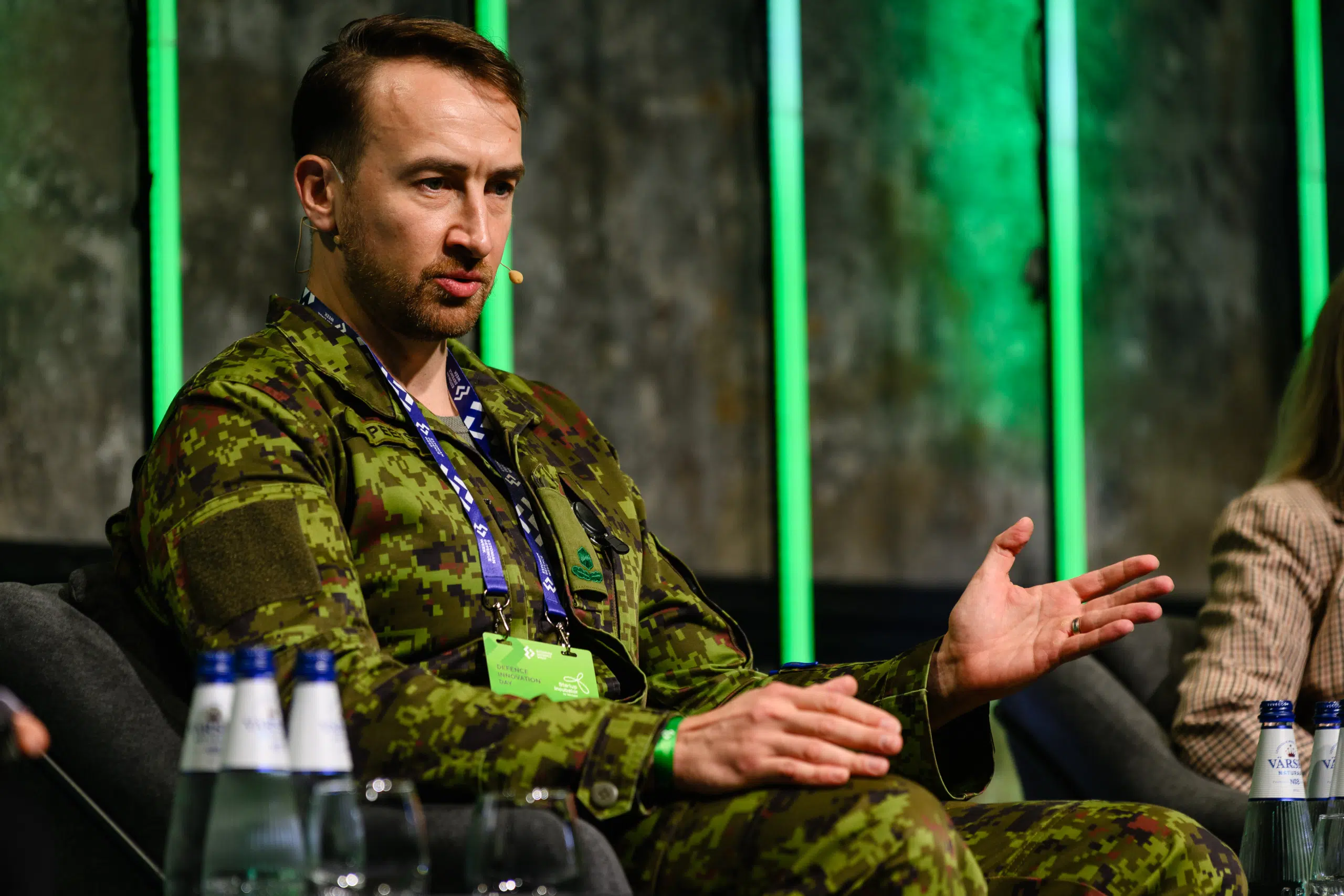
At Defence Innovation Day on 21 September, Major Ivo Peets will give a keynote titled Frontline Innovation: One Year of Lessons from the Field. As Commander of the Estonian Defence Forces’ Force Transformation Command, Peets has spent the command’s first year working to turn identified operational needs into implemented capabilities.
One of the clearest examples is the Unmanned Kill Chain project, which brought unmanned systems, electronic warfare assets, sensors and different types of drones into sustained use at battalion level. The project helped the EDF identify which solutions work, which need further development and which are ready to be scaled across manoeuvre units.
“The value was not in any single piece of equipment. It was the integration of several systems around the operational needs of one unit,” Peets says.
The Force Transformation Command has an implementation mandate and control over resources in areas assigned by the Chief of the Estonian Defence Forces as critical operational requirements. “We are not limited to giving advice,” Peets says. “We translate requirements arising from Estonia’s war plans into capability programmes, integrate the relevant technology and direct the resources assigned to those programmes.”
Where broader changes to plans or funding are needed, the command brings a proposal to the Commander of the Defence Forces, creating a direct link between an operational problem, a command decision and implementation. Its focus areas include unmanned and counter-unmanned systems, artificial intelligence and space-enabled capabilities.
Peets says parts of the process could previously take years. In selected cases, the Command has now moved from an identified problem to an integrated solution in about three months. “The main achievement is a clearer process for linking operational requirements, technology, funding and implementation,” he says.
What Estonia should learn from Ukraine
Ukraine can adapt systems rapidly through direct battlefield use, often through incremental changes made under wartime conditions. Peets argues that Estonia should learn from that process rather than replicate individual solutions.
“The main lesson is to copy the relevant aspects that speed up Ukraine’s feedback cycle, not individual products,” he says.
Estonia is preparing in peacetime, where safety, legal requirements, lifecycle costs, training and long-term support also have to be considered. “A solution that works in Ukraine today may be highly effective there, yet unsuitable for an Estonian reserve force that must store, maintain and operate it over many years,” Peets says.
Systems therefore need to evolve while remaining supportable, including through software and payload upgrades. Estonia is also shortening its own feedback loop through Chief Technology Officer positions in every service, supported by technology officers and specialists in subordinate units.
“This network connects warfighter problems with technology experts and industry. It makes industry a regular part of capability development and brings user feedback into the process much earlier,” Peets says.
That emphasis on adaptability also shapes cooperation on emerging technologies. In artificial intelligence development for military use, Peets says Estonia and Finland should begin with common standards, interfaces and selected use cases because individual models and technology providers will change over time.
Their close economic, technological and military ties provide a good basis for burden sharing, including dividing development work and comparing results. Cooperation also has clear limits: national control must remain over war plans, classified and operational data, access rights and decisions concerning the use of military force.
National systems should use open architectures so each country can continue developing and adapting them if an external provider becomes unavailable. Peets says Estonia and Finland aim to act as regional leaders in defence AI, while keeping the framework open to other NATO Allies and trusted partners outside the Alliance.
When can the force absorb new technology?
Estonia’s wartime structure includes close to 60,000 personnel. For a reserve-based force of that size, technical performance alone is not enough.
Peets sets four main conditions for scalability. A new system must be learnable within a limited training period, use standardised interfaces and integrate with existing command, communications and logistics systems. Its basic platform should have a longer lifecycle while allowing software, sensors or payloads to be upgraded in modules, and it must be producible, repairable and replaceable in greater numbers during crisis or war.
Peets describes this as the difference between technology readiness and user readiness. “Technology readiness tells us whether the system works. User readiness tells us whether the force can absorb it,” he says.
That does not mean equipping every unit with every possible system before a crisis. Peets argues for a sound baseline and the ability to add capabilities progressively as requirements and available quantities change.
The same logic applies to training. Peets stresses that the fundamentals of soldiering remain, even as the balance between skills and the threats soldiers face changes. Soldiers still need to use their weapons, move, communicate, survive and fight as a team.
“The answer is not to keep adding separate subjects to an already full programme,” Peets says.
The war in Ukraine has placed greater emphasis on concealment, dispersion, electronic protection, counter-drone measures and the use of sensors. Technology can also free training time: a drone or sensor, for example, may perform part of a reconnaissance task that previously required more of a soldier’s time.
Training priorities therefore need to be reviewed continuously, with less emphasis on tasks technology has replaced and greater emphasis on new threats. CTOs and unit technology officers support this by connecting instructors, units and companies and making technological adaptation part of routine service.
When failure is useful
Testing less mature technologies means accepting that some trials may fail. For Peets, the question is what kind of failure is acceptable and who owns the risk.
“A failed trial is not automatically a failed project. If the test answers a relevant question without creating unacceptable danger, it produces useful knowledge,” he says.
The Estonian Defence Forces must own the decision to conduct a trial and provide a controlled testing environment, including responsibility for personnel safety, operational security, legal compliance and the protection of equipment and infrastructure. The company remains responsible for its product, including its technical maturity, stated performance and development choices.
It must also carry the commercial risk that the product may fail, require further investment or prove unsuitable for military use. Peets distinguishes this from risks to life, security or operational readiness, which cannot be treated in the same way as technical failure.
“Defence innovation cannot mean transferring all development and business risk from industry to the state,” he says.
Beyond the prototype
For the Estonian Defence Forces, proving that a technology works is only the first step. The primary question is military utility: does the solution address a real capability gap, work in relevant battlefield conditions and have value for current or future force development?
The assessment must also consider whether it can be produced at the required scale, supported throughout its lifecycle, integrated with other systems and supplied during crisis or war.
Peets also draws a boundary around how far the EDF should go in assessing the company itself. Investment potential is not a military evaluation criterion, but a company’s ability to attract investment, maintain a competent team and finance continued development can indicate whether the solution has a credible future.
Wartime supply also raises the question of domestic production. Some critical capabilities, Peets argues, should be produced or supported in Estonia, while domestic production may make less sense for narrower products with limited strategic value. The issue is therefore not how much Estonia can produce at home, but where domestic capacity materially strengthens military capability and security of supply.
Peets says companies should work continuously with military users through development, experimentation, production, adaptation and wartime sustainment rather than enter the process only during procurement.
Civilian expertise has a role as well. Engineers, software developers, data specialists, researchers and production experts should have clearer routes for contributing through their professional skills, including in wartime roles.
“A reservist should feel that civilian expertise has direct value to national defence,” Peets says. “Our aim is to connect more civilian technology experts with defined defence needs and suitable wartime roles.”
What success should look like
By the Force Transformation Command’s second anniversary, Peets wants the impact to be visible at unit level. A battalion commander should be able to see a problem move from observation to decision, testing and fielding within a single training or planning cycle.
“The problem no longer disappears into a long administrative process,” he says.
For conscripts and reservists, the change should be visible in everyday training: encountering new technologies, learning to use them and practising against the threats they create. Peets ultimately measures progress by whether this way of working becomes routine.
“The clearest measure of success is a routine system in which a problem identified by a unit brings together the right military, reservist and industry expertise and produces a usable solution within an operationally relevant timeframe,” he says.
Peets will discuss these lessons further at Defence Innovation Day on 21 September at Kultuurikatel in Tallinn. It is the first day of Estonian Defence Week. Participation is free of charge, but registration is mandatory and subject to approval.
The event is organised by Tehnopol and the Ministry of Economic Affairs and Communications through the NATO DIANA Estonian Accelerator. It is supported by the Estonian Ministry of Defence. One thematic block is shaped with the input from Sparkup Tartu Science Park.
Source: tehnopol.ee