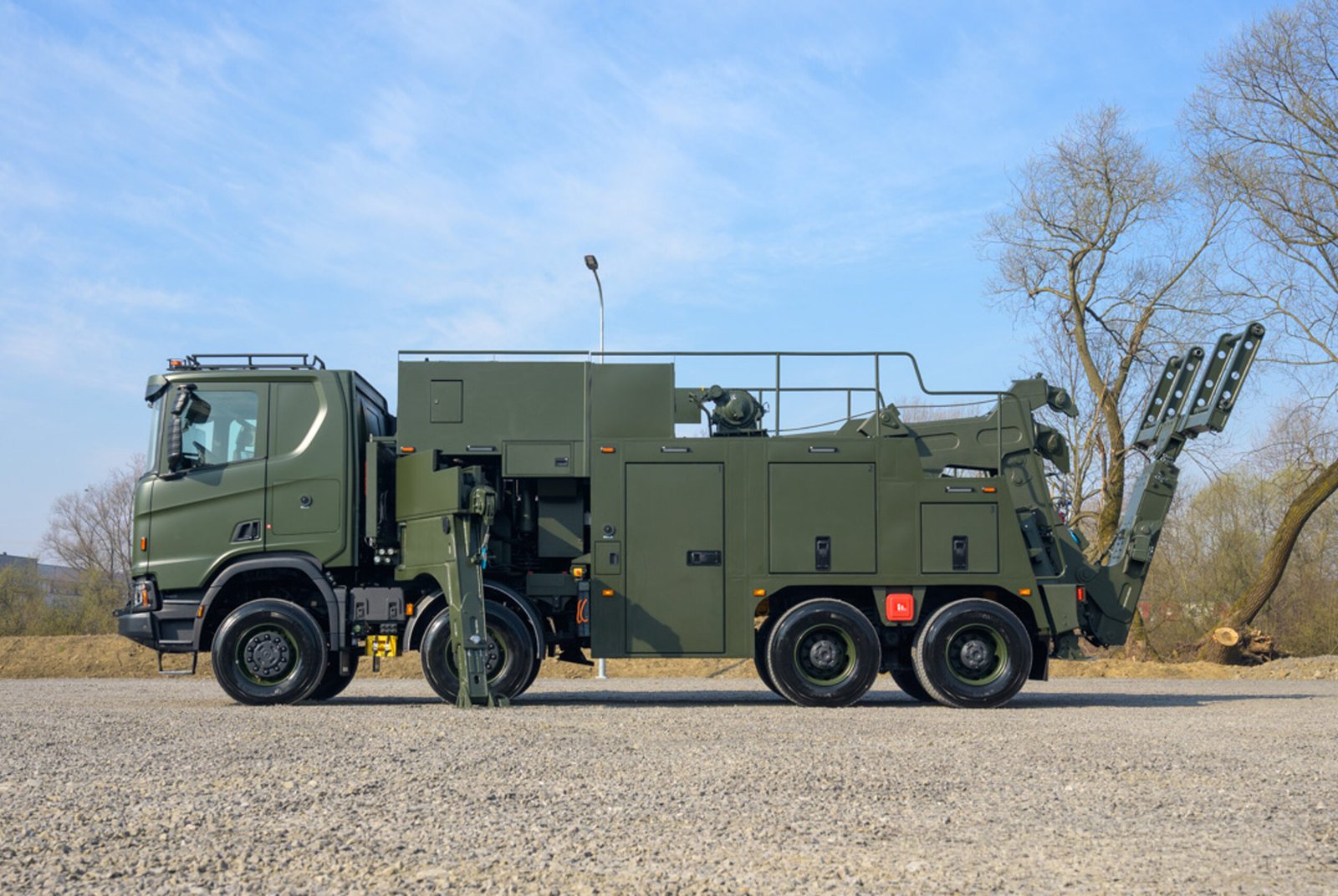
As many as 45 heavy recovery and technical rescue vehicles for the Armed Forces of the Kingdom of Sweden will be delivered by the company “Szczęśniak Pojazdy Specjalne” (Szczęśniak Special Vehicles) from Bielsko-Biała. The heavy recovery vehicle was designed and built by the Polish manufacturer using Polish technology and solutions in response to the expectations of the NATO member state’s Armed Forces. This is one of the few examples of procurement where Sweden has turned to products from manufacturers outside its own country. These vehicles are based on a 4-axle Scania R520 XT 8×8 all-wheel-drive chassis, and the execution of the contract is expected to be completed by the end of 2029.
— This project is an example of cooperation between Polish enterprises in delivering an advanced product to a demanding foreign customer — emphasizes Dariusz Nalepa, Military Projects Director at Szczęśniak Pojazdy Specjalne.
In this project, Szczęśniak is responsible for developing the design, integrating all systems, and building the complete vehicle. The oil hydraulics system, which drives the towing and lifting equipment, was designed and supplied by PONAR Wadowice SA. Their components are responsible for all mechanical elements integrated into the vehicle’s superstructure governing all movement and, consequently, its towing, lifting, and shifting capabilities. This is one of the few cases where Sweden has turned to products from manufacturers outside its own country. These vehicles are based on a 4-axle Scania R520 XT 8×8 all-wheel-drive chassis, and the execution of the contract is expected to be completed by the end of 2029.
Developed in Bielsko-Biała, the recovery and transport vehicle is a modern technical solution designed with reliability, safety, and operational efficiency in mind. The integration of the lifting-and-towing system with the advanced hydraulic system allows for a wide spectrum of operations. The use of high-strength materials, anti-corrosion coatings, electronic safety features, and ergonomic controls guarantees durability, safety, and ease of operation in all terrain and climatic conditions.
— Despite the high equipment requirements set by the customer, we managed to design, build, and conduct operational testing of the heavy recovery vehicle within approximately 12 months, which is a significant achievement — argues Dariusz Nalepa.
— In these vehicles, you will find very few off-the-shelf products; the vast majority were designed and manufactured specifically for them based on research, ideas, and solutions developed by the R&D departments of both cooperating Polish companies — emphasizes Krzysztof Kotorowicz, Key Account Manager at PONAR Wadowice.
— The result of the combined engineering teams’ work is solutions that combine functionality, mobility, and resilience, providing reliable support in the operational activities of technical and rescue services — adds Dariusz Nalepa.
The vehicle’s design, stability, and handling, as well as its operational efficiency in recovering vehicles, were successfully verified by Wojskowy Instytut Techniki Pancernej i Samochodowej (WITPiS – The Military Institute of Armored and Automotive Technology) in Sulejówek.
—It is worth emphasizing that, thanks to being equipped with high-pull winches and towing arms, these military recovery vehicles enable rapid retrieval and transport of heavy equipment, even in difficult terrain and under fire, minimizing the risk of losing valuable assets – said Dariusz Nalepa. Thus, they perform an important defensive function, increasing equipment survivability, the operational continuity of units, and the armed forces’ ability to conduct maneuver operations and regenerate combat capability. — However, it is worth noting that similar vehicles have a very broad spectrum of applications, by no means limited to the armed forces. The prototypes for today’s recovery vehicles are vehicles designed by Szczęśniak for the fire service.
The vehicles developed in Poland can tow military passenger cars, trucks, and buses with their body raised. They can also pull 3- and 4-axle trailers weighing up to 38 tons at speeds of at least 40 km/h. Of course, the primary task of the heavy recovery vehicle is the evacuation (towing) of typical military vehicles, including various types of wheeled and tracked armored personnel carriers.
The closer you get, the more there is
The primary equipment of the recovery vehicle is a towing and lifting device designed for the evacuation and transport of disabled vehicles in a semi-lifted position. This solution allows the vehicle to be picked up by the wheels, axle, or factory recovery points, and safely towed while maintaining control over the loads acting on the towing vehicle. In a short-boom configuration, it is possible to tow vehicles weighing up to approximately 16 tons, and in special circumstances—up to 20 tons. At maximum boom extension, the permissible load is approximately 9 tons.
Another key piece of equipment is an integrated winch system from the Swedish manufacturer Sepson, designed for recovery tasks, self-recovery, and towing equipment in off-road conditions. In this innovative solution, the winches are frame-mounted, transferring forces directly to the chassis support structure, which enables safe operation under high dynamic loads. This system includes: a main high-pull winch designed for continuous operation; cable routing utilizing directional rollers and anchoring points; and the ability to operate in single or multi-pulley configurations depending on the nature of the task, allowing the cable to be paid out in any direction, including forward via the self-recovery winch cable.
Hydraulics Control It All
As in most roadside assistance vehicles, an oil hydraulics system is used here to drive the superstructure components. It is responsible for powering the vehicle’s key operational devices, including the winches, the lifting-and-towing system, and the vehicle stabilization system during operation.
A characteristic feature of the system is the hydraulic cylinders with nitrided piston rods, which offer high resistance to corrosion and wear, as well as high fatigue strength. Furthermore, nitrided piston rods reduce the visibility of these components during operation and improve the overall aesthetics of the superstructure.
The vehicle is equipped with front and rear hydraulically controlled stabilizing outriggers. The outriggers are primarily responsible for stabilizing the vehicle during main winch operations and support the vehicle during operations involving the towing and lifting device. When extended, the outriggers transfer part of the load from the vehicle frame directly to the ground, reducing the risk of vehicle tipping, axle unloading, and frame structure overload.
— The power source of the system is a variable displacement hydraulic pump, which automatically adjusts system output to the current demand of the hydraulic components, reducing energy losses and improving the efficiency of the entire system. To increase reliability, the vehicle has been equipped with an electrohydraulic power pack. This allows for limited operation in the event of chassis failure. Additionally, we decided to equip the recovery vehicle with hydraulic supply and receiving sockets, enabling a second recovery vehicle to act as the power source in case of a breakdown. — Points out Krzysztof Kotorowicz.
Everything Hidden Under the Chassis
The carrier for the heavy recovery and rescue vehicles is an all-wheel-drive 4-axle Scania chassis from the specialized XT series—the R520 B8×8 HZ model, featuring high mobility and payload capacity, with an off-road 4-axle chassis designed for operations in demanding terrain conditions. This model is equipped with a 520 hp engine, an 8×8 drive with differential locks, and reinforced suspension to ensure operational reliability. The design allows for towing vehicles and vehicle combinations weighing up to 70 tons on paved roads, as well as conducting rescue and logistical operations off-road.
— The vehicles manufactured today are not our last word — assures Dariusz Nalepa. —The modular specialized superstructure and multifunctional cabin allow for further development of the design, so we can adapt the vehicle even better and more fully to the changing expectations of users.
It is worth adding that vehicles of this type represent a very valuable reinforcement of the rescue potential of the Armed Forces.
— The cooperation of our enterprises shows what kind of result can be achieved by combining expertise in power hydraulics with the experience of Szczęśniak Pojazdy Specjalne in designing and building technologically advanced special-purpose vehicles for rescue services, the military, or the fire brigade. From the knowledge and cooperation of two teams of engineers and technicians, modern and advanced Polish solutions have emerged, which are significant from the perspective of security and defense —concludes Marek Warzecha, President of the Management Board of Ponar Wadowice.