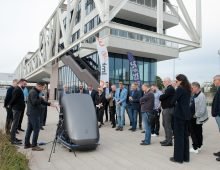
SJSC “Latvijas dzelzceļš” will be the first railway company in the Baltics to use a private 5G network technology provided by the LMT Group. The network is operating in test mode to prepare for the future FRMCS (Future Railways Mobile Communication System) technology implementation, which all railway companies must carry out by 2035 in accordance with European Union requirements. The demonstration of the private 5G network technology on June 30 was an opportunity to measure connection speed, network coverage, and signal strength to provide a basis for the next stages of development.
Private 5G networks give companies access to a fully isolated, highly secure and powerful communications infrastructure that is needed for real-time exchange of large volumes of data, sensor operations, automated machinery and robotic solutions at a level that standard Wi-Fi or public mobile networks cannot provide.
Unlike a public network, a private 5G network gives the company full control over communications capacity and ensures immediate, low-latency data processing even in the most complex conditions. Key benefits include the ability to control unmanned equipment and smart sensors in real time. The network operates autonomously and is protected from external interference or overloads, while precise data accounting makes it possible to optimise energy consumption and respond quickly to changes in infrastructure.
“Without security, mobility and connection stability, it is difficult to imagine modern development of both private and public sectors. The private 5G network ecosystem developed by the LMT Group is expanding rapidly in Latvia: the first projects were implemented in the security and port logistics sectors, while the current focus is on strengthening the competitiveness of companies in manufacturing, logistics, woodworking and agriculture. Private 5G in railway transport is a new experience that will allow us to further expand and improve the potential of this technology in the work of transport operators,” says Ingmārs Pūķis, Vice President of the LMT Group.
The test measurements of the private 5G network technology are currently being carried out on the Riga-Olaine “Vivi” passenger train route. The latest 5G technologies in railway transport make it possible not only to hold voice communications between the dispatcher, train driver and station staff, but also to send text messages, photos and video files. This enables infrastructure inspections to be carried out quickly and efficiently, and allows relevant parties to be informed in good time about changes in railway infrastructure caused by weather conditions or repair works.
“Testing private 5G network technologies makes it possible to practically assess the capabilities of the latest-generation communications technologies in railway infrastructure management. These solutions open up broader opportunities for faster data exchange, remote infrastructure monitoring and the use of new digital tools in the day-to-day operation of the railway. As we prepare for the introduction of FRMCS as the next European railway communications standard, we are proactively evaluating solutions that could help us use smart sensors, automation and data transmission capabilities even more effectively in the future. This is part of “Latvijas dzelzceļš” targeted infrastructure development, strengthening the role of rail in a modern, sustainable and digitally advanced European transport system,” says Artis Grinbergs, Chairman of the Management Board of “Latvijas dzelzceļš”.
“We see that the development of private 5G networks in railway infrastructure will help improve the passenger experience. These technologies can help us ensure even more precise train operations, better availability of real-time information and more convenient travel within the wider public transport system. We are already among the most punctual passenger carriers in Europe, and these technologies will help us maintain and develop this high level of quality. A private 5G network will allow us to exchange data with the infrastructure manager much more efficiently, make decisions faster and further improve the accuracy of train movements. It will also open up broader opportunities to synchronise train services with other forms of public transport, providing more convenient connections and more accurate real-time information for passengers,” says Raitis Nešpors, Chairman of the Management Board of “Vivi”.