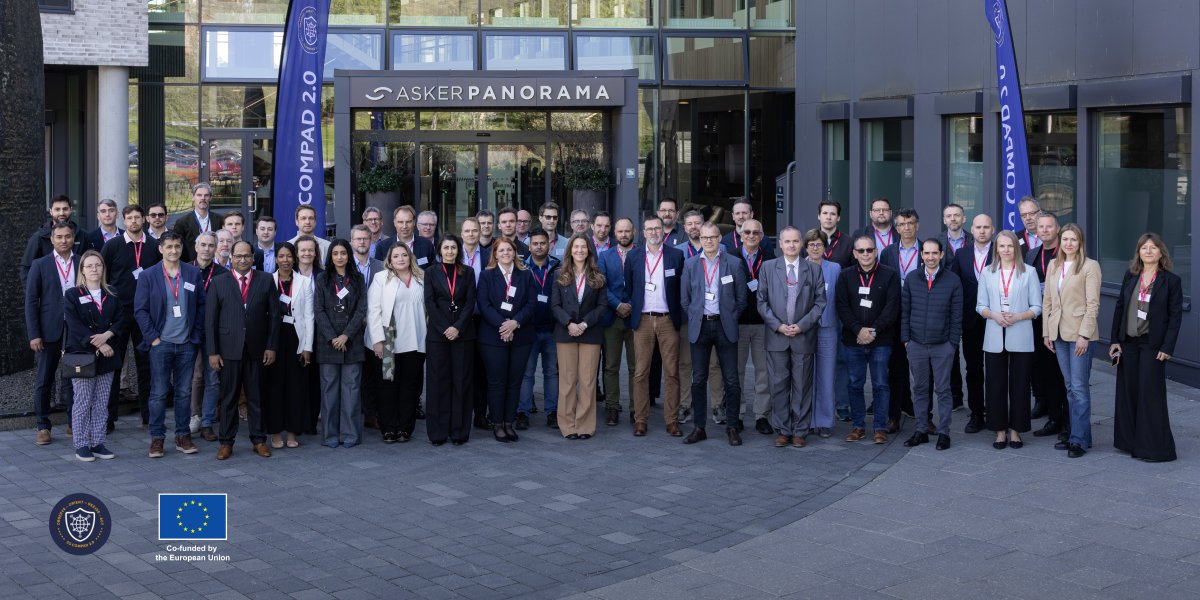
The European Defence Fund project 5G Communications for Peacekeeping and Defence 2.0, known as 5G COMPAD 2.0, completed its first intermediate demonstration session on May 19, 2026, in Asker, Norway. Hosted by Kongsberg, the event brought together consortium partners, industry stakeholders, and representatives from Ministries of Defence to showcase emerging 5G-enabled capabilities for defence operations, with particular emphasis on contributions from new consortium members.
5G COMPAD 2.0 is the second phase of the 5G Communications for Peacekeeping and Defence programme. The first phase demonstrated that civilian 5G technology could become a necessary component in existing military radio systems and showed how it could be integrated with military communications. The second phase moves the programme from proof of concept toward deployable systems that can support real field operations across land, sea, air, and space.
“With 5G COMPAD 2.0, we are building on three years of progress from the initial phase and advancing 5G capabilities for defence applications. Even at this early stage, we organise demonstrations every six months to gather direct feedback from supporting governments. This allows us to continuously refine our approach. 5G COMPAD 2.0 aims to deliver high-speed communication solutions and related services to the women and men who defend Europe. Strong collaboration between highly skilled European partners remains essential to address interoperability challenges and strengthen Europe’s overall capabilities.” – Bjorn Gyllenberg, SAAB, 5G COMPAD 2.0 Project coordinator.
The demonstration focused on capabilities that can help European defence forces improve situational awareness, strengthen resilience, and accelerate interoperability across domains. Four demonstrations were presented by Kongsberg and Nokia, Telefónica, Space Hellas, and Ericsson:
- Kongsberg and Nokia demonstrated network-as-a-sensor capabilities, collecting data from three different wireless components and showing how deployable 5G solutions can support current field operations.
- Telefónica presented a demonstration of multidomain interoperability, using Combat Cloud and Critical Mission capabilities over multidomain and public 5G network technology.
- Space Hellas demonstrated monitoring of a 5G core using both rule-based and anomaly detection techniques, integrated with a SIEM system to send real-time metrics and logs, detect abnormal or malicious behaviour, and visualise potential cyber and radio-frequency threats such as jamming and spoofing.
- Ericsson demonstrated 5G sensing capabilities for detecting aerial objects.
Together, the demonstrations highlighted the role of 5G in enabling anomaly detection, multidomain interoperability, deployable communications, network sensing, and cyber-resilient operations. These capabilities are central to the project’s broader technical focus areas, which include network-as-a-sensor functions, precise positioning without reliance on GPS, automatic network setup, non-terrestrial network connectivity, and dynamic spectrum sharing.
“5G cannot exist in isolation at the front line. One purpose of Demo 1 is to show interaction between 5G equipment, tactical routing, crypto and tactical radios for communications and sensing in heterogeneous systems.” – Gaute Haga Andersen, Kongsberg Defence Communication, Director Product Management.
The session in Asker marked the start of the project’s demonstration phase. It was the first of six planned demonstrations, consisting of five intermediate sessions and one final large-scale demonstration. This agile approach, in contrast to the Waterfall methodology typical to EDF projects, reflects the need to accelerate technology development at a time when operational requirements are evolving rapidly. Frequent demonstrations and fast feedback from project stakeholders are intended to support quicker iteration and ensure that the technologies being developed are suited to real-world defence conditions. The second demonstration is scheduled for November 2026.
5G COMPAD 2.0 runs from 2025 to 2028 and is supported by EUR 38,322,662.92 in funding from the European Defence Fund. The consortium is led by Saab and brings together 18 participants and three subcontractors across 13 countries, combining expertise in defence systems, telecommunications, cybersecurity, sensing, satellite connectivity, and operational integration.
Project: 101218568 — 5G COMPAD 2.0 — EDF-2024-DA