By Vadzim Smatrayeu, VP Fintech Services at IBA Group.
For decades, card acquiring was inseparably linked to specialized hardware. Accepting card payments meant purchasing certified POS terminals and managing logistics, installation, configuration, and maintenance. While this model worked well for traditional retail, it offered limited flexibility for fast-growing or highly dynamic business segments.
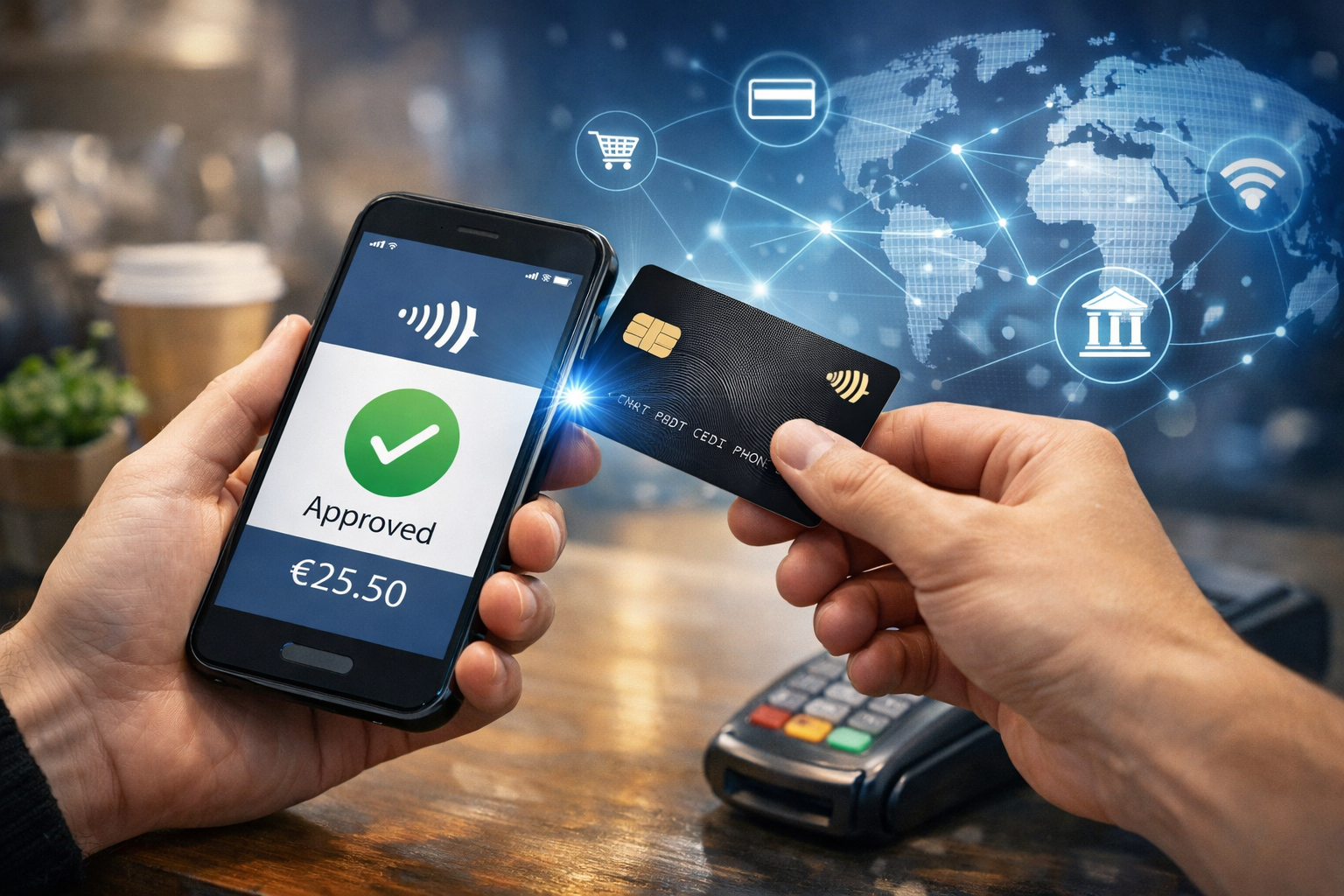
Tap-to-phone technology, also known as SoftPOS or Phone POS, emerged as a direct response to market and business demands.
From market maturity to new growth scenarios
In the European market, contactless payments became ubiquitous in stores, hypermarkets, and fuel stations, leaving banks and payment providers searching for new growth points.
Attention gradually shifted toward segments where traditional POS infrastructure was either too expensive or too slow to deploy: micro-merchants, market traders, couriers, seasonal businesses, pop-up locations, and tourism-driven regions. These are niches where dynamics are needed. There should be a fairly inexpensive, light, fast entrance. To buy a terminal, to get it, to wait for the logistics, to configure it, and then to take it somewhere – all this is too time- and resource-consuming.
In these environments, the ability to quickly roll out and just as quickly scale down payment infrastructure became critical.
As Vadzim Smatrayeu, VP Fintech Services at IBA Group, explains:
- Any business always faces the same question: where to find the next growth point. SoftPOS appeared exactly in those niches where traditional acquiring could not scale efficiently.
Tap-to-phone made it possible to add payment acceptance where it had never existed before, using devices that merchants already owned.
IBA Group’s journey toward tap-to-phone
IBA Group has been developing payment acceptance systems since around 2010. Over the years, the company built extensive expertise in acquiring and launching mPOS solutions that combined smartphones with external card readers. While these systems reduced costs and improved mobility, they still depended on additional hardware.
The widespread adoption of NFC changed the equation. Accepting payments directly on smartphones became a logical next step, but the industry was not immediately ready. NFC-enabled devices were not yet universal, and security models remained heavily hardware-centric.
The turning point came when payment systems began introducing standards enabling tap-to-phone solutions. During industry discussions, banks started asking whether such solutions could be launched quickly at the regional level.
- By that time, we already had mature EMV kernels and deep expertise in payment acceptance, Vadzim says. We adapted our existing systems to a fully mobile environment and launched the first pilot projects within months.
The first commercial deployments followed shortly afterward, requiring nothing more than an Android smartphone. This is how our own SoftPOS solution tapXphone, came to life. To date, it functions in more than 20 countries.
Why was tap-to-phone considered disruptive
Tap-to-phone challenged a long-standing industry assumption: that payment acceptance must rely on dedicated, certified hardware. Instead, it proposed using consumer devices as full-fledged payment terminals.
This shift raised two major concerns. First, how would customers perceive paying by tapping a card to a phone rather than a terminal? Second, how could the same level of security be guaranteed in an open mobile environment?
Security became the defining challenge of the technology’s early stages, particularly for higher-value transactions requiring PIN verification.
Security and standards at the core
From a transaction perspective, SoftPOS and traditional POS terminals are identical: both rely on EMV standards and follow the same authorization flows. The difference lies in how security is achieved.
Traditional terminals depend on hardware security modules. SoftPOS solutions operate in non-trusted environments, such as Android, where security must be enforced entirely through software. This requires continuous device monitoring, environment integrity checks, encrypted data handling, and secure PIN-on-Glass implementation.
“In SoftPOS, you take an initially untrusted environment and build a trusted space inside it. That is the fundamental difference compared to classic terminals,” Vadzim explains.
To standardize these requirements, the industry introduced the PCI MPOC (Mobile Payments on COTS devices) standard, which now underpins tap-to-phone implementations globally.
Android as the starting platform
Tap-to-phone solutions initially focused on Android due to its more open architecture and flexibility in accessing NFC and system-level functionality. Apple’s platform follows a different security philosophy, relying heavily on hardware-based secure elements, which limits third-party payment acceptance scenarios.
“The advantages are that on Apple devices, due to the control of the entire ecosystem of one company, there is a greater level of security. Android, on the contrary, is more open, and accordingly, there is more threat,” the expert says.
Development challenges and integration
Developing SoftPOS posed unique challenges. Being a pioneer meant dealing with uncertainty: requirements were not fully regulated, threats were evolving, and cybersecurity was a constant concern.
“Software gives flexibility and speed, but it is much easier to break than hardware,” Vadzim notes. “You have to build a culture of secure mobile application development, constantly monitor trends, identify vulnerabilities, and react in time.”
Integration with banking systems, however, was relatively straightforward. SoftPOS preserves the user experience of card payments. Existing processes, such as mPOS or classic terminals, could be adapted with minor adjustments. From idea to first commercial pilot launch took approximately two months.
Market position and competitive advantage
Globally, tap-to-phone solutions exist, but most tend to deliver similar functionality. IBA Group’s competitive advantages lie in security, speed, flexibility, and integration capability. Developing everything in-house allows control over algorithms and processes, ensuring both safety and fast transaction execution.
tapXphone can handle multiple payment types, integrate with fiscal modules, and scale to high volumes. More than 250,000 terminals are currently active, maintaining high SLA standards.
Market outlook
SoftPOS is positioned to complement existing infrastructure, enabling fast, low-cost payment acceptance in scenarios where hardware terminals are impractical.
For many markets, SoftPOS represents the first entry point into cashless payments for previously underserved segments. Smartphones enable both personal and merchant use, thereby expanding the reach of acquiring services.
As the expert summarizes, “Payment acceptance has stopped being a device. It has become software.”