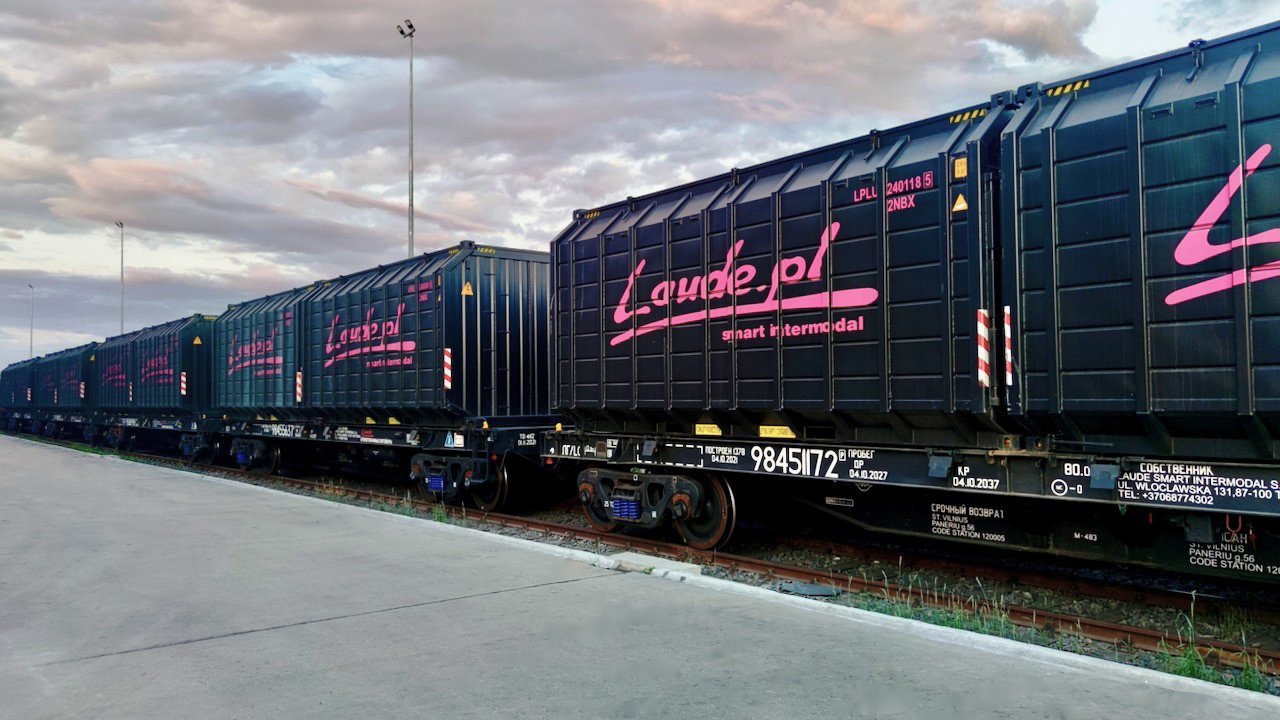
After years of Polish road hauliers dominating European markets, the time may have come for Polish rail companies to play an increasingly strong role in European logistics as well. We talk about the opportunities and challenges of today’s rail market with Marcin Witczak, President of the Management Board of Laude Smart Intermodal.
Can Polish rail companies make a stronger entry into the European freight market and, over time, play a role comparable to that of road transport firms? Which transport directions in Europe are the most promising? Where do we see bottlenecks?
Absolutely, yes. The European Union still allows several countries to effectively restrict market entry. That does not serve the markets, and the customer pays for it by buying a more expensive, lower-quality service. I am referring to Belgium and France, among others. For Poland to become a leader, it should have financial support from institutions such as PFR, BGK or ARP to fund the outlays needed to enter foreign markets. I am not only thinking of acquisitions. I also mean the purchase of rolling stock, licence fees and investment in our own terminals abroad.
For Laude Smart Intermodal, being a leader means above all delivering the most innovative solutions. Meeting that challenge requires enormous outlays. In rail, nothing can be done “at half the cost”. Every investment here means really big money, and the vast majority of rail companies cannot generate such funds on their own.
To sum up: as a country and as a logistics sector, we have the necessary potential, technical capacity and infrastructure in Poland. But to make a stronger push onto European rail routes, we need solid capital backing. And we are not talking about hundreds of millions here, but billions of zlotys. I am convinced, however, that this money would be sensibly invested.
In a word, can Europe’s railway lines take on more freight in the coming years?
Definitely. Rail infrastructure in the European Union is ready for it. As it is renovated and expanded, it will cope with more trains and more cargo. What is missing, both in Poland and in Europe, is the ability to run longer trains on a much larger number of routes. I mean trains at least 750 metres long.
Before we charge onto European routes, we have to deal with a potential threat hanging over our railways from “stray Russian drones”. We are talking about terminal security. Is Laude planning or considering protection of its Zamość terminal against such drones?
That in turn raises the question of whether we, as carriers, can protect ourselves against threats during transport in the border zone. That is the first point. Going a step further: are we considering using drones ourselves to counter threats to our terminals?
So let us start at the beginning, with our terminal in Zamość. The Laude terminal is located in a closed zone that is already protected today by the authorities appointed for that purpose. State services are responsible for protecting critical facilities, and they have the right tools, training and knowledge. The private sector has no access to weapons or military technology and no way of buying them. In any case, I am not sure that allowing companies to take independent action involving weapons would be the most sensible solution.
I would like to stress that drones should already be patrolling rail routes today, just as they patrol critical infrastructure.
A question has come up in public debate: since the Russians are systematically destroying Ukrainian rolling stock, mainly locomotives, can Poland help Ukraine in some way? Are there equipment reserves that could be handed over or sold to Ukraine?
Realistically, there are no such reserves. What I can see is handing over the entire LHS rolling stock fleet and quickly replacing it with new stock. LHS is preparing to renew its fleet anyway, but I don’t think it planned to transfer its existing stock to Ukraine. That is why the whole process is moving rather slowly. Still, I think nothing prevents us from looking at this strategically and deciding to hand over the broad-gauge locomotives and wagons we have to our Ukrainian partners. On our side, we would need to shorten, as far as possible, the approval procedures, for example for diesel locomotives on the only broad-gauge line in use in Poland.
Of course, supporting our eastern neighbours with locomotives would be crucial. It is a realistic solution, but we are talking about a minimum of two years to implement it. With political will, though, that period could probably be shortened very considerably. This matters because, to my knowledge, Poland does not have even a dozen or so broad-gauge locomotives, let alone several dozen, set aside in deep reserve. Nor do I really see any possibility of buying them on the open market.
I see sense in joint action on this by Poland and the Baltic states, including Finland. They are in a better position because they still run on broad gauge, so they have the right facilities. Such action, supported by simpler procedures and shorter testing periods, would be a step towards real help for Ukraine. Cooperation with these countries would also strengthen the resilience of the whole region to potential disruptions. This is a war, and we have to think outside the box. I encourage exactly this approach; otherwise we stand no chance. The purchase of new equipment could be subsidised from the Solidarity Corridor programme.
Finally, let us not forget that we all hope and expect that one day not only our wagons and containers, but also our locomotives and entire trains will run into Ukraine. So we too will need locomotives adapted to broad gauge.