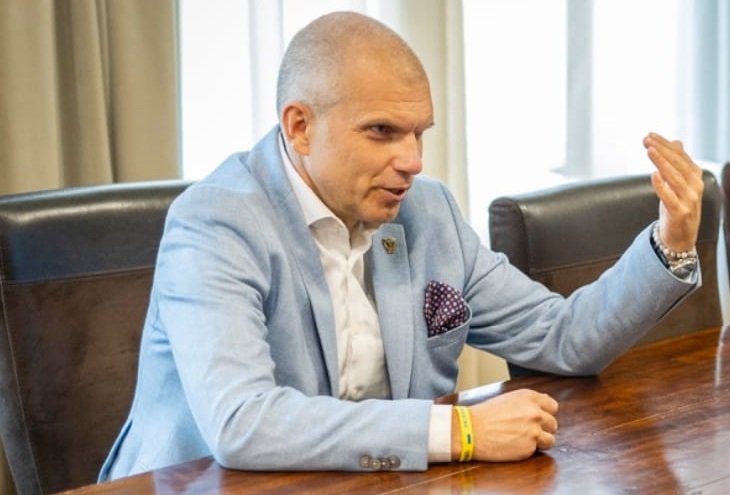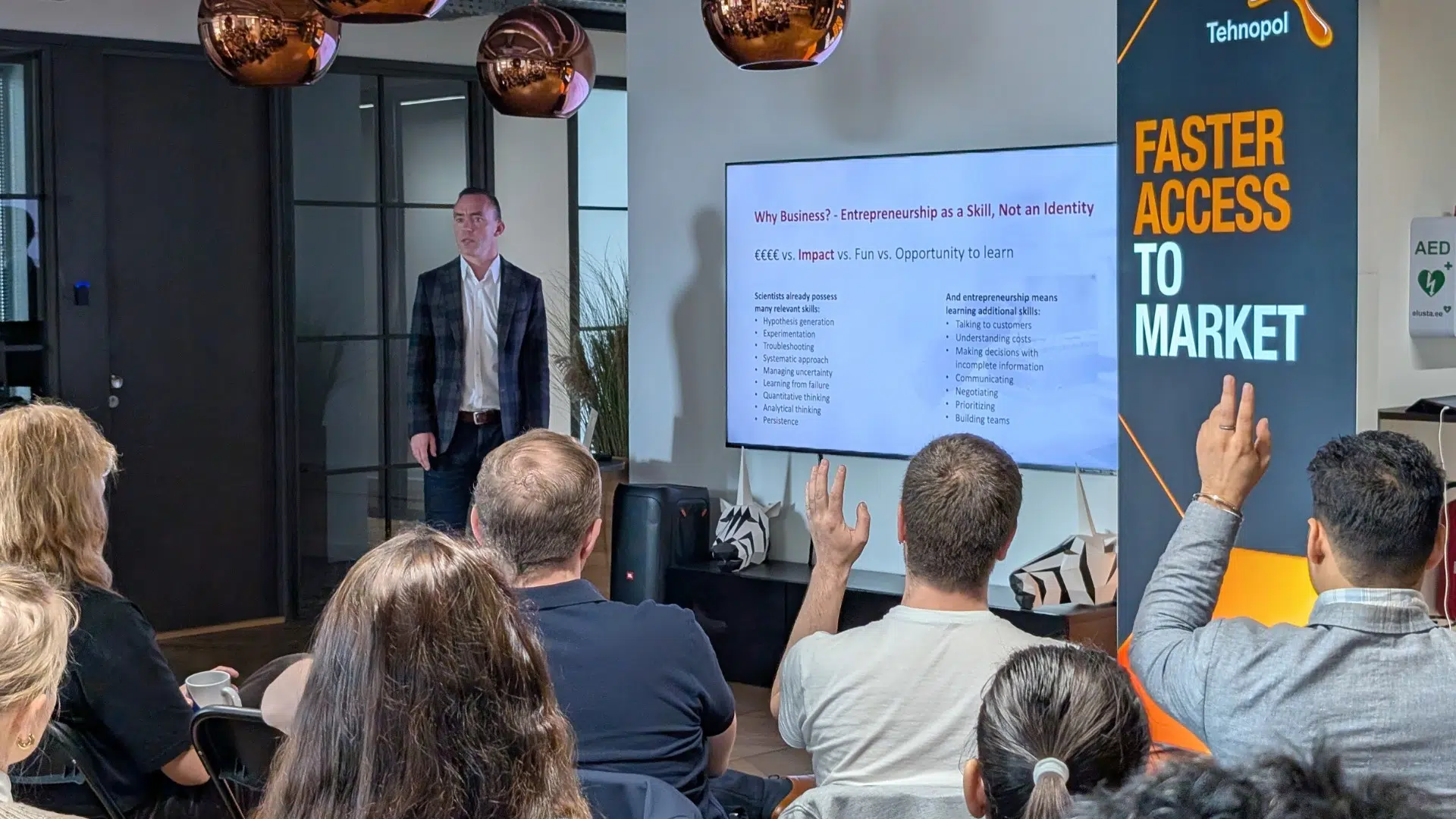
Turning a scientific discovery into a successful business requires more than innovative technology. Researchers must learn to identify real-world problems, work with experts from different fields and understand what it takes to bring a product to market. At Tehnopol’s DeepTech Coffee Morning on 8 October, Tanel Mahlakõiv, Director of Translational Research at Icosagen Cell Factory, shared practical lessons from his career in science and biotechnology.
Having studied and worked in Estonia, France, Germany and the United States, Mahlakõiv has experienced both academic research and the commercial biotechnology sector. His career has taken him from genetics and virology to immunology and personalised cancer treatments, with one central question guiding his work: how can scientific knowledge make a meaningful difference beyond the laboratory?
Start with the problem, not the technology
One of the key differences between science and business lies in the questions they ask. Scientists seek to understand how something works, discover new knowledge and demonstrate results. Businesses, however, must determine whether that knowledge solves a meaningful problem and whether the solution can be delivered reliably and economically.
According to Mahlakõiv, researchers often begin with an interesting discovery and then look for potential applications. In business, the process should frequently work in the opposite direction: first identify an important problem, then determine what a successful solution would need to look like.
A technology may be scientifically impressive without having a viable commercial application. For example, a promising drug candidate might prove impossible to manufacture at scale, face regulatory obstacles or lack a sufficiently large market.
This is why commercial potential, customer needs and practical feasibility should be considered from the beginning rather than after years of development.
Scientists already have valuable business skills
Moving from academia into entrepreneurship does not mean abandoning scientific thinking. Researchers already possess many skills that are valuable in business, including analytical thinking, systematic problem-solving, experimentation, managing uncertainty and learning from failure.
Mahlakõiv’s own career demonstrates how knowledge can be transferred between disciplines. Experience gained in virology and immunology has proved valuable in his current work on cancer treatments. Similarly, collaboration with experts from other scientific fields has allowed him to apply technologies in new contexts and make discoveries that would otherwise have been difficult to achieve.
However, researchers entering business must also develop additional skills, including understanding costs, communicating with customers, negotiating and making decisions with incomplete information.
Mahlakõiv encouraged scientists to view entrepreneurship as a skill that can be learned, rather than an identity they must adopt. Commercialising research does not necessarily mean prioritising profit over science. It can also be motivated by the desire to create meaningful impact, develop new solutions and contribute to society.
Equally important is recognising that no founder needs to know everything. Deeptech companies require multidisciplinary teams bringing together scientists, engineers, regulatory specialists, intellectual property experts and business development professionals.
Particularly in deeptech, where specialised equipment and infrastructure can require substantial investment, collaboration with universities, research institutions and established companies can help startups access the resources they need.
Personalised cancer therapy demonstrates the journey from research to impact
To illustrate how scientific knowledge becomes a practical solution, Mahlakõiv introduced a project currently underway at Icosagen Cell Factory: developing the capability to manufacture personalised CAR-T cell therapy in Estonia.
CAR-T cell therapy uses a patient’s own immune cells, which are genetically modified to recognise and attack specific cancer cells. The treatment has shown significant potential for patients with certain blood cancers, including leukaemia and lymphoma.
However, access to commercial CAR-T therapies in Estonia has been limited by the country’s small market, high treatment costs and lack of local manufacturing infrastructure.
To address this problem, Icosagen Cell Factory joined forces with Tartu University Hospital and North Estonia Medical Centre. Their initial objective is to establish local manufacturing capabilities for CD19 CAR-T cell therapy for approximately 20 patients per year.
The project follows a clear commercialisation logic: problem > solution > evidence > product > customer > impact.
While the scientific evidence supporting CAR-T therapy already existed, making the treatment available locally required considerably more than scientific expertise. The partners needed to establish manufacturing facilities, develop and validate production processes, introduce quality control systems, train personnel and address regulatory requirements.
After approximately two years of development, the team completed three manufacturing process validation runs during summer 2026. At the time of the presentation, the project was progressing through the necessary regulatory approval procedures.
The experience illustrates that scientific discovery is only a small part of bringing an innovation to market. Much of the work lies in transforming that discovery into a reliable, safe and economically viable product.
Importantly, the project is also establishing infrastructure and expertise that could support future personalised cancer treatments. By building a technological platform rather than focusing solely on one product, the team is creating opportunities to develop therapies targeting other types of cancer.
Understand the obstacles and know when to stop
Mahlakõiv also highlighted two challenges that researchers can underestimate when commercialising their ideas: regulation and intellectual property.
Drawing on his own experience with a startup concept involving the preservation of an individual’s healthy gut microbiome, he explained how regulatory requirements can make an otherwise promising idea commercially difficult to pursue.
Conversely, Estonian healthtech company Better Medicine provides an example of navigating regulatory challenges successfully. The company has developed AI-powered software supporting radiologists in detecting and assessing kidney tumours, demonstrating the importance of bringing innovative technology into compliance with medical device requirements.
Another essential business skill is knowing when to stop. While scientists often respond to unexpected results by designing further experiments, businesses must consider the resources required and the likelihood of commercial success.
Mahlakõiv recommended approaching development through a structured process: hypothesis > experiment > evidence > decision. Before committing significant resources, teams should define not only what success looks like, but also what results would justify abandoning or changing their approach.
This does not mean avoiding failure. Rather, it means learning from experiments early enough to make informed decisions before investing further time and money.
Turning knowledge into solutions
Mahlakõiv’s central message was that scientists can become successful entrepreneurs without giving up their scientific identity. However, turning research into real-world impact requires a broader perspective.
Customer needs, intellectual property, manufacturing capabilities, regulations, financing and market potential should all be considered early in the development process. These are not isolated steps to be addressed one after another, but interconnected questions that influence whether an innovation can ultimately succeed.
Scientific discoveries create opportunities. Turning them into solutions that people can actually use requires the right expertise, effective collaboration and a willingness to approach research from a business perspective.
The DeepTech Coffee Morning also introduced the DeepTech Accelerator, delivered by Tehnopol and Sparkup Tartu Science Park. The 18-month accelerator supports science-based startups and research teams in developing their technologies, validating business models, finding customers and preparing for investment. Selected teams can receive up to €170,000 in business development support.
Applications for the second round are open until 8 November. Learn more about the DeepTech Accelerator and apply here.
Source: tehnopol.ee