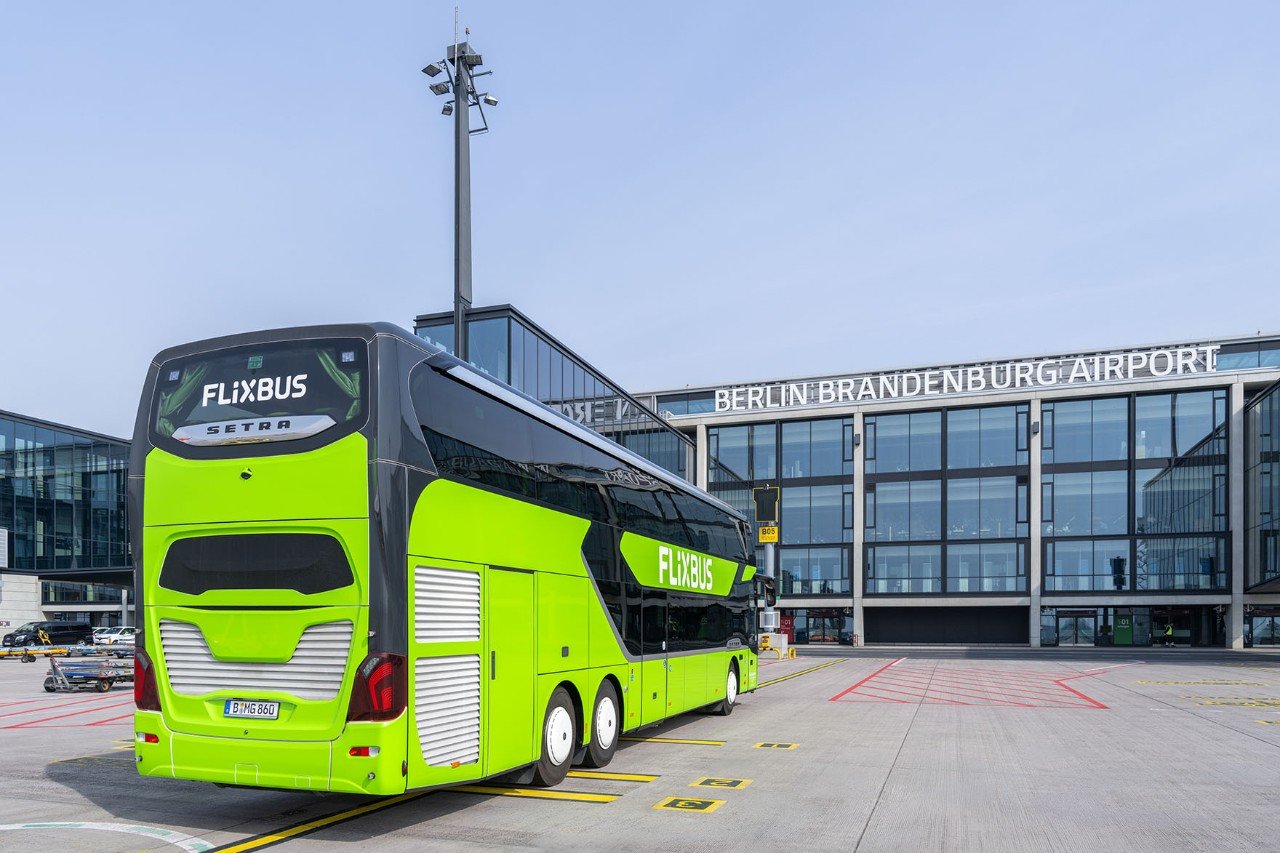
Berlin Brandenburg Airport (BER) will become even more accessible for many travellers from Eastern Germany this year: FlixBus is significantly expanding its services at BER. New direct services and more frequent departures offer greater flexibility for journeys to and from destinations. This benefits not only larger cities such as Leipzig, Jena and Schwerin, but also smaller and medium-sized towns, as well as regions that to date have been less well connected. FlixBus also offers a wide range of services for travellers from Poland.
Changes for Eastern Germany at a glance:
- Leipzig: FlixBus is expanding its service, up to nine daily journeys in each direction, up from the previous four. The fastest journeys take just over two hours.
- Schwerin, Jena and Chemnitz: Additional services bring both cities closer to BER.
- Görlitz and Zittau: Both towns will be connected to BER.
- Ore Mountains: Oberwiesenthal and Annaberg-Buchholz are set to receive a daily, direct service to BER for the first time.
- Baltic Sea coast: In July and August, a new seasonal service will run directly from BER to the holiday destinations of Warnemünde, BadDoberan and Kühlungsborn.
An extensive range of FlixBus services connects Poland and BER:
- Poznań: Travellers from the western Polish city can reach BER with up to 15 daily services in each direction; the journey time averages 3 hours and 20 minutes.
- Wrocław: Up to 13 daily services in each direction connect Poland’s third-largest city and BER, with journeys averaging about four hours.
- Szczecin: This major city on the German-Polish border is on average, about a 2.5 hour journey from BER. FlixBus offers up to 12 daily services in each direction.
“BER is Germany’s third-largest airport, the main airport for eastern Germany, and should be as accessible as possible for travellers. The fact that FlixBus is expanding its services so significantly will benefit many people in Eastern Germany, not just those in the major cities,” emphasises Aletta von Massenbach, Chief Executive Officer of Flughafen Berlin Brandenburg GmbH. “At BER, FlixBus passengers can walk to our two terminals in just a few minutes. There, they can expect state-of-the-art technology to ensure a stress-free departure, a wide range of dining and shopping options, as well as connections with some 80 airlines to 155 destinations in Europe and the world.”
“Airports are becoming increasingly important to FlixBus’s growth, from a strategic perspective. The high demand at BER Airport shows just how important direct long-distance bus services are for travellers from the wider catchment area,” says Daniel Packenius, Managing Director of FlixBus Central Europe. “In conjunction with BER Airport, we are working to further expand our services with specific targets – particularly in regions that to date have had little access to long-haul connections.”
BER is the largest airport hub in the German FlixBus network
In 2025, BER was among the ten busiest stops in the German FlixBus network in terms of passenger numbers, rendering it the most popular German airport among FlixBus travellers. During the peak season this year, up to 155 buses will stop at BER every day. This means that about 90 German and 60 Polish cities will be connected to BER directly, without the need to change trains.
This year’s service expansion has been made possible, not least, by the close partnership between FlixBus and Flughafen Berlin Brandenburg GmbH (FBB), which was established in June 2025. It is aimed at creating a long-distance bus service that is precisely tailored to the needs of passengers travelling to BER.
The airport operator provides FlixBus with passenger figures, anonymised data about passengers’ origins and current, and scheduled flight times for this purpose. FlixBus uses such data to tailor its services to passengers’ needs, and optimises its timetables accordingly. Booking options have also been expanded: FlixBus tickets can now be booked directly via the BER website.
About Flix
Flix is committed to transforming long-distance public transport by way of sustainable and affordable long-distance bus and train journeys, and operates in more than 40 countries spanning five continents. Flix’s brand portfolio includes FlixBus, FlixTrain, Kamil Koç and Greyhound. Since its foundation in 2013, Flix has rapidly established itself as a market leader in long-distance bus travel across Europe, North America and Türkiye, thanks to its asset-light business model and innovative technology platform, and has continued to expand into South America and the Asia-Pacific region.
Driven by growing awareness of sustainable travel, Flix has joined the Science Based Targets Initiative (SBTi), which provides a science-based framework for decarbonisation. In April 2024, the SBTi validated Flix’s short-term emissions reduction targets, thereby confirming that the company’s strategy is aligned with global climate goals.
Flix oversees the commercial side of the business, including network planning, pricing and operational control, marketing and sales, quality management and ongoing product development, using a data-driven approach. Day-to-day operations are handled by trusted Flix partners. This innovative combination of Flix’s technology and sales platform with traditional passenger transport has turned the European start-up into a leading travel tech company expanding globally.