By Balticnews.com.
Final Eurostat data for October show prices rising ten times faster in Lithuania than in Sweden. The cause is shared — the war in the Middle East — but tax choices, energy mixes and government relief help explain why households and businesses across the region now face very different costs.
Inflation in the euro area reached 4.0% in October, the highest since September 2023, according to final Eurostat figures published on 18 November. Behind the average lies a widening split across the Baltic Sea region. In Lithuania, consumer prices rose 6.1% on a year earlier, the second-highest rate in the EU after Romania. In Sweden, they rose just 0.6%, the lowest in the bloc. Germany, Estonia, Latvia, Finland, Denmark, Poland and Norway sit in between.
For companies that buy, sell and hire across these markets, the gap is no longer a statistical curiosity. It shapes wage talks, pricing, borrowing costs and the political pressure on governments heading into winter.
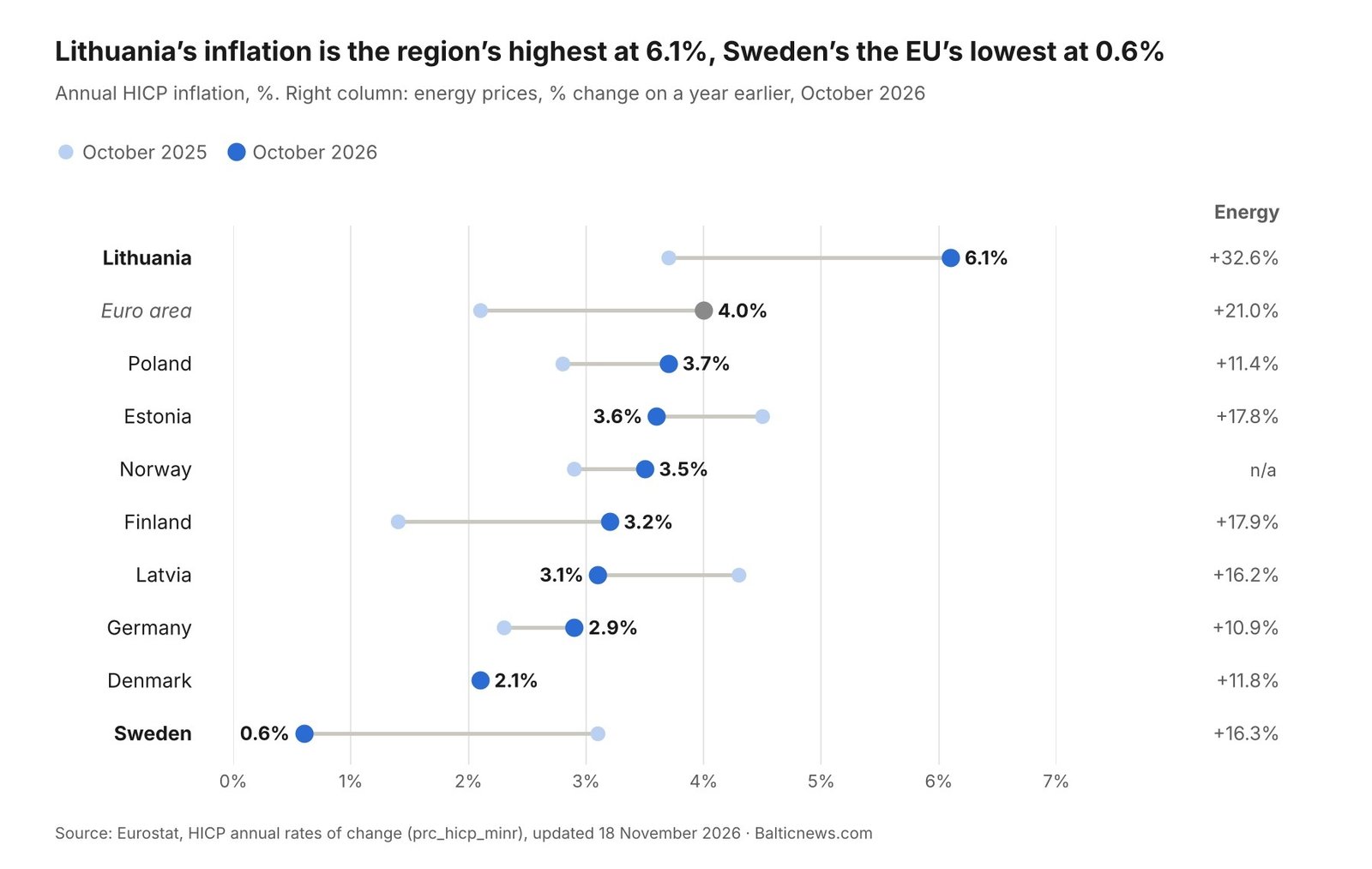
Chart: Annual HICP inflation in selected Baltic Sea region countries, October 2025 vs October 2026, and energy price inflation, October 2026. Denmark’s rate was 2.1% in both years, so the two points overlap. Euro area: 20 countries in October 2025, 21 in October 2026. Energy figure for Norway not available. Source: Eurostat.
The shock everyone shares
The trigger is the same everywhere. Fuel prices jumped after the US-Israeli war against Iran began at the end of February, and the closure of the Strait of Hormuz pushed global energy prices higher. By 20 August, Europe’s benchmark Dutch TTF gas futures were more than 130% above their level at the start of the year. In October, energy prices in the euro area were 21.0% higher than a year earlier.
ECB President Christine Lagarde attributes the latest rise to the Middle East conflict and reduced global refinery capacity. Core inflation, which strips out energy, food, alcohol and tobacco, edged up to 2.6% from 2.5% in September, and the ECB says it does not yet see second-round effects on wages.
Why the same shock lands differently
The ECB itself has noted that this shock is smaller than the 2021–22 energy crisis, and that differences in renewable generation between countries can make its impact uneven. October’s data bear that out — but national policy choices also shape how the shock reaches consumers.
Lithuania faces the steepest rise: energy prices there were up 32.6% year on year, against 21.0% across the euro area. Part of the reason is homegrown. Lithuania’s parliament abolished the reduced 9% VAT rate on district heating, hot water and firewood, a change that by itself adds about 11% to heating bills from January at unchanged pre-tax prices.
Germany sits at the other end, with energy inflation of 10.9%, the lowest in the group. Berlin cut fuel taxes again from 1 October until the end of 2026, a relief equivalent to about €0.17 a litre including VAT, at a cost of around €2.5 billion. Economy Minister Katherina Reiche has conceded the rebate is not an ideal solution, and social groups criticise it for also helping those who do not need support.
Sweden shows how far policy can offset the shock. Swedish energy prices rose 16.3%, yet headline inflation fell to 0.6%. The government cut petrol and diesel taxes to the EU minimum from May to September and expanded electricity support. Its own forecast credits low core inflation and temporary tax cuts for keeping price pressure down. A VAT cut on food from April has also helped: Statistics Sweden recorded lower food prices than a year earlier in October, while energy pushed prices up. Finance Minister Elisabeth Svantesson has called it “the worst global energy crisis we have seen.”
Estonia and Latvia are the surprise. Both now have lower inflation (3.6% and 3.1%) than a year ago (4.5% and 4.3%), despite energy prices up around 17%. In Estonia, last year’s tax increases inflated the 2025 base: Eesti Pank noted in May that the VAT rise would push inflation up only until July, and that at constant tax rates Estonian inflation had been among the lowest in the euro area.
Finland and Poland have moved up. Finnish inflation more than doubled over the year, to 3.2%. Poland’s harmonised rate rose to 3.7% from 2.8%, even after Warsaw capped fuel prices and cut VAT and excise duty on fuel.
The cost: growth, purchasing power and budgets
The bill extends well beyond the petrol pump. Eesti Pank cut its 2026 growth forecast for Estonia from 3.6% to 2.8% in March, citing the energy shock; in September it put 2026 growth at about 2.5%. Germany’s leading economic institutes cut their 2026 forecast to 0.6% in spring, from 1.3% before the war, before raising it back to 1.3% in their September joint forecast. Lietuvos bankas expects households to feel price rises more acutely as energy costs climb, though it projects wages will keep outpacing inflation.
Higher interest rates are already biting. The ECB reports that demand for mortgages declined substantially in the third quarter.
Fiscal room is thin. Lithuania’s independent fiscal institution has warned that broad support of the kind used in 2022–23 is no longer affordable and that relief must be targeted. Latvijas Banka expects Latvia’s budget deficit to exceed 3% of GDP in 2026 and approach 5% by 2028, driven largely by defence spending.
Governments: targeted help or broad relief?
The political debate splits along the same lines as the data. In Vilnius, Prime Minister Inga Ruginienė floated fuel price caps in March; Finance Minister Kristupas Vaitiekūnas countered that caps would interfere with market mechanisms. The government has since focused on targeted measures for the hardest-hit groups.
In Riga, former Prime Minister Evika Siliņa said in January that there was no energy crisis in the country, even as heating bills spiked in the harshest winter in 15 years. The Saeima later approved a cap on the price the district heating operator pays for heat, which has applied in Riga since 1 October.
In Tallinn, Prime Minister Kristen Michal asked ministers to consider cancelling planned excise increases so that higher world prices would not add further to domestic inflation. In November, however, the government rejected a cut in fuel excise duty. In Warsaw, Domański said on 6 November that the government would put forward proposals to protect households from rising gas prices; the regulated gas tariff has already been extended to the end of 2026.
Central banks: tightening into a slowdown
Monetary policy is now moving in one direction. The ECB raised rates in June and September and held its deposit rate at 2.50% on 29 October, warning that energy prices pose “upside risks to the inflation outlook and downside risks to the growth outlook.” Lagarde has since signalled that a rate hike is possible in December, with the decision depending on incoming data, and Bundesbank President Joachim Nagel has joined the calls for one.
Central bankers in the region echo the message. Lietuvos bankas governor Gediminas Šimkus has said the priority is to stop the energy surge from turning into long-term inflation. Bank of Finland governor Olli Rehn has noted that a US-Iran deal allowing oil shipments could bring inflation down faster than forecast. Latvijas Banka has raised its inflation forecast for Latvia to 3.6% for 2026 and 3.8% for 2027.
Outside the euro area, the Riksbank raised its policy rate by 0.25 points to 2% on 4 November and said further hikes are likely, as it expects CPIF inflation, its target measure, to rise above 2% next year. The National Bank of Poland held its reference rate at 3.75%, but its November projection raised the inflation forecast for 2027.
What would help
Across the region, officials converge on two answers: targeted, temporary support in the short term, and less dependence on imported fossil fuels in the long term. Lithuania’s energy minister points to large-scale apartment renovation and modernised heating networks. Estonia’s government has sent a nuclear energy bill to parliament and is adding gas-fired backup capacity, while private investors build battery storage. In Poland, Domański has argued that faster investment in cheap generation, grids and storage is the most effective protection for households.
The next test comes in mid-December, when the Riksbank (16 December) and the ECB (17 December) announce their decisions. For businesses, the message of October’s data is simple: across the Baltic Sea region, there is no longer one inflation rate to plan for.
Sources:
- Eurostat HICP database (prc_hicp_minr), all items, October 2026
- Eurostat HICP database, energy, October 2026
- Eurostat HICP database, all items, October 2025
- Eurostat: euro area annual inflation, October 2026 (release of 18 Nov 2026)
- ECB monetary policy statement, 29 Oct 2026
- ECB Economic Bulletin box on the 2026 energy shock
- Lovguiden: Lagarde on energy-driven inflation and a December hike
- Stock Analysis: euro area inflation 4.0% (Nagel via Reuters; ECB 17 Dec)
- RTÉ: Germany cuts fuel taxes amid Iran war energy shock
- Swedish government: economic forecast, June 2026
- Euronews: Europe’s gas prices have doubled
- Lietuvos bankas: economy will grow steadily, inflation to ease next year
- The Star: heating costs in Vilnius jump in January (VAT)
- LRT: Lithuania debates fuel price caps
- LRT: Lithuania preparing targeted measures
- Lithuanian National Audit Office (IFI)
- LRT: energy minister on renovation and heating networks
- lv/LETA: Siliņa – no energy crisis
- lv: heat price ceiling in Riga
- Latvijas Banka: macroeconomic projections, June 2026
- Eesti Pank: forecast, 31 Mar 2026
- Eesti Pank: forecast, 22 Sep 2026
- Eesti Pank: April inflation and VAT effect
- Baltic Times: Michal on excise duties
- Riigikogu: coping with high electricity and heating costs
- Verkkouutiset: Olli Rehn on uncertainty
- Riksbank: policy rate raised to 2 per cent
- Fiscal Requirements: Sweden fuel taxes to EU minimum
- DOI/TT: Svantesson on the energy crisis
- Statistics Sweden: CPI, October 2026
- pl: NBP holds rates, November projection
- Notes from Poland: fuel price caps
- com/Reuters: Domański on fuel measures
- com.ua/PAP Biznes: Polish gas prices
- Gramwzielone: Domański on energy transition
- German Federal Government: fuel tax relief
- RegFollower: German fuel tax cut law
- Euronews DE: Tankrabatt from October
- Börsen-Zeitung: controversial Tankrabatt
- ARY/AFP: Germany growth forecast
- Joint Economic Forecast for Germany, autumn 2026 (WIFO)
Data note: figures are Eurostat HICP annual rates (euro area = 21 countries in October 2026, including Bulgaria, which joined in January; 20 in October 2025), updated 18 November 2026; HICP can differ from national CPI (Sweden’s national CPI was 0.9% in October). Norway reports to Eurostat as an EEA country.